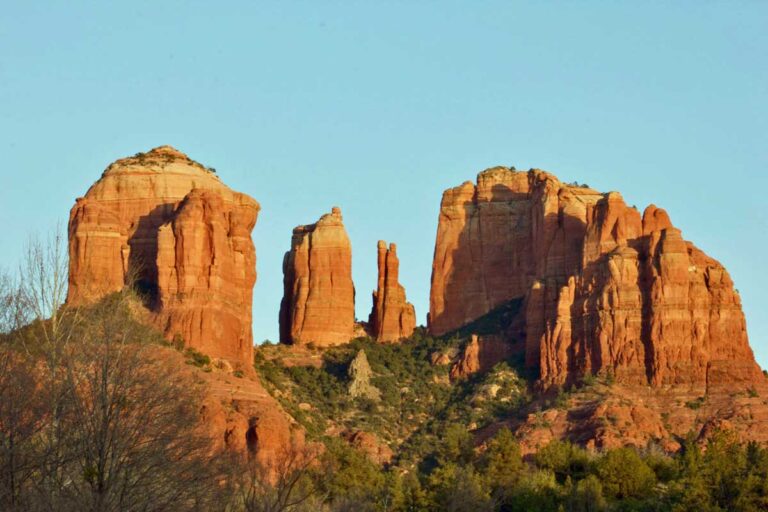
Sedona’s red rock formations create one of the most visually striking landscapes in America — towering sandstone buttes glowing orange against Arizona’s blue skies, carved over millions of years into the shapes that give them their names: Cathedral Rock, Courthouse Butte, Bell Rock, Devil’s Bridge. The town itself is a busy resort, but the landscape surrounding it is extraordinary by any measure, and Sedona’s combination of accessible hiking, dramatic viewpoints and natural swimming in the Oak Creek Canyon makes it one of the most rewarding short visits in the American Southwest. Beyond the immediate red rock country, the Verde Valley holds a well-preserved Sinaguan cliff dwelling and a wildlife park that takes a deliberately unconventional approach to the zoo format. These guides cover Sedona’s key attractions with practical information on parking permits, trail access, fees and what to expect on arrival, alongside road trip guides for the most popular routes into and out of the red rocks.
Sedona’s iconic landmarks and hiking routes
Sedona’s most-visited natural landmarks are all accessible as day hikes or short walks from car parks and trailheads — but the Red Rock Pass permit system and the popularity of the most famous sites means that planning ahead, particularly around parking, makes a significant difference to the experience. These guides cover what each landmark involves, how to reach it and what to expect from the trail.
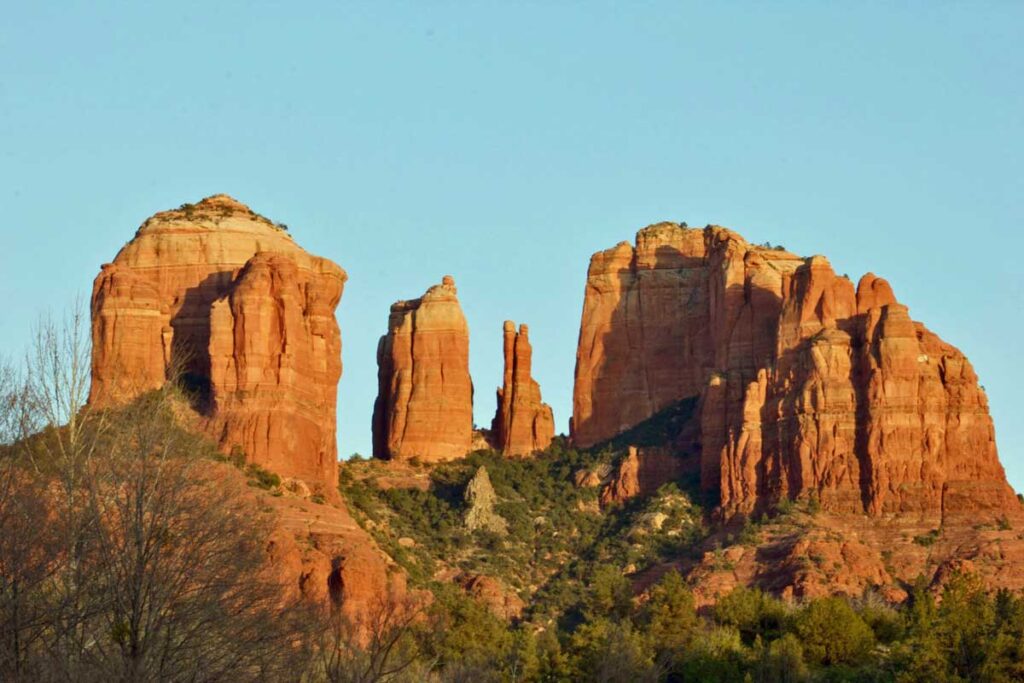
- Cathedral Rock, Sedona: permit prices, hours and visitor guide 2026 — the most photographed formation in Sedona, a twin-spired sandstone butte that also offers one of the most rewarding short scrambles in the red rock country, with permit requirements, parking logistics and the difference between the base trail and the more demanding summit approach covered in full.
- Red Rock Crossing, Sedona: the natural swimming hole beneath Cathedral Rock — the stretch of Oak Creek at the foot of Cathedral Rock, offering one of the finest natural swimming experiences in Arizona and one of the most photographed reflections in the Southwest, best visited early morning before the car park fills.
- Devil’s Bridge, Sedona: how to get there and visitor guide — the largest natural sandstone arch in the Sedona area, reached via a 4.2-mile round trip trail that is moderate but requires careful footing near the arch itself, with the car park filling by mid-morning in high season and shuttle options worth knowing about.
- Courthouse Butte, Sedona: ticket prices, hours and visitor guide — a 4-mile loop around one of Sedona’s most dramatic free-standing formations, combining easily with Bell Rock on the same walk and offering 360-degree views of the Village of Oak Creek landscape.
- Bell Rock, Sedona: practical guide with hours, prices and tips — the distinctive bell-shaped butte at the south end of the Bell Rock Pathway, one of the most accessible formations in Sedona for those who want the red rock landscape without a demanding trail, and one of Sedona’s designated vortex sites.
Viewpoints, overlooks and the Chapel of the Holy Cross
Not every rewarding experience in Sedona requires a hike. The Airport Mesa overlook and Schnebly Hill Vista offer panoramic views from cars or short walks, and the Chapel of the Holy Cross — built directly into the red rock — is one of the most architecturally distinctive religious buildings in the United States.
- Airport Scenic Overlook, Sedona: practical guide with hours, prices and tips — the most accessible panoramic viewpoint in Sedona, offering 360-degree views over the entire red rock basin from a car park on Airport Mesa, particularly spectacular at sunset and considered one of Sedona’s four main vortex sites.
- Schnebly Hill Vista Overlook, Sedona: practical guide with hours, prices and tips — a high-clearance vehicle recommended dirt road above Sedona leading to one of the most dramatic elevated views over the red rock country, with a perspective on the canyon landscape that is impossible to reach by foot from the town.
- Chapel of the Holy Cross, Sedona: what makes it special — a Roman Catholic chapel built between two red rock spires in 1956, designed by sculptor Marguerite Brunswig Staude as a direct response to the Empire State Building, free to enter and one of the most visually arresting pieces of architecture in Arizona.
Day trips from Sedona: the Verde Valley and the Grand Canyon
The Verde Valley immediately south of Sedona holds two of the most distinctive day trips in the region — a Sinaguan cliff dwelling that is more compelling than most visitors expect and a wildlife park that takes a deliberately unconventional approach to keeping animals. And the question of whether to attempt the Grand Canyon as a day trip from Sedona comes up so often it deserves an honest answer.
- Montezuma Castle National Monument: why it’s worth visiting even though you can’t go inside — a 12th-century Sinaguan cliff dwelling 20 storeys above the ground in a limestone alcove, one of the best-preserved ancestral Native American structures in North America, which can be viewed only from below — and why that limitation doesn’t diminish the experience as much as it might sound.
- Out of Africa Wildlife Park, Camp Verde: complete guide with prices, hours and tips — a wildlife park in the Verde Valley that operates on a deliberately different philosophy from conventional zoos, with large predator enclosures, a Wildlife Safari bus tour and a Tiger Splash show where big cats interact with handlers in water, reviewed honestly for who it suits and what it actually delivers.
- Should I do a Grand Canyon day tour from Sedona? — an honest answer to one of the most common planning questions for Sedona visitors, covering driving time, what you can realistically see in a day, the trade-offs between driving yourself and joining a tour, and whether the effort justifies the return given that a longer Grand Canyon visit is always the better option.
- Learn more about Arizona’s prehistoric peoples at the Verde Valley Archaeology Center in Camp Verde and Tuzigoot National Monument.
Road trips to and from Sedona
Sedona is most commonly approached from Phoenix to the south, but the drives from Tucson, from the Grand Canyon gateway town of Williams and from Albuquerque across the high desert are all rewarding in their own right. The drive onward to Santa Fe continues that high-desert journey through some of the most spectacular landscape in the Southwest. These guides cover the best stops, distances and drive times for five of the most popular routes.
- Phoenix to Sedona drive: best stops, distance and drive time — the most popular approach to Sedona, a two-hour drive north through the Verde Valley on I-17, with options to detour through Montezuma Castle, the Tuzigoot National Monument and the historic mining town of Jerome on the way.
- Tucson to Sedona road trip: best stops, distance and drive time — the drive north through the Sonoran Desert and up into the Verde Valley, with options through Phoenix or via the more scenic Oracle and Globe corridor through the Tonto National Forest.
- Williams to Sedona drive: best stops, distance and drive time — the drive south from the Grand Canyon’s South Rim gateway town, dropping from the Colorado Plateau ponderosa pine forest down through Oak Creek Canyon into the red rocks, one of the most scenically dramatic approaches to Sedona.
- Albuquerque to Sedona drive: best stops, distance and drive time — the drive west across New Mexico and into Arizona, crossing the high desert and the Painted Desert country, with stops that can include Petrified Forest National Park and Winslow before the final approach through Oak Creek Canyon.
- Sedona to Santa Fe road trip: best stops, distance and drive time — the drive northeast through Arizona and across the New Mexico border, passing through Winslow, the Petrified Forest and Gallup before the approach to one of the American Southwest’s most distinctive cities.
Planning your Sedona visit
Sedona requires a Red Rock Pass for parking at most trailheads — $5 per day or $15 per week — and several of the most popular sites (Cathedral Rock, Devil’s Bridge) fill their car parks by 8am on peak season weekends. Early morning starts are not optional in summer; they are the single most important logistical consideration. Spring (March to May) and autumn (September to November) are the most pleasant seasons for hiking; summer temperatures regularly exceed 38°C and most serious hiking should be done before 10am. The town itself is expensive and busy; visitors who want more flexibility can stay in Cottonwood or Flagstaff and drive in.
How many days do you need in Sedona?
Two to three days covers Sedona’s main attractions comfortably. A first day suits the southern landmarks — Bell Rock, Courthouse Butte and the Chapel of the Holy Cross, with the Airport Mesa overlook at sunset. A second day works well for Cathedral Rock and Red Rock Crossing in the morning and Devil’s Bridge in the afternoon. A third day opens up a day trip to Montezuma Castle and the Verde Valley, or a drive up to the Grand Canyon for those willing to make the early start.
What is Sedona best known for?
Sedona is best known for its red rock formations — particularly Cathedral Rock, Bell Rock and Devil’s Bridge — and for its reputation as a centre of New Age spirituality, associated with the four designated vortex sites (Airport Mesa, Cathedral Rock, Bell Rock and Boynton Canyon) that attract visitors seeking spiritual energy alongside the hiking and scenery. The Tlaquepaque Arts and Crafts Village is the main shopping destination, and Sedona’s restaurant scene is considered strong for a town of its size.
For more Arizona travel articles and inspiration, visit the Arizona travel guides on the site.