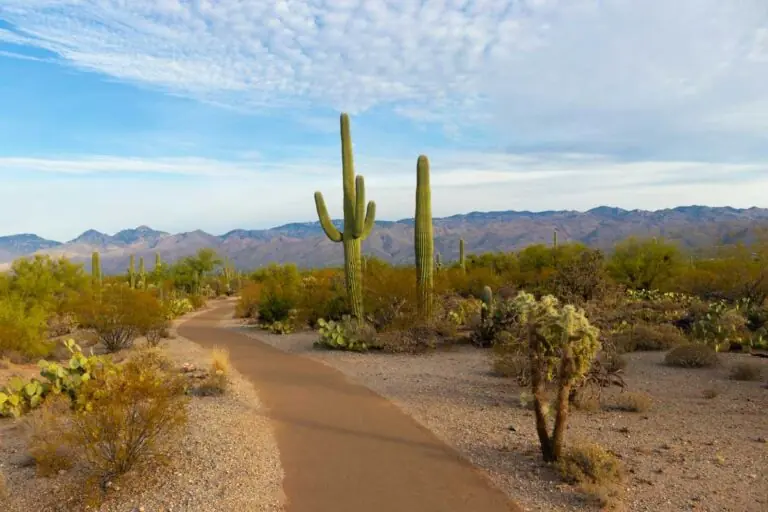
Tucson sits in the Sonoran Desert at the foot of five mountain ranges, surrounded by one of the most distinctive landscapes in North America — a cactus forest where saguaros grow to 12 metres tall and the desert floor blooms briefly and brilliantly after winter rains. It is also a city with a layered history: a Spanish colonial mission that predates the United States, a Cold War missile silo preserved beneath the desert, and the world’s largest collection of military aircraft baking in the Arizona sun at a nearby air force base. Beyond the obvious sights, Tucson has a university science centre with a working planetarium, a well-regarded city zoo and easy road trip access to the Wild West town of Tombstone. These guides cover Tucson’s key attractions with practical information on ticket prices, opening hours and what to expect on arrival, alongside road trip guides for 11 of the most popular routes to and from the city.
Saguaro National Park and Tucson’s desert landscapes
The Sonoran Desert that surrounds Tucson is among the most biodiverse in the world, and two of the city’s most rewarding attractions put visitors directly into it. Saguaro National Park — uniquely split into two separate districts on opposite sides of the city — protects the largest concentration of the giant cactus that defines the Arizona desert; Colossal Cave Mountain Park takes visitors underground into a dry cave system in the Rincon Mountains to the southeast.

- Saguaro National Park, Tucson: ticket prices, opening hours and visitor tips — the only US national park split into two non-contiguous districts, with the Rincon Mountain District to the east and the Tucson Mountain District to the west, both protecting stands of giant saguaro cactus alongside desert wildlife including Gila woodpeckers, coyotes and Gila monsters.
- Colossal Cave Mountain Park, Arizona: hours, prices and visitor guide — a dry cave system in the Rincon Mountains southeast of Tucson, with guided tours through stalactite and stalagmite formations and a history as a Butterfield Overland Mail stop and reputed outlaw hideout in the late 19th century.
Aviation, aerospace and Cold War history
Tucson’s location in the Arizona desert — year-round sunshine and low humidity — made it ideal for storing aircraft, and the result is one of the most extraordinary aviation collections in the world. A short drive away, a decommissioned Titan II ICBM still sits in its silo beneath the desert floor, the only one of its kind preserved and open to the public. These two museums form one of the most distinctive pairings of attractions available from any American city.
- Pima Air and Space Museum, Tucson: practical visitor guide — one of the world’s largest air and space museums, with over 400 aircraft displayed across indoor hangars and an outdoor boneyard, including a SR-71 Blackbird, a Space Shuttle mock-up and aircraft spanning the full history of aviation from First World War biplanes to Cold War jets.
- Titan Missile Museum, Arizona: practical visitor guide — the only Titan II intercontinental ballistic missile site preserved intact in the United States, where a nine-megaton nuclear warhead once sat on 24-hour alert during the Cold War, with guided tours descending into the launch control centre and the silo where the missile still stands.
Culture, science and wildlife in Tucson
Away from the desert and the military museums, Tucson has a strong cultural and scientific offer rooted in its position as a university city with deep Spanish colonial and Tohono O’odham heritage. The mission church south of the city is one of the finest examples of Spanish Colonial Baroque architecture in the United States; the science centre at the University of Arizona has a working research telescope; and the city zoo is a compact but well-regarded institution in one of Tucson’s most popular parks.
- San Xavier del Bac Mission, Tucson: practical visitor guide — the White Dove of the Desert, a late 18th-century Spanish Colonial Baroque mission church on the Tohono O’odham Nation reservation south of Tucson, with an extraordinary painted and gilded interior still used as an active place of worship and considered the finest surviving example of its architectural style in the United States.
- Flandrau Science Center and Planetarium, Tucson: practical visitor guide — the science museum and public observatory at the University of Arizona, with a 16-inch research telescope open for public viewing on clear nights, hands-on science exhibits and a full-dome digital planetarium showing daily programmes.
- Reid Park Zoo, Tucson: practical visitor guide — a compact but well-curated municipal zoo in the heart of Tucson’s Reid Park, with notable African elephant, Andean bear and flamingo collections, good family facilities and ticket prices that undercut most comparable American city zoos.
- Plan your visit to the Kitt Peak National Observatory near Tucson.
- Plotting a visit to the Tucson Desert Art Museum and Tucson Presidio Museum.
Road trips to and from Tucson
Tucson sits at the crossroads of routes connecting Phoenix to the north, the Mexican border to the south, the Rio Grande corridor to the east and the Old West towns of southeast Arizona. The city makes a natural hub for exploring the wider Sonoran Desert Southwest, and several of the drives — particularly southeast toward Tombstone and Bisbee — are destinations in their own right. These guides cover 11 of the most popular routes, with best stops, distances and realistic drive times.
- Phoenix to Tucson drive: best stops, distance and drive time — the 100-mile route south through the Sonoran Desert on I-10, with options to detour through Casa Grande Ruins National Monument, the Biosphere 2 research facility and the historic town of Florence, Arizona.
- Casa Grande to Tucson drive: best stops, distance and drive time — the shorter desert drive south through Pinal County, passing the Casa Grande Ruins — a 14th-century Hohokam great house that is one of the largest prehistoric structures in North America.
- Albuquerque to Tucson drive: best stops, distance and drive time — the drive southwest from New Mexico across the Chihuahuan Desert and into Arizona, passing through the Rio Grande Valley, the border town of Deming and the Sonoran-Chihuahuan transition zone.
- Las Cruces to Tucson road trip: best stops, drive time and distance — the drive west from southern New Mexico along the I-10 corridor through the Chihuahuan Desert, crossing into Arizona and passing the Chiricahua National Monument and Willcox wine country.
- El Paso to Tucson road trip: best stops, drive time and distance — the drive west along I-10 through the Chihuahuan Desert and across the Arizona state line, with the Chiricahua National Monument and the Willcox Playa wildlife area as the most rewarding detours.
- Dallas to Tucson road trip: best stops, drive time and distance — the long drive west through West Texas on I-10, passing through San Antonio, Fort Stockton, El Paso and across the New Mexico and Arizona desert before arriving in Tucson.
- Santa Fe to Tucson road trip: best stops, distance and drive time — the drive south from New Mexico’s historic capital through Albuquerque and the Rio Grande Valley, crossing into Arizona along the I-10 corridor through the southern desert.
- Bisbee to Tucson drive: best stops, distance and drive time — the drive north from the historic copper mining town of Bisbee through Cochise County, with options to detour through Tombstone, the Chiricahua National Monument and Kartchner Caverns State Park.
- Tucson to Tombstone drive: best stops, distance and drive time — the drive southeast to the best-preserved Wild West town in America, site of the Gunfight at the O.K. Corral in 1881, with options to combine it with Bisbee and Kartchner Caverns on a full-day southeast Arizona loop.
- Tucson to Sedona road trip: best stops, distance and drive time — the drive north through Phoenix or via the more scenic Oracle and Globe route through the Tonto National Forest, climbing from the Sonoran Desert to the red rock country of the Verde Valley.
- Tucson to Flagstaff road trip: best stops, drive time and distance — the drive north through Phoenix and up the Mogollon Rim escarpment on I-17, climbing nearly 5,000 feet as the Sonoran Desert gives way to ponderosa pine forest on the Colorado Plateau.
Planning your Tucson visit
Tucson’s climate divides the year sharply: October to April is the ideal visiting window, with warm days, cool nights and reliable sunshine. May and June are intensely hot and dry before the summer monsoon arrives in July, bringing dramatic afternoon thunderstorms that transform the desert landscape. A car is essential — Tucson is a sprawling desert city with limited public transport between attractions, and several of the key sites (Saguaro’s two districts, Colossal Cave, the Titan Missile Museum) are spread across a wide area. The Pima Air and Space Museum and Titan Missile Museum are close enough to combine in a single day; the two Saguaro districts each deserve a separate half-day visit.
How many days do you need in Tucson?
Three to four days covers Tucson’s main attractions comfortably. A first day suits the Saguaro National Park Rincon Mountain District in the morning and the San Xavier del Bac Mission in the afternoon. A second day works well for the Pima Air and Space Museum and the Titan Missile Museum. A third day can combine the Tucson Mountain District of Saguaro with the Flandrau Science Center in the evening for a planetarium show. A fourth day suits a road trip to Tombstone and Bisbee.
What is Tucson best known for?
Tucson is best known for Saguaro National Park, the giant cactus landscape that surrounds the city, and the University of Arizona, which gives it a cultural depth unusual for a desert city of its size. Among visitors it is increasingly known for its food scene — Tucson is a UNESCO City of Gastronomy, the first in the United States — and for the Cold War heritage of the Titan Missile Museum. The proximity to Tombstone, the Chiricahua Mountains and the Mexican border makes it a natural base for exploring wider southeastern Arizona.