Vienna blends imperial grandeur with a genuinely contemporary creative energy. The Habsburg legacy is everywhere — in the baroque Belvedere Palace, the Gothic towers of St Stephen’s Cathedral and the vast Hofburg complex — but the Austrian capital consistently rewards those who venture beyond the famous Ringstrasse. The Naschmarkt captures Vienna’s multicultural food culture. The Hundertwasserhaus is one of the most architecturally eccentric buildings in Europe. The Museum of Art Fakes is exactly what it sounds like, and considerably more entertaining than you’d expect. And Vienna’s position at the heart of Central Europe makes it one of the best bases on the continent for day trips and rail journeys onward to Salzburg, Ljubljana and beyond. These guides provide practical planning details — ticket prices, opening hours, train schedules and honest assessments of what’s worth your time.
Imperial palaces and historic landmarks
Vienna’s architectural landscape is defined by the Habsburg dynasty and its Gothic and baroque centrepieces. The Hofburg, which served as the imperial winter residence for six centuries, contains several distinct attractions that each warrant their own visit.
- Belvedere Palace, Vienna: what to see and ticket price guide — a magnificent baroque palace complex housing Austria’s most significant art collection, with Gustav Klimt’s The Kiss as the centrepiece of the Upper Belvedere and formal gardens connecting the two palace buildings.
- St Stephen’s Cathedral (Stephansdom), Vienna: ticket price guide and visitor information — Vienna’s iconic Gothic cathedral, with a multi-coloured tiled roof that dominates the city centre, options to climb the south tower or descend to the Habsburg catacombs, and a free interior that rewards extended exploration.
- Imperial Apartments, Vienna: ticket prices, hours and visitor guide 2026 — the opulent state rooms of the Hofburg palace used by Emperor Franz Joseph I and Empress Elisabeth, covering 19 rooms of the historic winter residence with original furnishings and imperial tableware.
- Sisi Museum, Vienna: ticket prices, hours and visitor guide 2026 — the museum dedicated to Empress Elisabeth (“Sisi”), housed within the Hofburg and covering the fascinating and tragic life of the empress who became the most obsessively mythologised figure of the Habsburg era.
- Imperial Carriage Museum, Vienna: practical guide for first-time visitors — the Wagenburg at Schönbrunn Palace, housing the largest collection of imperial court carriages and sleighs in the world, including the coronation coach of Emperor Charles VI.
Art, science and specialist museums
Vienna’s museum offer extends well beyond the imperial palaces. The Kunsthistorisches Museum is one of the great art museums of Europe; the House of Music is among the finest interactive music museums in the world; and a former anti-aircraft tower in the Haus des Meeres has been improbably converted into a tropical aquarium.
- Kunsthistorisches Museum, Vienna: practical guide for first-time visitors — one of the great encyclopaedic art museums of Europe, housed in a monumental building facing the Natural History Museum across the Maria-Theresien-Platz, with outstanding collections of Old Masters, Egyptian antiquities, Greek and Roman artefacts and decorative arts.
- Weltmuseum Wien, Vienna: practical guide for first-time visitors — a world cultures museum in the Hofburg presenting non-European civilisations through ethnographic collections built up over five centuries, covering the Americas, Africa, Oceania and Asia.
- House of Music (Haus der Musik), Vienna: ticket prices, hours and visitor guide 2026 — a highly interactive museum of sound and musical history spread across five floors, covering the physics of sound, the history of the Vienna Philharmonic and a room where visitors can conduct a virtual orchestra.
- Mozarthaus Vienna: inside the composer’s only surviving residence — the apartment on the Domgasse where Wolfgang Amadeus Mozart lived from 1784 to 1787, composing The Marriage of Figaro in the rooms that are now open to visitors, with exhibition floors above.
- Museum of Art Fakes, Vienna: the stories of the great forgers — one of Vienna’s most unusual attractions, dedicated to the history of art forgery and the audacious, often extraordinary stories of the people who fooled the world’s most prestigious museums and collectors.
- Sigmund Freud Museum, Vienna: practical guide for first-time visitors — the Berggasse 19 apartment where Freud lived and practised for 47 years before fleeing the Nazis in 1938, with his original waiting room, consulting room furniture and an extensive archive of photographs and documents.
- Haus des Meeres Aquarium, Vienna: practical guide for first-time visitors — a tropical aquarium and terrarium built inside a repurposed WWII anti-aircraft flak tower in the Esterházy Park, with sharks, piranhas, free-roaming lizards and a rooftop observation deck as unexpected perks of a visit.
Neighbourhoods, markets and architecture
The authentic heartbeat of modern Vienna is found in its residential districts. Leopoldstadt, the island district between the Danube Canal and the river, has a distinctly different atmosphere from the imperial centre. The Naschmarkt is the city’s most vibrant food market. And the Hundertwasserhaus is the single most visually unexpected building in a city not short of architectural ambition.
- Leopoldstadt, Vienna: a guide to District II — the island district between the Danube Canal and the river, known for its green spaces, strong Jewish heritage, kosher bakeries, the Prater park and a laid-back residential atmosphere noticeably different from the tourist-heavy First District.
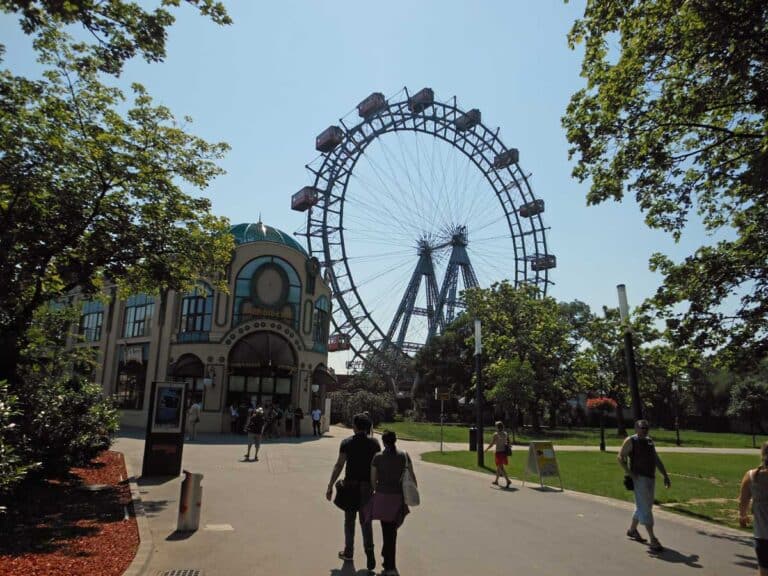
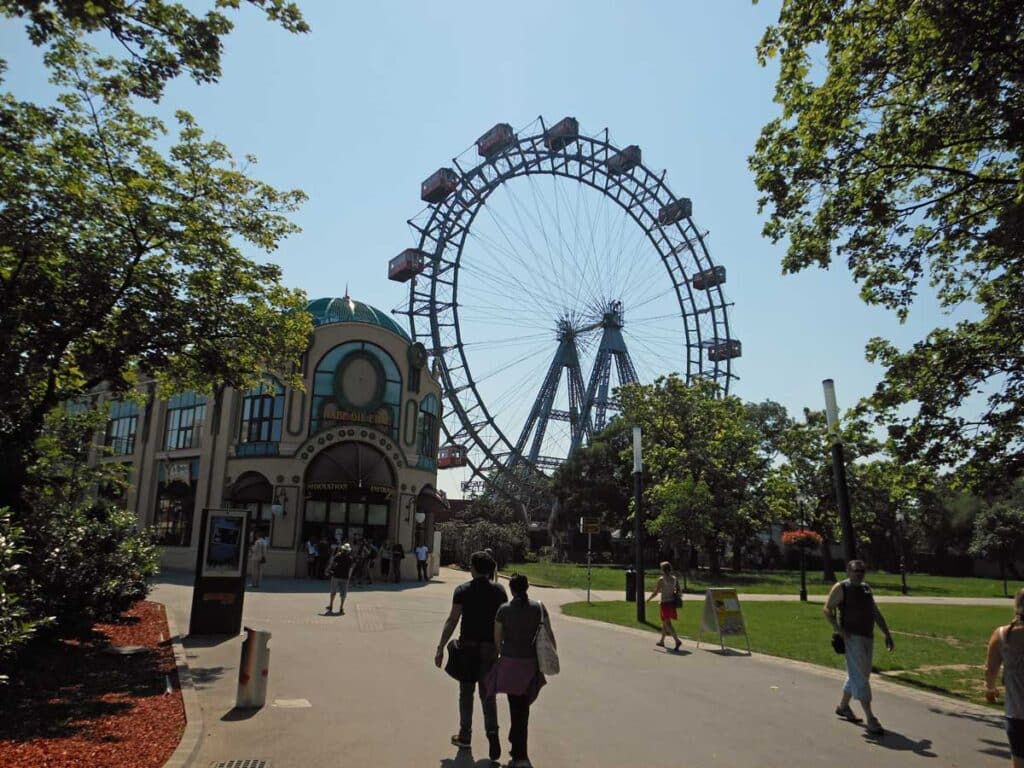
- Wiener Riesenrad, Vienna: visitor guide with ticket prices, hours and must-know tips — the 1897 giant Ferris wheel in the Prater amusement park, one of the oldest surviving Ferris wheels in the world, offering elevated views over Leopoldstadt and the Vienna skyline from its traditional wooden cabins.
- The Naschmarkt, Vienna: why it might be your favourite part of the city — Vienna’s most famous food market, a 1.5km stretch of stalls selling produce, street food and deli goods from across the Mediterranean and Middle East, best on a Saturday when the flea market extends along one side.
- Hundertwasserhaus, Vienna: history, design and visiting options — Friedensreich Hundertwasser’s eccentric, colourful and deliberately irregular apartment complex, built in 1985 with undulating floors, rooftop trees and a complete rejection of the straight line, one of the most visually distinctive buildings in Europe.
Rail travel from Vienna
Vienna’s position at the heart of Central Europe makes it one of the best rail hubs on the continent. These guides cover the most useful connections for visitors using Vienna as a base or gateway.
- Vienna to Salzburg by train: times, ticket prices and day trip options — the 2.5-hour high-speed ÖBB rail connection to the birthplace of Mozart, with a comparison of ticket options, guidance on what to book in advance and an honest assessment of whether Salzburg works as a day trip from Vienna.
- Vienna to Ljubljana: direct train vs indirect train vs bus — a logistical breakdown of the travel options between the Austrian and Slovenian capitals, covering journey times, prices and the practical trade-offs between the available routes.
Planning your Vienna visit
Vienna’s city centre is compact and walkable, and the U-Bahn network connects the outlying attractions efficiently. The Vienna City Card can offer good value for visitors planning several paid attractions over multiple days, including unlimited public transport. Several of the most visited sites — including the Belvedere, Mozarthaus and House of Music — benefit from advance booking during summer. The Naschmarkt is best visited on a Saturday for the flea market; most sites are closed or have reduced hours on public holidays. Vienna is a year-round destination — the Christmas market season in late November and December transforms the city’s public spaces and is among the finest in Europe. For a wide range of guided tours and experiences, browse Vienna tours and activities on Viator.
How many days do you need in Vienna?
Three to four days covers Vienna’s main attractions comfortably. A first day suits the imperial centre — St Stephen’s Cathedral, a walk along the Ringstrasse and the Belvedere Palace in the afternoon. A second day works well for the Hofburg complex — the Imperial Apartments, Sisi Museum and the Kunsthistorisches Museum across the square. A third day suits the House of Music, a morning at the Naschmarkt and an afternoon in Leopoldstadt. A fourth day allows the Freud Museum, the Haus des Meeres and a day trip to Salzburg by fast train.
What is Vienna best known for?
Vienna is best known internationally for classical music — the home city of Beethoven, Schubert, Brahms and Mahler, and the city where Mozart spent his most productive years — and for the Habsburg imperial legacy that shaped its palaces, museums and coffee house culture. Klimt’s The Kiss at the Belvedere is one of the most visited paintings in Europe. The city is also known for its Christmas markets, its Viennese ball season and a coffee house culture that UNESCO recognised as an Intangible Cultural Heritage.