
The Roman Baths is a 2,000-year-old Roman bathing complex and museum located in Abbey Church Yard, Bath, BA1 1LZ, in the centre of Bath’s UNESCO World Heritage city, immediately next to Bath Abbey. Owned and managed by Bath & North East Somerset Council, the site includes the naturally hot Sacred Spring, the Great Bath, the East Baths, a temple precinct, and a museum containing thousands of objects excavated from the site. This guide covers opening hours, ticket prices, transport, parking, accessibility, what to see, and practical visitor tips.
To skip the detail and secure your place, book your Roman Baths tickets online.
Updated May 2026. A permanent security screening system is now in operation at the entrance, requiring all visitors to pass single-file through a threat detection system before entering. Bag searches also take place. Many older guides and third-party listings make no mention of this, and visitors who are unprepared may find entry slower than expected, particularly during busy periods. Allow extra time at the door.
Quick facts
| Opening hours | Daily 09:00–18:00; last entry 17:00 |
| Closed | 25 and 26 December; altered hours on 24 December and 1 January |
| Adult ticket (online, advance) | £23.50–£33.00 (varies by season and day) |
| Adult ticket (on the door) | £2 more than the equivalent online price |
| Child ticket (6–18, online, advance) | £16.50–£26.00 (varies by season and day) |
| Under 6 | Free (ticket still required – reserve when booking) |
| Carer or companion | Free |
| Address | Abbey Church Yard, Bath, Somerset BA1 1LZ |
| Entrance location | In Abbey Church Yard, next to Bath Abbey |
| Nearest station | Bath Spa (5–10 minute walk) |
| On-site parking | None |
| Nearest Blue Badge parking | Cheap Street, Bath, BA1 1NA (3-hour spaces) |
| Typical visit length | 90 minutes to 2 hours |
Why book the Roman Baths Entry Ticket?
- 🏛️ The Great Bath: Stand at the edge of the massive, emerald-green pool that sits at the heart of the complex, still lined with original Roman lead and surrounded by 19th-century statues of Roman governors.
- 🔥 Britain’s Only Hot Springs: Witness the Sacred Spring where 1,170,000 liters of naturally hot water—heated by the earth’s core—rise to the surface every single day at a constant 46°C.
- 🎭 Interactive CGI & Projections: Experience Roman life through clever light projections and life-sized CGI “ghosts” that demonstrate how the bathhouse would have looked and functioned 2,000 years ago.
- 🎧 Bill Bryson Audio Guide: Enjoy a witty and insightful narrated tour available in multiple languages, including a special commentary by best-selling author Bill Bryson for a unique perspective on the site.
- 🏺 The Temple of Sulis Minerva: Explore the museum’s vast collection of archaeological finds, including the haunting bronze head of the goddess Sulis Minerva and the powerful “Gorgon’s Head” pediment.
The Roman Baths opening hours
The Roman Baths is open daily from 09:00 to 18:00, with last entry at 17:00. These are the current standard hours confirmed by the official website for May 2026. Hours may extend during peak summer months; the official website publishes any seasonal variations.
The site is closed on Christmas Day (25 December) and Boxing Day (26 December). Altered hours apply on Christmas Eve and New Year’s Day. Bank holiday opening times may also vary; check the official website before visiting on a public holiday. The site does not close at any point during the standard operating day.
The Roman Baths ticket prices
Ticket prices at the Roman Baths vary by season and by whether you visit on a weekday or at a weekend or bank holiday. All prices below are for advance online bookings; tickets purchased on the door cost £2 more per ticket in each case. The prices shown are taken from the official Roman Baths website and cover all 2026 pricing bands.
| Ticket type | Weekday range | Weekend / bank holiday range |
|---|---|---|
| Adult (19+) | £23.50–£29.00 | £26.50–£33.00 |
| Student | £22.50–£28.00 | £25.50–£32.00 |
| Senior (65+) | £22.50–£28.00 | £25.50–£32.00 |
| Child (6–18) | £16.50–£22.00 | £19.50–£26.00 |
| Family: 2 adults + 2–4 children | £59.00–£77.00 | £69.00–£88.00 |
| Family: 2 adults + 1 child | £54.00–£70.00 | £63.00–£80.00 |
| Family: 1 adult + 2–4 children | £44.00–£57.00 | £51.00–£66.00 |
| Under 6 | Free (reserve when booking) | Free (reserve when booking) |
| Carer or companion | Free | Free |
| UK benefits recipients (Universal Credit, Pension Credit, ESA) | £1 per person | £1 per person |
The lower end of each range applies to weekday visits between November and May; the higher end applies to weekend visits between June and August. The exact price for your chosen date is shown when you select a time slot. Book directly with the Roman Baths; third-party sites do not offer lower prices.
The practical implication is significant: a family of two adults and two children visiting on a summer weekend pays £88 online, compared to £59 for a weekday visit in autumn or winter. If your dates are flexible, a weekday visit in the shoulder months offers the greatest saving.
Additional add-ons:
- Guided tour (1 hour): £8 per person, in addition to entry ticket; free for children under 6. Tours depart at 10:00, 11:00, 12:00, 13:00, 14:00, and 15:00 daily. Maximum 16 people per tour; advance booking is recommended.
- Archaeology Adventures (school holidays only): £6 per child, in addition to entry ticket; 30-minute sessions at 11:00 and 12:00.
- Official guidebook: £7.00, available at booking or on site.
Notable free and reduced entry schemes:
- Children who are Blue Peter badge holders receive free entry; badge and photo ID card must be presented on arrival.
- Local residents of Bath & North East Somerset with a valid Discovery Card receive free entry to the Roman Baths and Victoria Art Gallery.
- Full-time students at Bath Spa University, University of Bath, and Bath College receive free entry with a valid student ID.
- UK visitors receiving Universal Credit, Pension Credit, or ESA are entitled to £1 tickets for themselves and up to four accompanying children aged 6–18 at £1 each; must be booked in advance online, not available on the door.
National Trust and English Heritage memberships do not entitle holders to free or discounted entry. The Roman Baths is owned by Bath & North East Somerset Council and is not part of either organisation’s portfolio.
A Bath Attractions combination ticket is available, covering the Roman Baths, the Fashion Museum at the Assembly Rooms, and the Victoria Art Gallery; details and pricing are published on the official website.
Ticket prices were taken from the official Roman Baths website pricing pages and last updated in May 2026.
Five great things to do in Somerset
- 🏛️ Learn the 2,000 year history – and taste the waters at the Roman Baths in Bath.
- 🔒 On a guided Shepton Mallet prison tour – learn about life behind bars.
- 🎬 See the Bridgerton filming locations – on a TV and movies-themed walking tour in Bath.
- 🌳 Learn about Glastonbury’s trees – on a nature tour with a twist.
- 🚶 Cover Bath’s highlights – on an expert-guided walking tour.
How to get to the Roman Baths
The Roman Baths is a 5 to 10 minute walk from Bath Spa railway station, which is served by Great Western Railway from London Paddington (approximately 90 minutes), Bristol Temple Meads (approximately 15 minutes), and South Western Railway from London Waterloo. The entrance to the Roman Baths is in Abbey Church Yard, next to Bath Abbey.
- By train: Bath Spa station is the closest mainline station. From the station exit, follow signs to the city centre and Bath Abbey; the Roman Baths entrance is adjacent to the Abbey in Abbey Church Yard.
- By coach: Regular National Express and other coach services run from London Victoria, Heathrow, and Gatwick airports to Bath bus station. The bus station is approximately 5 minutes’ walk from the Roman Baths.
- By car: Bath is approximately 100 miles west of London and 10 miles east of Bristol. The city centre is a Low Emission Zone. There is no parking at the Roman Baths itself (see Parking section below).
- Park and Ride: Several Park and Ride services operate on the outskirts of Bath, dropping off in the city centre within a short walk of the Roman Baths. This is the recommended option for drivers visiting Bath.
Parking at the Roman Baths
There is no parking at the Roman Baths. The site is in the pedestrianised centre of Bath and has no on-site car park.
Several pay and display car parks are available within walking distance of the site. The nearest three-hour Blue Badge spaces are on Cheap Street, Bath, BA1 1NA. Further Blue Badge parking areas are listed on Bath & North East Somerset Council’s website. The city centre has several multi-storey car parks, though driving into Bath city centre is not recommended during peak times. Park and Ride is the most practical option for visitors arriving by car; services run from multiple points on the outskirts of the city. Shopmobility, with electric scooters to hire, is located less than a 10-minute walk from the Roman Baths, near Bath Spa railway station.
How long to spend at the Roman Baths
The official recommendation is 90 minutes to 2 hours for a standard visit. This covers the museum, the Great Bath and East Baths, the Sacred Spring, the Temple Precinct, and time with the audioguide.
Visitors who add a guided tour (1 hour, booked additionally) should allow at least 3 hours in total. The official website notes that visitors booking the last entry slot of the day (17:00) may not have enough time to see everything; earlier slots are recommended if time is a consideration. The last entry is at 17:00; the site closes at 18:00.
Accessibility at the Roman Baths
The Roman Baths is approximately 90% accessible to wheelchair users, though the site is located six metres below street level and has 13 sets of steps. Full access requires use of the four lifts on site.
- Lifts: Four accessible lifts give access to the mezzanine displays, lower museum, Great Bath, and East Baths. The maximum lift width is 1,200mm. For safety, a maximum of four wheelchair users can access the lower levels at any one time. Visitors who require lifts are strongly advised to contact the Customer Service team in advance on 01225 477785 to ensure availability at their chosen time.
- Motorised scooter: One motorised scooter is available on site for visitors whose own scooters exceed 1,200mm width. It cannot be reserved in advance and is not for general use.
- Wheelchairs: Two manual wheelchairs are available on site; these cannot be reserved in advance.
- Pushchairs: Pushchairs are not permitted inside the museum due to steps and narrow walkways. They must be left in the main reception hall. Baby carriers are available from staff as an alternative; these are limited and cannot be reserved, so bringing your own is recommended.
- Hearing impairments: Audioguides compatible with the “T” switch on hearing aids are available. A British Sign Language tour is available on mobile devices (Opus Touch handsets), free of charge with entry. Printed audioguide text is also available.
- Visual impairments: A descriptive audioguide is available. Braille information panels and tactile models are located throughout the site.
- Sensory bags with both child and adult versions are available from staff; a refundable £10 deposit is required.
- Assistance dogs are welcome, including guide dogs, hearing dogs, and other registered assistance dogs. Water bowls are available on request.
- Blue Badge parking: Nearest 3-hour spaces on Cheap Street, BA1 1NA.
- Carer tickets: Free for one accompanying carer or companion. Select a free carer ticket when booking online.
For full accessibility details and to discuss specific requirements, contact the Customer Service team on 01225 477785 or visit romanbaths.co.uk/accessibility.
Inside the Roman Baths: what to see
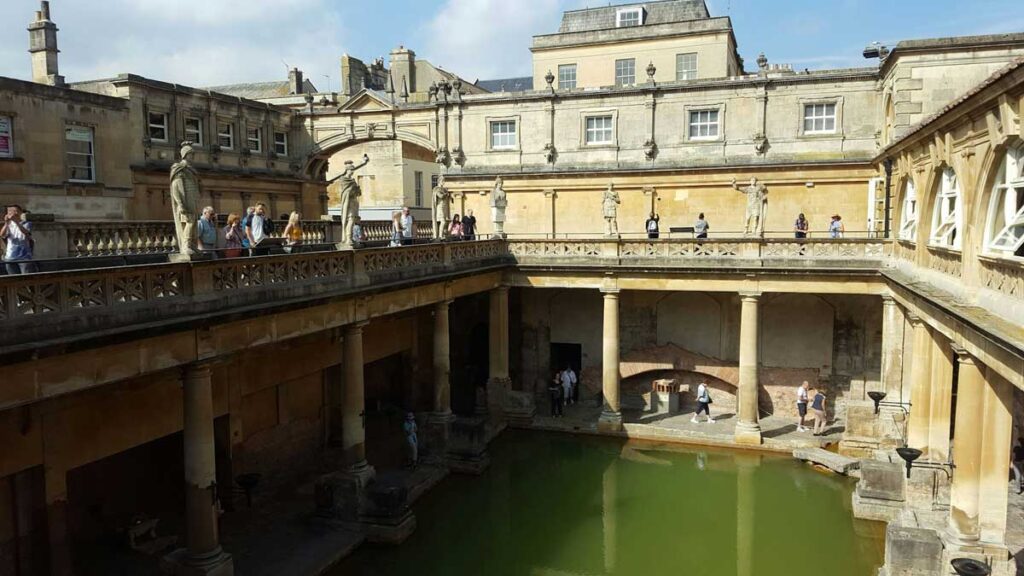
The visit follows a one-way route through the building and covers six main areas, each included in the standard entry ticket. An audioguide is provided free of charge; it is available in 12 languages for adults, and in English, French, and German for children. A personal audioguide narrated by Bill Bryson is also available in English.
The Sacred Spring (Aquae Sulis): The starting point of the visit, and the reason the site exists. Naturally hot water at 46°C rises here from deep underground at a rate of approximately 1.3 million litres per day. The spring has been flowing continuously for thousands of years. The Romans built a temple and bathing complex around it in the 1st century AD, naming the site Aquae Sulis after the local goddess Sulis, later merged with the Roman goddess Minerva into Sulis Minerva. The water has a distinctive orange-brown colour from the iron and other minerals it carries.
The Temple Precinct: Adjacent to the Sacred Spring, the remains of the Roman temple dedicated to Sulis Minerva are visible at ground level. The precinct includes the base of the altar, where animals were sacrificed and offerings were made. Curse tablets – thin sheets of lead inscribed with personal grievances and thrown into the sacred spring to invoke divine intervention – are among the most significant finds from the site. Original tablets are displayed in the museum; reproductions are positioned here.
The Great Bath: The centrepiece of the complex, the Great Bath is a large lead-lined pool fed by the Sacred Spring, open to the sky above. The pool is approximately 12 metres long and 8.5 metres wide, with steps leading into the water on all sides. The lead lining dates to the Roman period and is still intact. The surrounding paved terrace, columns, and niches are largely Victorian restorations, added when the baths were excavated in the 19th century. Life-size Roman character actors are stationed throughout the site on certain days and interact with visitors in character.
The East Baths: Beyond the Great Bath, the East Baths include a series of progressively heated rooms – the equivalent of a modern sauna sequence – including the caldarium (hot room), tepidarium (warm room), and frigidarium (cold plunge pool). Projections onto the walls use film reconstructions to show how these rooms would have appeared when in use, including the faces of bathers.
The museum: The museum displays thousands of objects excavated from the site over the past two centuries. Highlights include: the gilt bronze head of Sulis Minerva, one of the most significant objects from Roman Britain, which was part of a larger cult statue housed in the temple; the Gorgon’s Head pediment, a carved stone relief from the temple’s front that merges Roman and Celtic iconography; a large collection of Roman curse tablets with their inscriptions deciphered and translated; Roman coins thrown as votive offerings into the Sacred Spring; and reconstructed mosaics. Computer animations and scale models throughout the museum show how the full complex appeared during the Roman period.
The Pump Room: Directly adjacent to the Roman Baths, the 18th-century Pump Room is Bath’s historic Georgian assembly room and is now a restaurant and tea room operated by Searcys. It is not included in the Roman Baths entry ticket and operates with its own entrance and booking system. Visitors can taste a glass of the thermal spa water in the Pump Room.
Practical visitor tips
| Tip | Detail |
|---|---|
| Security screening adds time at entry | All visitors pass through a threat detection system at the entrance. During busy periods, this creates a queue before you even reach the ticket desk. Arrive before your booked slot by at least 15 minutes on weekends and in summer. |
| Book online and book early | Tickets often sell out in advance during summer months and over school holidays. The official site recommends booking at least 24 hours ahead. Online tickets are £2 cheaper per ticket than on-the-door prices. |
| Bags are restricted to 30 litres maximum | Large rucksacks, pull-along suitcases, and shopping bags with wheels are not permitted on site. Bag searches are carried out at entry. There is no luggage storage at the Roman Baths; the nearest facility is the Bath Luggage Storage Centre. |
| Do not bring a pushchair into the museum | Pushchairs must be left in the reception hall. Bring your own baby carrier if visiting with an infant; the site’s limited supply of baby carriers cannot be reserved in advance. |
| The last entry slot leaves limited time | The last entry is at 17:00 and the site closes at 18:00. The official recommendation for a full visit is 90 minutes to 2 hours. Booking an earlier slot gives more flexibility. |
Frequently asked questions about the Roman Baths
| Question | Answer |
|---|---|
| Do you need to book tickets in advance for the Roman Baths? | Advance booking is strongly recommended. Tickets frequently sell out during summer and school holidays. Online tickets are also £2 cheaper per ticket than on-the-door prices. Book at romanbaths.co.uk. |
| Can you swim in the Roman Baths? | No. The water is not treated and is not safe for bathing. The nearby Thermae Bath Spa uses the same naturally hot spring water, treated to make it safe, and is open for swimming and spa use. |
| Is the Roman Baths suitable for children? | Yes. Children under 6 enter free. There are character actors on site, a children’s audioguide in three languages, and Archaeology Adventures sessions during school holidays. Pushchairs must be left at reception. |
| Do National Trust or English Heritage members get free entry to the Roman Baths? | No. The Roman Baths is owned by Bath & North East Somerset Council and is not part of either organisation’s membership scheme. |
| Is the Roman Baths open on Sundays and bank holidays? | The site is open daily including Sundays. Bank holiday hours may vary; check romanbaths.co.uk before visiting on a public holiday. The site is closed on 25 and 26 December only. |
Things to do near the Roman Baths
Bath Abbey – Directly adjacent to the Roman Baths entrance in Abbey Church Yard. A 15th-century cathedral with a fan-vaulted ceiling, tower tours, and the Discovery Museum. Entry requires a ticket; see the guide to Bath Abbey for details.
Thermae Bath Spa – Approximately 2 minutes’ walk south on Bath Street. The only natural thermal spa in the UK open for public bathing, using the same hot spring water as the Roman Baths, treated to make it safe. Includes a rooftop open-air pool. Entry requires advance booking.
No. 1 Royal Crescent – Approximately 15 minutes’ walk north. A Georgian townhouse museum furnished as it would have appeared in the late 18th century, with original furniture and period interiors. Tickets required; limited walk-ins available.
Fashion Museum – Approximately 15 minutes’ walk north at the Assembly Rooms on Bennett Street. A national collection of historic and contemporary dress spanning four centuries. Entry is charged; included in the Bath Attractions combination ticket with the Roman Baths.
Holburne Museum – Approximately 20 minutes’ walk east at the end of Great Pulteney Street. Bath’s principal art gallery, housed in an 18th-century building, with collections including works by Gainsborough, Turner, and Stubbs. Free entry to the permanent collection.
What to visit tomorrow: Roman sites near Bath
Chedworth Roman Villa, Gloucestershire – Approximately 45 minutes by car north-east of Bath. A National Trust property preserving the remains of one of the largest Romano-British villas in the country, with in-situ mosaics, hypocaust heating systems, and a small museum. Entry charged.
Caerleon Roman Fortress and Baths, Newport, Wales – Approximately 1 hour by car west via the M4. The site of the Roman legionary fortress of Isca, with remains of the amphitheatre (one of the best preserved in Britain), barracks, and a Roman bathhouse. The National Roman Legion Museum adjacent to the site is free to enter. Managed by Cadw and Amgueddfa Cymru.
Corinium Museum, Cirencester – Approximately 40 minutes by car north-east. Cirencester (Roman Corinium Dobunnorum) was the second-largest Roman city in Britain. The Corinium Museum holds one of the most significant collections of Romano-British artefacts in the country, including mosaic floors displayed in situ. Free entry.
Fishbourne Roman Palace, Sussex – Approximately 2 hours by car east via the A272 or A303. The largest known Roman residential building in Britain, with the finest collection of in-situ Roman mosaic floors in the country. Managed by Sussex Past; entry charged.
Silchester Roman Town (Calleva Atrebatum), Hampshire – Approximately 1 hour by car east via the A4. One of the most complete examples of a Roman walled town in Britain, with the full circuit of defensive walls still standing to near-original height. The site is managed by English Heritage; the walls are accessible year-round. The Reading Museum holds artefacts from the excavations.
More Somerset travel
Other Somerset travel guides on Planet Whitley include:
- Visitor guide to the Jane Austen Centre in Bath.
- What to look out for at Wells Cathedral – one of the most attractive Gothic cathedrals in the UK.
- Learn the witch legend at the Wookey Hole Caves.
- What to know before visiting Cleeve Abbey in Somerset.
- Key information for those planning to visit Farleigh Hungerford Castle in Somerset.
