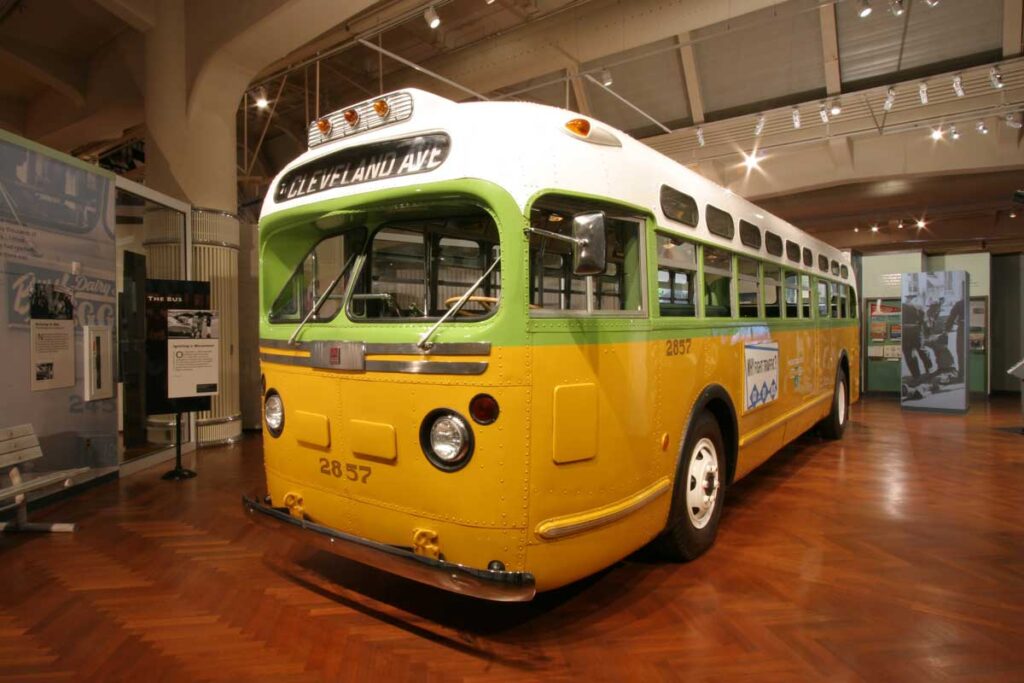
The Henry Ford Museum near Detroit is packed with landmark artefacts from American history. But it’s a humble, old-fashioned bus that stops visitors in their tracks.
After a series of big-hitting attractions – the bike shop where the Wright Brothers built the first plane, the courthouse where Abraham Lincoln practiced law, the car which JFK was assassinated in – you don’t expect to be taken aback by a mere bus.
The Henry Ford Museum just outside Detroit, and the adjoining Greenfield Village, pack in so many hits of modern history that it’s surely the greatest museum in the US. But it’s the simple, old-fashioned bus that makes the hairs stand on end.
What makes the Rosa Parks bus so significant?
The colour scheme’s a jaunty green and orange, while the sign at the top marks out the destination as Cleveland Avenue.
Cleveland Avenue no longer exists in Montgomery, Alabama. It was renamed in 1965, in honour of a former passenger on this very bus. That passenger was local seamstress Rosa Parks, who on December 1st 1955 refused to leave her seat to allow a white passenger to sit there.
The bus driver called the police, and Parks was arrested. She was later found guilty of disorderly conduct and violating a local ordinance.
5 great Detroit experiences to book
- 🏛️ Discover why Detroit is America’s most architecturally underrated city on a specialist architecture walking tour.
- 🍔 On a downtown Detroit food tour, taste Motor City’s specialities.
- 🚁 See the Detroit skyline – and Canada – from above on a helicopter ride.
- 🍸 Take a Detroit bar tour – and learn the city’s history while hopping between bars.
- 👻 Encounter murder and mystery on a Detroit ghost tour.
The Montgomery Bus Boycott and the birth of the Civil Rights movement
This was the beginning of the Montgomery Bus Boycott, in which the black residents of Montgomery refused to ride on the city’s buses. The boycott lasted over a year, until the US Supreme Court ruled that racial segregation on buses was illegal, and the segregated seating policy was abandoned.
Parks’ polite refusal to move was a brave act in itself, but it sparked something much bigger. It is generally seen as the spur for the organised Civil Rights movement in the US.
Leadership was required to maintain the boycott, and four days after Parks’ arrest, the Montgomery Improvement Association was formed. Elected as its president was Martin Luther King Jr, the man who would later become the global figurehead of the Civil Rights Movement.
The wheels of the bus had stopped, but the wheels of change had been set in motion – and the 1964 Civil Rights Act eventually outlawed all discrimination based on race, gender or religion.
How the Henry Ford Museum tracked down and restored the bus
Almost as interesting as the tale of how one woman’s refusal to be intimidated by a bus driver is the story of how the bus was tracked down and ended up in the Henry Ford’s collection.
The bus company sold it off in the 1970s, but the man who bought it had no documentary evidence that it was the Rosa Parks bus. Donna Braden, the museum’s ‘curator of public life’, says: “The bus was really just a shell that he stored things in. He’d stripped the inside and thrown away all the seats.”
When it came up for auction in 2001, the auction house knew vague family stories wouldn’t quite cut it as evidence. Luckily, employees managed to track down a scrapbook put together by a bus station manager. He had collected a series of articles about the bus boycott.
Braden says: “On one of the pages, which was right when the Rosa Parks incident happened, he wrote down the actual number of the actual bus and the name Blake – the name of the bus driver.”
Authenticating the evidence: forensics, handwriting and history
After comparing the number of the bus to check they matched up, and getting a forensics expert to authenticate the paper and handwriting, there was sufficient proof.
The Henry Ford put in the highest bid at auction, then spent over $300,000 restoring the bus. Original parts and furnishings were used where possible, while parts from identical 1948 buses were used to fill the gaps.
Lovingly refurbished, the bus now stands unobtrusively amongst a sea of classic cars.
Visiting the Rosa Parks bus today
Almost 60 years on from the Montgomery Bus Boycott, the doors of the vehicle where it started stand permanently open. Anyone of any race, gender or religion can step inside and sit down – in any seat they choose.
Henry Ford Museum: tickets, opening hours and parking
Prices and opening times are subject to change. Always confirm the latest details on the official website before visiting.
| Question | Information |
|---|---|
| How much does the Henry Ford Museum cost for adults? | General admission starts at around $34 for adults (ages 12–61). Prices use dynamic seasonal pricing, so check the official website for current rates. |
| How much are tickets for children and seniors? | Seniors (62+) receive a 10% discount. Youth (ages 5–11) receive a 25% discount. Children aged 4 and under are admitted free. |
| Is Greenfield Village included with a museum ticket? | No. Greenfield Village is a separate venue with its own admission (from around $37 for adults). Combination tickets are available. |
| What are the Henry Ford Museum opening hours? | The Henry Ford Museum of American Innovation is open daily, 9:30am–5:00pm. |
| When is Greenfield Village open? | Greenfield Village is open seasonally, Friday–Sunday, 9:30am–5:00pm (April–November), with special openings for Holiday Nights in December. |
| When is the Ford Rouge Factory Tour open? | Monday–Saturday, 9:30am–5:00pm (last tour departs at 3:00pm). Closed Sundays. |
| How much does parking cost at the Henry Ford Museum? | Parking costs $9–$10 per day (added at checkout for online orders). Members and Giant Screen Experience-only visitors park free. |
| Are there discounts for military visitors? | Yes. Active US military receive free admission year-round to the museum and Greenfield Village. Parking fees are also waived during the Blue Star Museums programme (Armed Forces Day through Labour Day). |
| Are there discounts for low-income visitors? | Yes. SNAP/EBT and WIC cardholders pay $3 per person per venue (for up to four guests), with parking fees waived. |
| Where is the Henry Ford Museum? | 20900 Oakwood Blvd, Dearborn, MI 48124 — approximately 13 miles west of downtown Detroit. |
Things to do near the Henry Ford Museum
Greenfield Village – Right next door to the museum, this sprawling open-air village spans 80 acres and brings American history to life. Visitors can ride in a Model T, tour Thomas Edison’s laboratory, and watch demonstrations of 19th-century crafts and trades.
Ford Rouge Factory Tour – Also part of The Henry Ford complex, this five-part tour takes you inside Ford’s working Dearborn Truck Plant, where you can watch F-150 trucks roll off the very assembly line where Henry Ford pioneered mass production.
Automotive Hall of Fame – Located directly adjacent to the Henry Ford Museum on Oakwood Boulevard, this dedicated museum celebrates the pioneers of the car industry and the history of the automobile.
Detroit Institute of Arts – Around 15 miles away in midtown Detroit, this world-class art museum holds more than 65,000 works, including Diego Rivera’s celebrated Detroit Industry frescoes and a Van Gogh self-portrait.
Detroit Zoo – About 20 miles north in Royal Oak, this popular zoo is home to more than 3,300 animals and features a Butterfly Garden, a Penguinarium, and extensive open-range habitats.
More Detroit travel
Other Detroit travel guides on Planet Whitley include:
- Plan your visit to the Michigan Science Center – with opening hours, ticket prices and visitor tips.
- See the birthplace of the Model T Ford at the Ford Piquette Avenue Plant in Detroit.
- What to expect at the Belle Isle Aquarium and Dossin Great Lakes Museum in Detroit.
- What to see and when to see it at the Detroit Institute of Arts.
- Getting to Detroit: What to see on the Cleveland to Detroit drive.