
Updated in September 2026, this Tulum ruins guide covers ticket prices, opening hours, transport, accessibility and what to see.
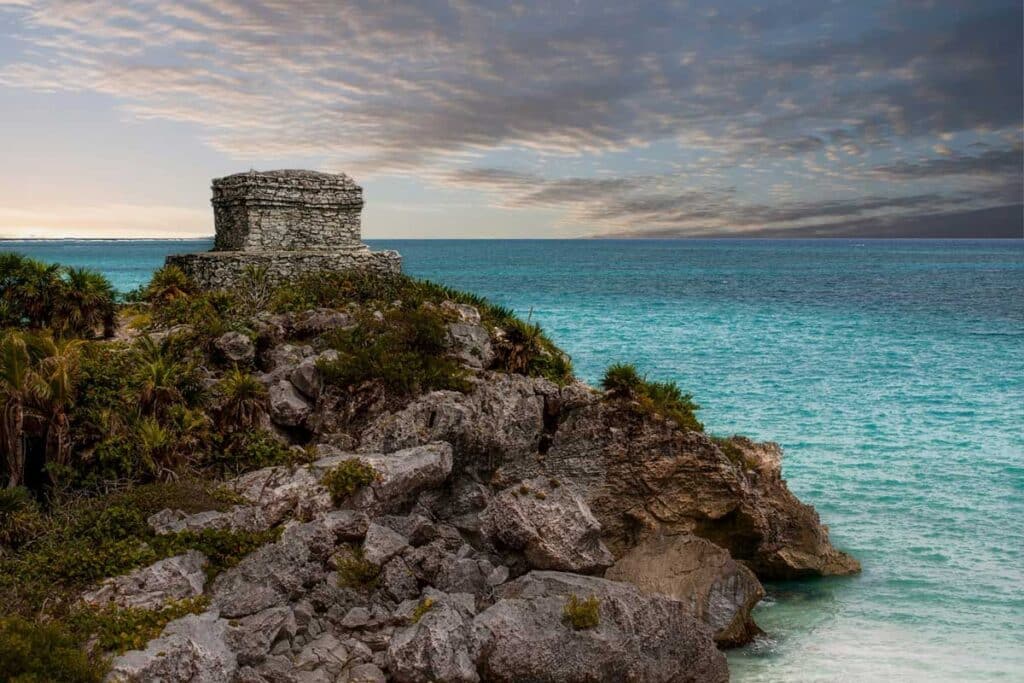
Tulum is Mexico‘s most visited coastal Maya site, its clifftop temples overlooking the Caribbean Sea. Following a federal decree in July 2026, entry fees were restructured and simplified: Parque del Jaguar, the protected area surrounding the ruins, is now free for Mexican visitors, with a new, lower unified pricing structure for everyone else.
Quick facts
| Category | Details |
|---|---|
| Opening hours | Daily 8:00 am–5:00 pm. Last entry to the ruins 3:30 pm |
| Ticket prices | $265 MXN total for foreign visitors; $80 MXN for Mexican nationals (free Sundays) |
| Address | Km 230, Chetumal–Cancún highway, 128 km south of Cancún |
| Nearest transport | ADO bus, colectivo, or the Maya Train to Tulum, then local transport to the site |
| Typical time needed | 1.5 to 2.5 hours, plus time for Parque del Jaguar |
Tulum opening hours
The archaeological zone opens daily, 8:00 am to 5:00 pm, with last entry to the ruins at 3:30 pm. The surrounding Parque del Jaguar, which now controls the approach to the site, generally keeps similar or slightly longer hours; its internal shuttle service to the ruins tends to run less frequently after 2:00 pm.
Tulum ticket prices
Fees at Tulum currently combine charges from three bodies: INAH (the archaeological zone), CONANP (the national park), and Parque del Jaguar, operated by Grupo Mundo Maya. Following a July 2026 federal decree, park entry is now free for Mexican visitors and costs $100 MXN for foreign visitors. Combined access to the archaeological zone and national park costs $80 MXN for Mexican nationals (Monday to Saturday) and $165 MXN for foreign visitors. In total, a foreign visitor pays around $265 MXN to see everything, while Mexican nationals pay $80 MXN plus the free park entry.
Sundays are free for Mexican nationals and foreign residents across all three charges. Accredited tourist guides and permanent residents of the protected area or adjacent towns also enter free at any time; a valid physical ID is required to claim any free or discounted rate.
Opening hours and ticket prices were checked on the official INAH website and last updated in August 2026. Given how often these fees have changed since Parque del Jaguar was created in September 2024, confirming the current structure shortly before your visit is worthwhile.
How to get to Tulum
The main entrance to the archaeological zone is at Km 230 of the federal Chetumal–Cancún highway (Route 307), about 128 km south of Cancún. Parque del Jaguar has two main access points: a main entrance near the Tulum Maya Train station, with free parking, and a south entrance on Avenida Cobá, in Tulum’s hotel zone, with paid parking.
Colectivos and ADO buses run regularly from Cancún, Playa del Carmen and Tulum town to the site; drivers should note that private vehicles generally cannot drive directly to the ruins or beach without a reservation at a beach club or restaurant inside the park.
Parking at Tulum
Free parking is available at the main entrance near the Maya Train station, though spaces fill quickly at busy times. The Avenida Cobá entrance has paid parking, typically around $100–160 MXN.
How long to spend at Tulum
Most visitors need 1.5 to 2.5 hours for the archaeological zone itself. Since access now runs through Parque del Jaguar, allow extra time for the walk or shuttle ride from parking to the ruins, and consider adding time for the park’s beaches and trails.
Accessibility at Tulum
Paths through the ruins cross uneven, natural ground, and the approach through Parque del Jaguar can involve a walk of a kilometre or more from parking to the entrance; a free shuttle operates for visitors who prefer not to walk. Full wheelchair access is limited given the site’s terrain.
Inside Tulum: what to see
Sixteenth-century sources call the site “Zamá,” meaning “morning” or “dawn” in Maya. The name “Tulum,” meaning “wall” or “palisade,” is comparatively recent, referring to the fortified wall that still encloses much of the site.
That wall, between roughly 170 and 380 metres long, encloses the main complex on its north, south and west sides, with five gateways and two watchtowers; the eastern side needs no wall, since it faces the Caribbean Sea directly.
The site is dominated by El Castillo, Tulum’s tallest structure, which preserves a temple with three entrances decorated with serpentine columns and zoomorphic masks at its corners. In front of it lies a dance platform, and to the southwest stands the Temple of the Initial Series, where archaeologists found Tulum’s earliest documented date: 564 AD.
Since 2024, the surrounding Parque del Jaguar has added new visitor infrastructure, including a museum and an 82-foot observation tower, reached by 137 steps, offering panoramic views over the jungle canopy and coastline.
Practical visitor tips
| Tip | Detail |
|---|---|
| Timing | Arrive at opening (8:00 am) for cooler temperatures and thinner crowds. |
| Crowds | Tulum is Mexico’s second most-visited archaeological site after Chichén Itzá. |
| Layout | Allow extra time to walk or shuttle from parking through Parque del Jaguar to the ruins. |
| Entry process | Expect to pay separate park and archaeological zone fees; bring a physical ID for any discount. |
| On-site logistics | Wear sturdy shoes for uneven ground, and bring water and sun protection. |
Frequently asked questions about Tulum
| Question | Answer |
|---|---|
| Is Tulum suitable for children? | Yes, though supervise children near the clifftop edges and uneven paths. |
| Do you need tickets in advance for Tulum? | No. Tickets are bought at the entrance, though arriving early avoids queues. |
| Is Tulum open every day? | Yes, daily from 8:00 am to 5:00 pm, with last entry at 3:30 pm. |
| Is Parque del Jaguar free to enter? | Yes, for Mexican nationals, since a July 2026 decree; foreign visitors pay $100 MXN. |
| Can you drive directly to the Tulum ruins? | Generally no; visitors park at Parque del Jaguar and walk or take a shuttle in. |
Things to do near Tulum
- Gran Cenote: a popular swimming and snorkelling cenote, a short drive from the ruins.
- Tulum Pueblo: the town centre, with restaurants, shops and cenote tours.
- Playa Paraíso: a well-regarded beach within easy reach of the archaeological zone.
- Casa Cenote: a coastal cenote good for snorkelling, north of Tulum.
- Sian Ka’an Biosphere Reserve: a UNESCO-listed wetland and reef reserve, south of Tulum.
Alternative attractions
- Cobá: jungle ruins with a climbable pyramid, about 45 minutes away.
- Muyil: a quieter Maya site near the Sian Ka’an reserve, about 30–40 minutes away.
- Ek Balam: a lesser-visited Maya site near Valladolid, about 1.5 hours away.
- El Rey: compact Maya ruins in Cancún’s Hotel Zone, about 1.5 to 2 hours away.
- Chichén Itzá: a UNESCO World Heritage Maya site, about 2 hours away.


