Bamberg Cathedral (Bamberger Dom St. Peter und St. Georg) is a historic medieval church and the seat of the Archbishop of Bamberg, located at Domplatz 2 in the heart of Bamberg, Germany. This guide covers opening hours, ticket prices, transport or parking, accessibility, and practical visitor tips.
This German cathedral guide was updated in April 2026 and reflects the current seasonal schedule, including the temporary sightseeing restrictions on Saturdays to accommodate the summer organ concert series.
Quick facts
| Category | Details |
| Opening hours | Mon-Wed: 09:00 to 18:00; Thu-Fri: 09:30 to 18:00; Sat: 09:00 to 16:30; Sun: 13:00 to 18:00 (summer hours) |
| Ticket prices | Free admission |
| Address | Domplatz 2, 96049 Bamberg, Germany |
| Nearest public transport | Domplatz bus stop or walk from Bamberg Hauptbahnhof |
| Typical time needed | 45 to 60 minutes |
Bamberg Cathedral opening hours
The Bamberg Cathedral operates on a seasonal schedule. During the summer season from April to October, the cathedral is open from 09:00 to 18:00 from Monday to Wednesday, and from 09:30 to 18:00 on Thursday and Friday. On Saturdays, it is open from 09:00 to 16:30, and on Sundays and public holidays, it opens from 13:00 to 18:00 following morning worship services.
During the winter season from November to March, the weekday closing time shifts slightly earlier to 17:00, and Sunday closing time also shifts to 17:00.
The cathedral is completely closed to sightseers during mass, weddings, and other religious events. Between May and October, the cathedral is closed for general sightseeing every Saturday from 11:30 to 13:00 to host the weekly organ concerts, with entry restricted only to concert ticketholders during this period.
Bamberg Cathedral ticket prices
General admission ticket prices for Bamberg Cathedral are entirely free for all visitors looking to explore the main nave. Because the building functions as an active Catholic church, no mandatory entrance fee is required, though voluntary donations toward the upkeep of the historic structure are always welcomed.
Opening hours and ticket prices were checked on the official website and last updated in April 2026.
How to get to Bamberg Cathedral
The most direct way to reach Bamberg Cathedral using public transport is via the local bus network, which departs from the central bus station (ZOB). Visitors can take the bus route heading directly to the Domplatz stop, which drops passengers right on the historic Cathedral Square.
For visitors arriving by train, the central railway station (Bamberg Hauptbahnhof) is located approximately 1.5 miles east of the cathedral. From the station, visitors can take a direct bus to the ZOB and transfer, or enjoy a scenic 30-minute walk through the historic Old Town and across the river, though this involves a final steep ascent up the Domberg (Cathedral Hill).
Parking at Bamberg Cathedral
There is no dedicated visitor parking directly at Bamberg Cathedral, as the Domplatz is a restricted historic square completely closed to tourist coaches and most private vehicles.
Visitors arriving by car must use the municipal underground car parks situated in the lower sections of the city before walking up the hill. The City-Altstadt car park on Geyerswörthstraße and the Georgendamm underground facility are among the closest and most convenient options. From these garages, visitors face a short but steep 10-minute walk up the cobbled streets to reach the cathedral entrance.
How long to spend at Bamberg Cathedral
Most people spend between 45 and 60 minutes exploring Bamberg Cathedral. This duration provides sufficient time to walk through the expansive nave, view the famous sculptures, and observe the papal and imperial tombs at a steady pace.
Visitors intending to explore the adjacent Diocesan Museum to view the cathedral’s treasury and 11th-century imperial cloaks, or those planning to walk around the Alte Hofhaltung (Old Court) and Neue Residenz located on the very same square, should allocate up to two and a half hours for a comprehensive Cathedral Hill experience.
Accessibility at Bamberg Cathedral
Bamberg Cathedral is accessible for wheelchair users, featuring step-free entry points that allow visitors to navigate the primary level of the nave without encountering major architectural barriers. The vast interior aisles are wide enough to accommodate mobility devices comfortably.
However, visitors should note that the exterior approach to the cathedral presents significant challenges due to the steep gradient of Cathedral Hill and the uneven historic cobblestones paving the Domplatz. While the nave is accessible, certain secondary areas such as the crypt contain stairs and are not fully wheelchair accessible.
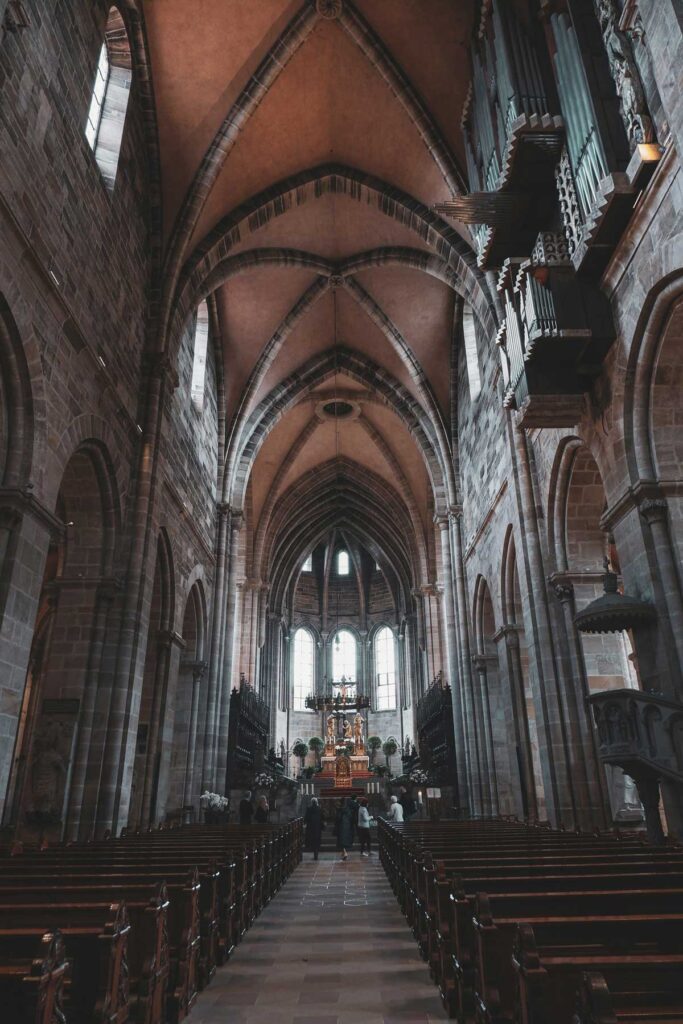
Inside / what to see at Bamberg Cathedral
The interior of Bamberg Cathedral, dedicated to St. Peter and St. George, showcases a striking blend of late Romanesque and early Gothic architectural styles. The current structure is the third iteration of the church, originally founded by Emperor Heinrich II in 1002, with the present building dating largely from the 13th century following two devastating fires.
One of the most significant highlights inside the cathedral is the tomb of the holy imperial couple, Emperor Heinrich II and Empress Kunigunde. Carved by the renowned Renaissance sculptor Tilman Riemenschneider between 1499 and 1513, the intricate marble tomb depicts ornate scenes from the couple’s lives and legends.
Equally famous is the “Bamberg Horseman” (Bamberger Reiter), a life-size equestrian statue attached to one of the nave’s pillars. Created by an unknown sculptor in the 13th century, the identity of the crowned rider remains one of the great mysteries of medieval art, drawing historians and art enthusiasts from around the world.
The cathedral also holds immense ecclesiastical significance as it houses the tomb of Pope Clement II, who previously served as the Bishop of Bamberg before his papacy. This marble sarcophagus remains the only papal tomb located anywhere north of the Alps.
Additionally, visitors can view the Marian Altar carved by Veit Stoss. This masterpiece of late Gothic woodcarving was originally created for another regional church but was safely relocated to the cathedral in the 20th century.
Practical visitor tips
| Tip Category | Practical tip |
| Timing | Arrive on a weekday morning when the cathedral opens to enjoy the expansive nave before larger group tours ascend the hill. |
| Crowds | Maintain absolute silence during the designated “Quiet Days,” such as Good Friday or All Saints’ Day, when guided tours are strictly forbidden. |
| Layout | Be prepared for a physically demanding climb up the cobbled Domberg, as the historic cathedral sits high above the rest of the Old Town. |
| Entry process | Check the service schedule online before walking up the hill, as general sightseeing is strictly prohibited during mass and weddings. |
| On-site logistics | Dress respectfully with shoulders and knees covered, as this remains an active place of worship with traditional dress code expectations. |
Frequently asked questions about Bamberg Cathedral
| Question | Answer |
| Is Bamberg Cathedral suitable for children? | Yes, children are welcome to view the horseman and tombs, provided they remain quiet in the active church setting. |
| Do you need to book tickets in advance for Bamberg Cathedral? | No, general admission to the nave is completely free and requires no advance booking or timed entry slots. |
| Is Bamberg Cathedral open on Sundays? | Yes, the cathedral opens for general sightseeing on Sundays from 13:00 to 18:00 (17:00 in winter) after morning services. |
| Are bags allowed at Bamberg Cathedral? | Standard day bags are permitted, but large rucksacks and luggage should be left at your hotel or a station locker. |
Things to do near Bamberg Cathedral
- Alte Hofhaltung (Old Court): Located directly adjacent to the cathedral, this historic complex features a picturesque inner courtyard framed by medieval half-timbered buildings.
- Neue Residenz Bamberg: Situated across the Domplatz, this 17th-century palace features ornate state apartments and a beautiful public Rose Garden overlooking the city.
- Diözesanmuseum Bamberg (Diocesan Museum): Set within the chapter house next to the cathedral, this museum displays the cathedral treasury, including authentic 11th-century imperial robes.
- Altes Rathaus (Old Town Hall): A 10-minute walk down the hill brings visitors to this iconic half-timbered building constructed directly on a small island in the Regnitz river.
- Klein Venedig (Little Venice): Located a short walk away along the riverbank, this picturesque row of former fishermen’s houses is best viewed from the opposite shore or a boat.
More Germany travel
Other Germany travel articles on Planet Whitley include:
- Discover the origins of the Bauhaus movement in the Bauhaus Museum Weimar.
- What to see at the Gutenberg Museum in Mainz.
- How to visit Eltz Castle and Marksburg Castle in Rhineland-Palatinate.
- Practical guiide to visiting Bentheim Castle in Lower Saxony.
- What to know before visiting Lichtenstein Castle in Baden-Württemberg.