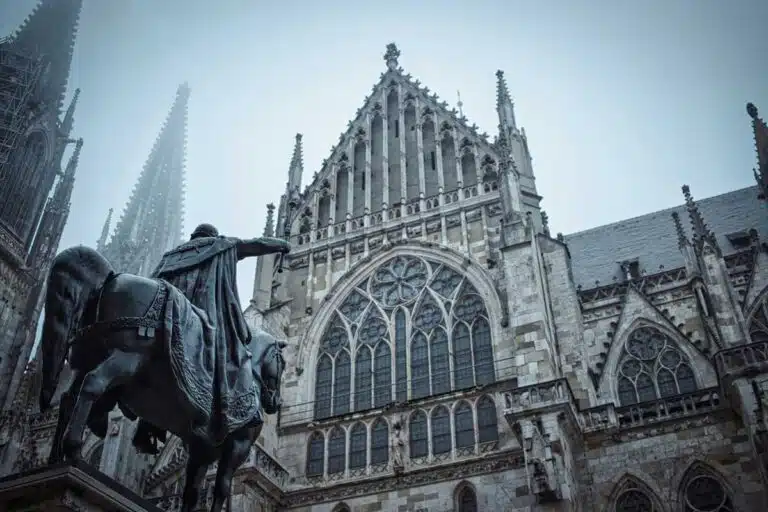
German cathedrals range from vast Gothic landmarks that dominate city skylines to Romanesque churches packed with medieval sculpture and imperial history. The guides below cover some of the country’s most historically significant cathedrals, from the towering twin spires of Cologne Cathedral to the UNESCO-listed artistry of Naumburg Cathedral and the great organ traditions of Bavaria.
Germany’s great Gothic cathedrals
Several of Germany’s best-known cathedrals are defined by Gothic architecture on an enormous scale. Cologne Cathedral took more than 600 years to complete and still dominates the Rhine skyline, whilst Regensburg Cathedral is one of Bavaria’s purest Gothic churches. In Berlin, the grand dome of Berlin Cathedral reflects a much later imperial vision of Protestant church architecture.
- The Cologne Cathedral ticket price guide explains tower climb costs, opening hours and what to see inside Germany’s most visited cathedral.
- The Berlin Cathedral visitor guide covers dome access, crypts and the vast interiors built during the German Empire period.
- The Regensburg Cathedral is known for its soaring Gothic nave, medieval stained glass and prominent position beside the Danube.
World Heritage churches and medieval Germany
Some of Germany’s most rewarding cathedral visits are in smaller historic cities rather than major capitals. Naumburg Cathedral is internationally recognised for its medieval sculpture, whilst Bamberg Cathedral and Erfurt Cathedral anchor remarkably well-preserved old towns filled with half-timbered buildings, steep lanes and centuries of church history.
- The UNESCO-listed Naumburg Cathedral is best known for the expressive 13th century donor statues created by the Naumburg Master.
- The Erfurt Cathedral rises above a huge stone staircase beside St Severus Church in the centre of Thuringia’s medieval capital.
- The Bamberg Cathedral contains the famous Bamberg Horseman statue and the tomb of Emperor Henry II.
Bavarian cathedral cities and organ traditions
Bavaria has a particularly dense concentration of major cathedral cities, each with distinct architectural styles and religious traditions. Passau Cathedral is renowned for its enormous pipe organ, Augsburg Cathedral blends Romanesque and Gothic elements, and Munich’s brick-built Frauenkirche has become one of the defining symbols of the Bavarian capital.
- The Augsburg Cathedral contains some of Germany’s oldest stained glass windows alongside Romanesque foundations dating back more than 1,000 years.
- The Passau Cathedral is particularly known for its giant organ and regular classical music concerts inside the Baroque interior.
- The Frauenkirche is recognised by its twin onion-domed towers that dominate Munich’s historic centre.

For those wishing to explore beyond Germany, there are also several guides to European cathedrals covering major churches across the continent.