Dunkeld Cathedral is a partly ruined medieval cathedral and active Church of Scotland parish church on the north bank of the River Tay in the village of Dunkeld, Perthshire. It is managed jointly by Historic Environment Scotland (the ruins and grounds) and Dunkeld Cathedral Parish (the choir, which serves as a working church). This guide covers opening hours, admission, transport and parking, accessibility, and practical tips for planning your visit.
The easiest way to visit is as part of a Best of Scotland in a day tour from Edinburgh, which also includes Blair Castle and Queen’s View at Loch Tummel.
Last updated: May 2026. A significant restriction is currently in place and is absent from many guides: there is no visitor access to the ruined cathedral nave or the bell tower following precautionary restrictions imposed after high-level masonry safety inspections. Many guides describe walking through the nave and climbing the tower; neither is currently possible. The grounds, the chapter house, and the active parish church (choir) remain open. The parish is also in the early stages of a £4.2 million restoration project for the choir, which is not mentioned in older guides.
Quick facts
| Detail | Information |
|---|---|
| Address | Cathedral Street, Dunkeld, PH8 0AW |
| Summer hours (1 Apr–30 Sep) | Daily, 9:30–17:30 (last entry 17:00) |
| Winter hours (1 Oct–31 Mar) | Daily, 10:00–16:00 (last entry 15:30) |
| Closed | 25 & 26 December; 1 & 2 January |
| Admission | Free |
| Parking | Public pay-and-display in Dunkeld town centre |
| Nave and tower access | Currently closed (masonry safety restrictions) |
| Typical visit length | 45–75 minutes |
Dunkeld Cathedral opening hours
The cathedral grounds and the portion used as the parish church are open every day. From 1 April to 30 September: 9:30–17:30 (last entry 17:00). From 1 October to 31 March: 10:00–16:00 (last entry 15:30). Closed 25 and 26 December and 1 and 2 January.
The cathedral is a working church; access may be restricted during services, weddings, concerts, and other events. Historic Environment Scotland advises checking their unexpected closures page before travelling, as adverse weather can cause short-notice closures.
Paths in the grounds can be slippery after rain and in winter. Take particular care on the cathedral’s cobbled and stone surfaces.
Why book the Best of Scotland in a Day Tour?
- 🏰 Blair Castle & Gardens: Explore the ancient, white-walled home of the Dukes of Atholl, complete with fine collections of weapons, hunting trophies, and the unique history of Europe’s only legal private army.
- 🌲 The Hermitage Woodland Walk: Take a peaceful walk through a magnificent stretch of forest featuring towering Douglas firs, leading to the Black Linn waterfall and a picturesque 18th-century folly.
- 👑 The Iconic Queen’s View: Drink in one of Scotland’s most famous vistas, looking out across the glittering waters of Loch Tummel toward the majestic peak of Schiehallion.
- ⛪ Dunkeld Cathedral: Visit a striking, partly ruined cathedral nestled on the banks of the River Tay, capturing the serene history of Scotland’s ancient ecclesiastical capital.
- 🚐 Very Small-Group Comfort: Maximize your time with an intimate group (averaging around 12 passengers) traveling in a luxury Mercedes mini-coach, allowing for personal interactions with an expert driver-guide.
Dunkeld Cathedral admission
Dunkeld Cathedral is free to visit. No tickets are required and no booking is needed for individual or family visits. Donations to support the ongoing restoration project are welcomed; a donations box is available in the chapter house.
The Historic Environment Scotland Explorer Pass does not need to be used at Dunkeld Cathedral, as entry is free. The pass does provide access to other nearby HES sites such as Huntingtower Castle (Perth) and Elcho Castle.
Opening hours and admission status were checked on the official Historic Environment Scotland website and last updated in May 2026.
How to get to Dunkeld Cathedral
Dunkeld Cathedral is in the village of Dunkeld, off the A9, approximately 15 miles north of Perth and 15 miles south of Pitlochry. The cathedral is at the north end of Cathedral Street, which runs from the market square to the riverside. The approach on foot along Cathedral Street — a narrow road lined with white-painted National Trust for Scotland Little Houses — is itself part of the experience.
By train: Dunkeld and Birnam station is around 1 mile south of the cathedral across the Thomas Telford bridge. Trains run from Perth (~15 minutes) and Pitlochry (~10 minutes). Check scotrail.co.uk for timetables.
By bus: Scottish Citylink and local bus services stop at Dunkeld. Check travelinescotland.com for routes and times from Perth, Pitlochry, and other nearby towns.
By car: From the A9 northbound or southbound, follow signs for Dunkeld (junction for Dunkeld and Birnam). Use the North Car Park (closest to the cathedral; also has public toilets) or the Coach Park for larger vehicles. Both are well signposted in the village.
Parking at Dunkeld Cathedral
There is no dedicated public car park at the cathedral itself. Pay-and-display car parks in Dunkeld town centre are the practical option for most visitors; the North Car Park (nearest to the cathedral) also has public toilets.
Accessible parking: A small accessible parking area at the cathedral can be arranged in advance for visitors with mobility difficulties. Email argyllslodgingadmin@hes.scot at least one working day before your visit to request access.
How long to spend at Dunkeld Cathedral
Most visitors spend 45 to 75 minutes at the cathedral and its grounds. The nave and tower are currently closed, which reduces the full extent of the site somewhat compared with a normal visit. The grounds, the chapter house with its museum display and small shop, the active parish church, and the riverside area remain well worth visiting. Adding a walk through Dunkeld village extends the outing considerably.
Accessibility at Dunkeld Cathedral
Most paths around the site are paved. The east end of the cathedral (the active parish church) has a small threshold on entry but is otherwise accessible. The chapter house welcome area, small shop, and museum display are accessible. The cathedral grounds and the grassy riverside area are accessible on foot, though the graveyard has some uneven terrain.
The ruined nave has a wooden ramp leading into it from the grounds, but the nave is currently closed to visitors. The bell tower is accessed from the graveyard over a small threshold stone and is also currently closed.
Accessible parking can be arranged in advance; email argyllslodgingadmin@hes.scot with at least one working day’s notice.
Note: The HES page states that the nearest adapted public toilets are approximately 10 miles away. The North Car Park in Dunkeld town has public toilets. The parish church may have limited internal facilities; contact dunkeldcathedral.org for current provision.
Assistance dogs are permitted throughout the site. Visitors’ dogs are not permitted at Dunkeld Cathedral.
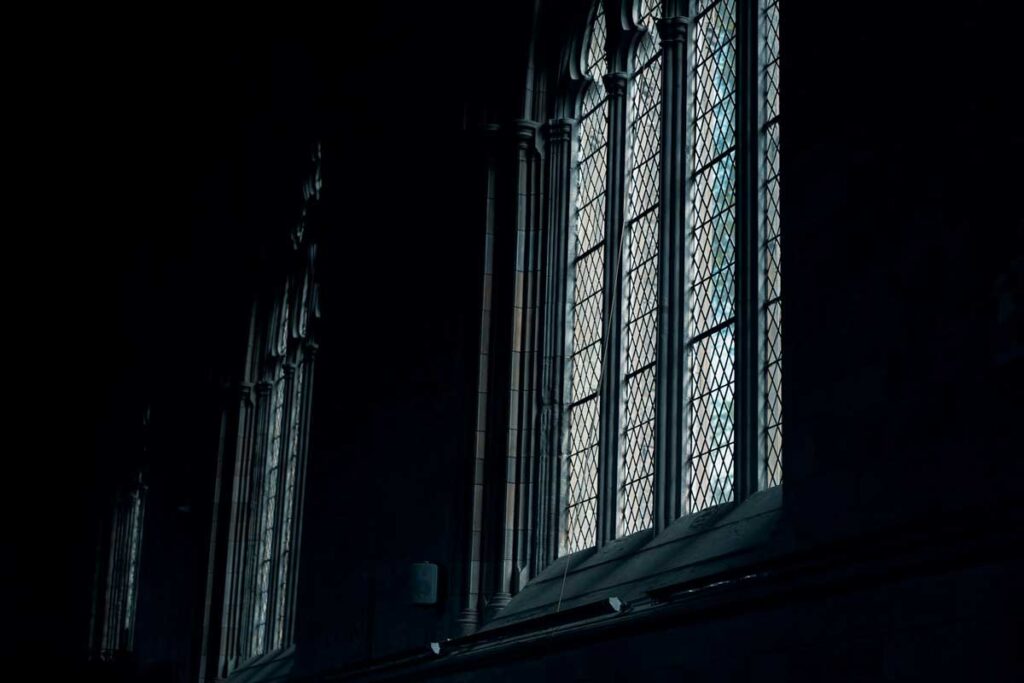
Inside Dunkeld Cathedral: what to see
The cathedral grounds and setting are the first thing to absorb. The cathedral stands at the end of a cobbled street beside the River Tay, surrounded by ancient trees and an extensive graveyard, with the forested hills of the Tay valley as a backdrop. The setting is generally considered one of the most picturesque of any Scottish cathedral.
The history is long and layered. In 849, King Kenneth MacAlpin brought relics of St Columba from Iona to Dunkeld to protect them from Viking raids, establishing the site as a major ecclesiastical centre. The present cathedral developed over approximately 250 years from the late 1200s. The choir (east end, late 13th century) was repaired and reopened as a parish church in the 17th century. The nave was begun in 1406 and lost its roof shortly after the Protestant Reformation in 1560, leaving it a roofless ruin.
The choir (active parish church) is the best-preserved and most accessible part of the building. It is a working Church of Scotland parish; Sunday services are held here. The interior includes the effigy of Alexander Stewart, Earl of Buchan — known as the Wolf of Badenoch — who burned Elgin Cathedral in 1390 and whose tomb is one of the most remarkable medieval monuments in Scotland. The choir is currently the subject of a £4.2 million restoration project.
The chapter house is immediately accessible on entering the grounds and contains a small welcome area, a museum display run by the Society of Friends of Dunkeld Cathedral, and a shop. An audio tour of the site is available; scan the QR code at the entrance or access it directly via the cathedral website.
The bell tower ground floor contains medieval paintings from the 1500s on the vault; the tower once served as an ecclesiastical court. The tower is currently closed to visitors pending masonry safety clearance.
The ruined nave is the larger, western section of the cathedral. It is roofless, with grass for a floor, and in normal circumstances can be walked through. It is currently closed to visitors following the masonry safety restrictions. The exterior can be seen from the grounds.
The graveyard is extensive and well-maintained, with graves dating across many centuries. It is freely accessible and worth time in its own right. A grassy riverside area next to the cathedral provides access to the River Tay.
Practical visitor tips
| Tip | Detail |
|---|---|
| The nave and tower are closed | Do not plan your visit around exploring the roofless nave or climbing the bell tower. Both are currently inaccessible due to masonry safety restrictions with no confirmed reopening date. |
| The cathedral is a working church | Services, weddings, and concerts take place in the choir. Check the calendar before visiting to avoid restricted access. Access during a service is usually limited to the rear of the building. |
| Use the audio tour | The QR trail and audio tour on the cathedral’s own website provide substantial historical context that isn’t covered by the limited on-site signage. |
| Combine with a walk through Dunkeld village | Cathedral Street’s Little Houses (managed by the National Trust for Scotland) are worth seeing as you approach or leave. The market square, the Thomas Telford bridge, and the Birnam/Dunkeld riverside walk are all within easy reach on foot. |
| Paths can be wet and slippery | The cathedral’s stone and cobbled paths, and the grassy graveyard, can be treacherous after rain or in winter. Wear footwear with a grip sole. |
Frequently asked questions about Dunkeld Cathedral
| Question | Answer |
|---|---|
| Is Dunkeld Cathedral free to visit? | Yes. Entry to the cathedral grounds and the open areas is free at all times during opening hours. Donations to the restoration fund are welcomed. |
| Is the Dunkeld Cathedral nave open to visitors? | No. The ruined nave and the bell tower are currently closed to visitors following precautionary restrictions imposed after masonry safety inspections. The grounds, chapter house, and active parish church (choir) remain open. |
| Is Dunkeld Cathedral open on Sundays? | Yes. Standard hours apply on Sundays (9:30–17:30 summer; 10:00–16:00 winter). A Church of Scotland service is held in the choir on Sunday mornings; visitor access to that area may be limited during the service. |
| Is Dunkeld Cathedral suitable for children? | Yes. Entry is free for all ages. The grounds and riverside area are accessible and enjoyable for families. The ruined gothic setting is atmospheric; older children in particular tend to find it engaging. Dogs are not permitted, which may affect planning. |
| Can you park at Dunkeld Cathedral? | No dedicated public car park is at the cathedral. The North Car Park in Dunkeld town centre (nearest; has public toilets) is the recommended option. |
Things to do near Dunkeld Cathedral
Dunkeld Little Houses (NTS) — Cathedral Street itself is lined with white-painted early 18th-century cottages, reconstructed by the National Trust for Scotland after the 1689 Battle of Dunkeld. Several are open as NTS properties; all can be seen from the street. Free to view from outside.
The Hermitage, Dunkeld (Forestry and Land Scotland) — Around 2 miles north-west of Dunkeld off the A9, The Hermitage is a popular woodland walk centred on Ossian’s Hall above the Falls of Braan. Salmon can sometimes be seen from the footbridge. Car parking charges apply; the walk is free.
Loch of the Lowes Wildlife Reserve (Scottish Wildlife Trust) — Around 2 miles north-east of Dunkeld, Loch of the Lowes is a freshwater loch with a visitor centre and hides overlooking nesting ospreys (April to August). Small admission charge.
Birnam Wood and Birnam Oak — On the south bank of the Tay, immediately across the Thomas Telford bridge from Dunkeld, the Birnam Oak is believed to be a survivor of the ancient Birnam Wood mentioned in Shakespeare’s Macbeth. A short riverside walk from Birnam village leads to the tree. Free.
Beatrix Potter Garden, Birnam — In Birnam village (5 minutes’ walk across the bridge), a small garden celebrates the connection between the village and Beatrix Potter, who spent childhood holidays here and based early characters on local wildlife. Free.
What to visit tomorrow: ruined abbeys and historic cathedrals within two hours of Dunkeld
Arbroath Abbey, Angus — Around 1 hour 15 minutes east of Dunkeld, Arbroath Abbey is the site where the Declaration of Arbroath was signed in 1320, asserting Scottish independence. The red sandstone ruins are extensive and include an intact sacristy.
St Andrews Cathedral, Fife — Around 1 hour east of Dunkeld, the ruins of St Andrews Cathedral are among the largest in Scotland. The site includes the St Rule’s Tower (climb for views) and a museum of medieval sculpture.
Dunblane Cathedral, Stirlingshire — Around 50 minutes south of Dunkeld, Dunblane Cathedral is an active parish church with a substantially intact medieval nave. The adjacent Leighton Library is a rare surviving 17th-century library open to the public.
Elgin Cathedral, Moray — Around 2 hours north of Dunkeld, Elgin Cathedral is the most substantial ruined cathedral in Scotland, burned in 1390 by the same Wolf of Badenoch whose tomb is in Dunkeld’s choir.
Scone Palace, Perth — Around 15 minutes south of Dunkeld, Scone Palace is the ancient coronation site of Scottish kings and the original home of the Stone of Destiny. The palace contains significant collections of art and furniture and is surrounded by 100 acres of grounds.