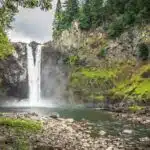
Kilt Rock is a 90-metre sea cliff on the Trotternish Peninsula, Isle of Skye, Scotland, featuring vertical basalt columns resembling the pleats of a Scottish kilt, with Mealt Falls waterfall cascading over the cliff edge into the sea. This guide covers opening times, admission, parking, accessibility and practical tips for visiting this viewpoint.
The lookout is one of the key stops on a one day Isle of Skye and Eilean Donan Castle tour from Inverness.
Quick facts
| Detail | Information |
|---|---|
| Opening times | Open 24 hours a day, year-round. Unstaffed viewpoint. |
| Admission | Free entry. Car parking £3 for up to two hours. |
| Address | Kilt Rock Viewpoint, A855, Staffin, Isle of Skye, IV51 9JE |
| Getting there | 15 miles north of Portree on A855. Stagecoach bus 57 stops nearby. |
| Time needed | 15 to 30 minutes for the viewpoint. |
Kilt Rock opening times
Kilt Rock viewpoint is open 24 hours a day, year-round. There are no gates, staff or operating hours. The site can be visited at any time, though daylight hours are obviously recommended to appreciate the views and for safety.
The car park operates 24 hours with payment machines accepting coins and cards. The site is exposed to coastal weather and can be windy and wet. Winter visitors may encounter snow and ice.
Kilt Rock admission
Entry to the viewpoint is free. There are no admission charges to view Kilt Rock or Mealt Falls.
Car parking costs £3 for up to two hours for standard vehicles. Payment is made at coin or card-operated machines in the car park.
Opening times and admission information were checked and updated in January 2026.
How to get to Kilt Rock
Kilt Rock is located on the A855 road on the Trotternish Peninsula in north Skye, approximately 15 miles (24 kilometres) north of Portree and 2 miles (3 kilometres) south of Staffin village.
By car from Portree, take the A855 north towards Staffin. After passing through the village of Valtos, look for brown tourist signs marked “Kilt Rock”. The journey takes approximately 30 minutes. From the south (Skye Bridge at Kyleakin), the drive is approximately 50 miles (80 kilometres) and takes 90 minutes via Portree.
By public transport, Stagecoach bus route 57 operates between Portree and Uig via Staffin. The bus stops on the A855 near the Staffin Dinosaur Museum, approximately 5 minutes’ walk (400 metres) north of the Kilt Rock car park entrance. Check Stagecoach Highland timetables as services are limited, particularly in winter.
The postcode IV51 9JE directs to Elishader, approximately 500 metres from the viewpoint.
Without your own wheels, the best way of getting there is on a day tour from Inverness that covers multiple sites, including Eilean Donan Castle, the Old Man of Storr and the Kyle of Lochalsh.

Parking at Kilt Rock
A large car park is provided on site. The car park accommodates cars, minibuses and coaches. The surface is compacted gravel and tarmac. Parking bays are marked.
Parking costs £3 for up to two hours for standard vehicles, payable at coin or card machines in the car park. No change is given from cash payments. Motorcycles and bicycles park free.
The car park can fill quickly during peak season (May to September), particularly between 10:00 and 16:00. Arriving before 09:00 or after 17:00 helps avoid crowds. Coach parties arrive regularly throughout the day during summer.
How long to spend at Kilt Rock
Most visitors spend 15 to 30 minutes at Kilt Rock viewpoint. The viewing platform is located immediately adjacent to the car park, requiring less than one minute to walk from parked vehicles.
The clifftop path extends approximately 100 metres in each direction from the main viewing platform, allowing visitors to see different perspectives of Kilt Rock, Mealt Falls and the coastal cliffs. Walking the full accessible path and reading information boards typically takes 15-20 minutes.
Visitors interested in photography, wildlife watching (dolphins, basking sharks) or simply enjoying the views may spend 30-45 minutes. The site is exposed to wind and weather, which may limit time spent outdoors.
Accessibility at Kilt Rock
Kilt Rock viewpoint is partially accessible for people with mobility issues. The path from the car park to the cliff edge viewing area is short (less than 50 metres) but consists of compacted gravel which may be challenging for wheelchairs, particularly after rain.
The viewing platform features safety railings at wheelchair height, allowing wheelchair users to see the views. The platform is level with no steps required. Some areas of the clifftop path are uneven.
The site has no toilets or shelter. The nearest public toilets are in Staffin village, approximately 2 miles (3 kilometres) away. No seating or benches are provided at the viewpoint.
There are no designated disabled parking bays, but the car park is adjacent to the viewing area minimising walking distance.
What to see at Kilt Rock
Kilt Rock (Creag an Fheilidh in Scottish Gaelic) is a 90-metre-high sea cliff composed of vertical hexagonal basalt columns stacked above dolerite sills. The rock formation resembles the pleats of a traditional Scottish kilt. The multicoloured stone includes grey basalt and reddish-brown sedimentary rock, creating patterns similar to tartan fabric.
The basalt columns formed approximately 60 million years ago when lava flows cooled between layers of sandstone. The Trotternish Peninsula features lava layers up to 1.2 kilometres thick. The vertical columnar jointing occurs when cooling lava contracts and fractures into geometric patterns.
Mealt Falls cascades approximately 55-90 metres (sources vary) from the cliff top directly into the Sound of Raasay below. This British waterfall is fed by Loch Mealt, a freshwater loch located 300 metres inland. The waterfall is most impressive after rainfall when water flow increases. During dry periods, the waterfall may reduce to a trickle.
The viewing platform offers panoramic views north along the Trotternish coastline, south towards the cliffs of Rubha nam Brathairean (Brothers Point), and across the Sound of Raasay towards Raasay island and mainland Scotland. On clear days, the Outer Hebrides are visible to the west.
Safety fencing around the viewpoint produces an eerie musical sound when strong winds blow through the metal posts and cables. The phenomenon resembles an aeolian harp or wind organ.
Marine wildlife including dolphins, porpoises, basking sharks and seals can sometimes be spotted in the waters below. Seabirds including fulmars, gulls and razorbills nest on the cliff faces.
Practical tips for visiting Kilt Rock
| Tip |
|---|
| Visit early morning (before 09:00) or evening (after 17:00) to avoid tour buses and crowds during peak season. |
| Bring waterproof and windproof clothing as the viewpoint is exposed to coastal weather regardless of forecast. |
| Walk north along the clifftop path (away from the main platform) for fewer crowds and additional cliff views. |
| The waterfall is most impressive after rain; dry periods reduce water flow significantly. |
| Keep back from unfenced cliff edges when exploring beyond the main viewing platform. |
| Dolphins and basking sharks are spotted most frequently during summer months; bring binoculars. |
| No toilets, food or shelter are available; visit facilities in Staffin or Portree before arriving. |
Facilities at Kilt Rock
There are no facilities at Kilt Rock viewpoint. The site has no toilets, visitor centre, café, shelter or seating. Information boards at the viewpoint explain the geology and history.
Nearest facilities:
- Public toilets: Staffin village (2 miles north)
- Cafés and shops: Staffin village or Portree (15 miles south)
- Petrol stations: Portree (15 miles south)
Visitors should plan accordingly and bring food, drinks and layers for changeable weather.
Frequently asked questions about Kilt Rock
| Question | Answer |
|---|---|
| Is Kilt Rock suitable for children? | Yes, but close supervision is required. The main viewing platform has safety barriers, but unfenced cliff edges exist beyond the platform. |
| Do you need to book to visit Kilt Rock? | No. The viewpoint is freely accessible at all times with no booking required. Simply arrive and park. |
| Is Kilt Rock open on Sundays? | Yes. The viewpoint is accessible 24 hours a day, seven days a week, year-round. |
| Can you walk down to Kilt Rock? | No. The rock is a 90-metre cliff face accessible only by sea. The viewpoint is on the clifftop. |
| Is Kilt Rock wheelchair accessible? | Partially. The short path to the viewing platform is compacted gravel which may be challenging. The platform has wheelchair-height railings. |
| Are dogs allowed at Kilt Rock? | Yes. Dogs should be kept on leads due to cliff edges and sheep grazing in adjacent fields. |
Geology and formation
Kilt Rock formed during the Palaeogene period approximately 60 million years ago when the North Atlantic began opening. Extensive volcanic activity produced flood basalt lava flows covering large areas of northwest Scotland, including Skye.
At Kilt Rock, lava flowed over sedimentary rocks and cooled rapidly. As the basalt cooled, it contracted and fractured into vertical hexagonal columns through a process called columnar jointing. This geological feature is similar to the Giant’s Causeway in Northern Ireland and Fingal’s Cave on Staffa.
The underlying rocks are Jurassic sedimentary formations. The red and brown colouration comes from iron-rich sediments deposited approximately 170 million years ago when this area was covered by shallow seas.
Things to do near Kilt Rock
Old Man of Storr (10 miles south) is a dramatic rocky pinnacle and landslip on the Trotternish Ridge. A popular walking trail leads to viewpoints below the pinnacle. Allow 2-3 hours.
Quiraing (5 miles north) features dramatic cliff scenery, landslips and rock formations created by ancient landslides. The circular walk takes 2-3 hours.
Staffin Dinosaur Museum (2 miles north) displays dinosaur fossils and footprints discovered on Skye. The museum explains the island’s Jurassic history.
Lealt Falls (3 miles south) is a waterfall tumbling into a gorge, viewable from a clifftop path. The site includes ruins of a diatomite processing plant.
Duntulm Castle (8 miles north) comprises ruined clifftop fortifications dating from the 14th-16th centuries. The headland offers views across to the Outer Hebrides.
More Scotland travel
Other Scotland travel articles on Planet Whitley include:
- Live out your Outlander fantasies at Beauly Priory and the Clava Cairns.
- Explore Scottish history on Culloden Battlefield.
- How – and why – to get to the Commando Memorial in the Scottish Highlands.
- The logistics of stopping at the Loch Tulla Viewpoint.
- What to expect at the Falls of Shin near Lairg.