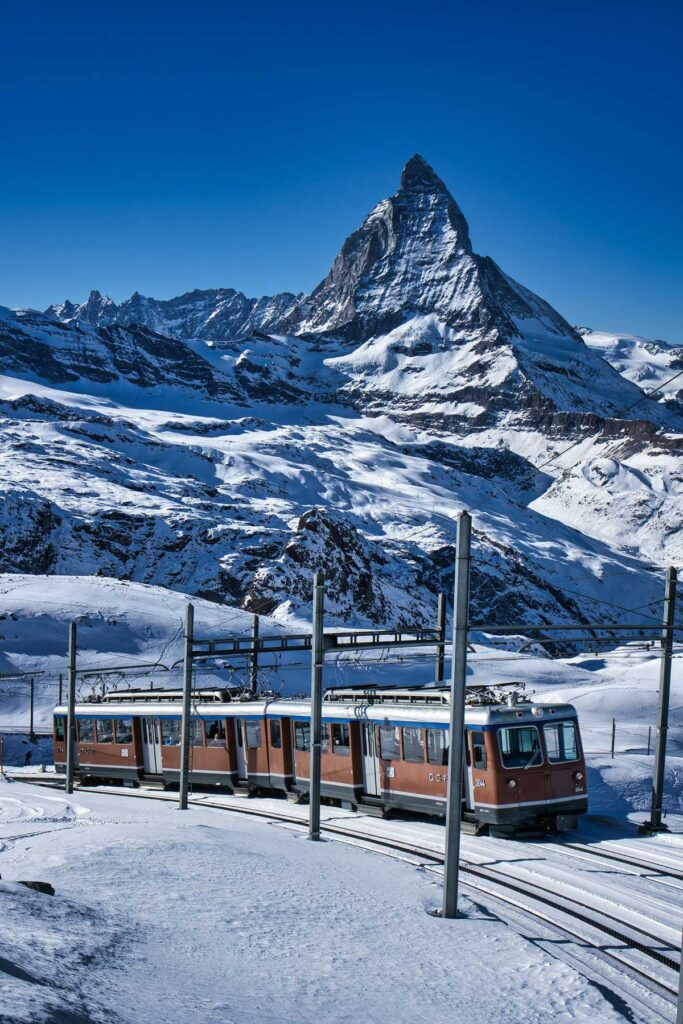
The Gornergrat Railway is Switzerland‘s first electric cogwheel railway, opened in 1898, carrying passengers from Zermatt at 1,604 metres up to the Gornergrat summit at 3,089 metres.
Two things that most guides get wrong: first, the railway is completely out of service from 2 to 14 November 2026 due to construction work — with no alternative transport provided — so visitors planning an autumn trip must plan around this closure.
Second, neither the Eurail Pass, the Interrail Pass, nor the SBB day pass gives any discount on the fare, despite many guides and aggregators implying otherwise. Only the Swiss Travel Pass and the Swiss Half Fare Card (GA) reduce the price, by 50%.
Book through GetYourGuide to lock in your tickets and avoid the queues that build at the station during peak summer months.
Quick facts
| Detail | Information |
|---|---|
| Valley station | Opposite the Matterhorn Gotthard Bahn station, Zermatt |
| Summer timetable (20 Apr–1 Nov) | Every 24 minutes from 08:00; first train at 07:00 |
| Winter timetable (from 15 Nov) | Every 48 minutes from 08:24; first train at 07:00 (Mon–Fri) |
| Closure | 2–14 November 2026: no service (construction) |
| Full return fare (summer, May–Oct) | CHF 132 per adult |
| Full return fare (winter, Nov–Apr) | CHF 96 per adult |
| Swiss Travel Pass / Half Fare Card | 50% discount |
| Children (summer: under 6; winter: under 9) | Free |
| Dogs | Free |
| Journey time | Approximately 33 minutes to the summit |
| Typical visit duration | Half-day to full day |
Timetable and operating hours
The railway runs every day of the year except during planned maintenance periods. In summer (20 April to 1 November 2026), trains depart every 24 minutes from 08:00. The first departure from Zermatt is at 07:00. Additional trains run outside these hours at busier periods.
From 2 to 14 November 2026 the railway is entirely suspended due to construction work. The official timetable page explicitly states that no alternative transport is available during this period.
From 15 to 27 November 2026 a reduced winter service resumes, with trains every 48 minutes from 08:24 and a first departure at 07:00 on weekdays. The full winter timetable beyond November 2026 should be confirmed on the official site, as seasonal adjustments apply. Always check the live timetable before travelling, as mountain weather can affect services.
Ticket prices
All prices are in Swiss francs and include VAT.
Individual fares — full journey (Zermatt to Gornergrat)
| Summer (May–Oct) | Winter (Nov–Apr) | |
|---|---|---|
| One-way | CHF 66 | CHF 48 |
| Return | CHF 132 | CHF 96 |
Intermediate station fares (one-way, summer / winter)
| Route | Summer one-way | Winter one-way |
|---|---|---|
| Zermatt – Rotenboden | CHF 57 | CHF 45 |
| Zermatt – Riffelberg | CHF 42 | CHF 36 |
| Zermatt – Riffelalp | CHF 29 | CHF 26 |
| Zermatt – Findelbach | CHF 23 | CHF 21 |
Discounts
| Pass / situation | Discount |
|---|---|
| Swiss Travel Pass, Swiss Half Fare Card (GA) | 50% |
| Children (summer: ages 6–15.99; winter: ages 9–15.99) | 50% |
| Children with Junior Card (ages 6–15.99) | Free |
| Children (summer: under 6; winter: under 9) | Free |
| Dogs | Free |
| Eurail Pass, Interrail Pass, SBB day pass | No discount |
| Groups of 10 or more paying passengers | 20% off the applicable fare |
The Eurail and Interrail passes explicitly do not reduce the fare. The official FAQ confirms this. Many popular travel guides state otherwise — they are wrong. Book through GetYourGuide to purchase tickets securely in advance, particularly for summer and peak holiday periods.
Why ride the Gornergrat Railway?
- 🚞 History on rails: The Gornergrat Railway opened in 1898 as Switzerland’s first electric cogwheel railway and has been operating continuously for over 125 years.
- 🏔️ Unmatched Matterhorn panorama: From the summit at 3,089 metres, you look out over the Matterhorn and 28 other four-thousand-metre peaks, including the Dufourspitze and the Dom, plus the sweeping Gorner Glacier.
- 🎟️ ZOOOM the Matterhorn included: The ticket includes entry to the “ZOOOM the Matterhorn” interactive multimedia exhibition, giving the visit substance even when cloud covers the summit.
- 🐕 Dogs and young children ride free: Dogs travel at no charge year-round; children under 6 (summer) or under 9 (winter) pay nothing.
- 🌿 Five stops, five different worlds: From forest and alpine meadows at Riffelalp to the Blacknose sheep at Riffelberg and the glacier-edge landscape of Rotenboden, the journey is as rewarding as the destination.
How to get there
Zermatt is a car-free village. You cannot drive into the village itself.
By car: Drive to Täsch, the last town on the valley road before Zermatt. Täsch has a large multi-storey car park (Matterhorn Terminal Täsch). From Täsch, the Matterhorn Express shuttle train runs frequently to Zermatt in about 12 minutes.
By train without a car: The Matterhorn Gotthard Bahn connects Zermatt to Visp and Brig on the main Swiss rail network. From Zürich, the journey to Zermatt takes roughly 3.5 hours via Bern and Visp. From Geneva, allow around 2.5 hours via Lausanne and Visp. The Glacier Express from St Moritz also terminates at Zermatt.
From Zermatt to the Gornergrat station: On arrival at Zermatt station, cross the station square. The Gornergrat Railway valley station is directly opposite the Matterhorn Gotthard Bahn station. It is a flat, short walk and step-free.
Parking
You cannot drive to Zermatt. The nearest parking is at Täsch, approximately 5 km down the valley. The Matterhorn Terminal Täsch car park has around 2,200 spaces and operates year-round. It is a paid, covered facility. From there, take the Matterhorn Express shuttle train to Zermatt. For current Täsch parking rates and capacity, check the Matterhorn Gotthard Bahn website before travelling — the Gornergrat Railway does not manage this facility and does not publish its tariffs.
How long to spend
The train journey from Zermatt to Gornergrat takes about 33 minutes each way. Most visitors spend two to three hours at the summit, combining the panoramic terrace, the ZOOOM the Matterhorn exhibition, and lunch at one of the summit restaurants. Add time for stopping at intermediate stations — Rotenboden in particular, for the Riffelsee lake — and a half-day is the realistic minimum. Walkers who descend one or more stages on foot will easily fill a full day.
Accessibility
The Gornergrat Railway valley station in Zermatt and the summit station at 3,089 metres are both wheelchair-accessible. The step-free transfer between the Matterhorn Gotthard Bahn station and the Gornergrat station in Zermatt is confirmed on the official site. However, the intermediate stations at Findelbach and Rotenboden are explicitly noted as not fully accessible for wheelchair users. Visitors with mobility limitations should plan to travel directly to the summit without alighting at those stops.
The high altitude (3,089 metres) can cause altitude sickness in some visitors, regardless of fitness level. Symptoms include headache, nausea, and dizziness. The official site recommends being well prepared for changeable mountain weather at all times. Dogs and young children qualify for free travel; prams and pushchairs are manageable on the trains themselves, though the terrain at the summit is rocky and uneven in places.
What to see along the route and at the summit
Findelbach (first stop): The train passes through thick Swiss stone pine forest shortly after leaving Zermatt. Findelbach is the lowest intermediate stop and serves mainly as a trailhead for walkers descending from higher stations. The scenery here still feels sheltered and lush, in sharp contrast to what awaits above.
Riffelalp (second stop): The Riffelalp plateau sits just below the tree line and is home to the historic Riffelalp Resort hotel. In summer, the flora is rich and the meadows open up with the first clear views towards the Matterhorn. A short side track leads to one of the area’s quieter vantage points.
Riffelberg (third stop): Above the tree line and into open alpine pasture, Riffelberg is where the Valais Blacknose sheep graze during the summer months. Their distinctive shaggy coats and square faces make them a popular photographic subject. A restaurant here also offers one of the first clear panoramic views of the Matterhorn.
Rotenboden (fourth stop): Rotenboden is the stop most walkers specifically target. A short path leads from the station to the Riffelsee, a small lake whose still surface creates a near-perfect reflection of the Matterhorn. The reflection is sharpest in the morning. Note that Rotenboden station itself is not accessible for wheelchair users.
Gornergrat Summit (3,089 metres): The summit terrace gives a 360-degree panorama encompassing the Matterhorn, 28 other four-thousand-metre peaks, and the vast Gorner Glacier — one of the largest glacier systems in the Alps. The panoramic viewing platform is open to all visitors.
ZOOOM the Matterhorn: The interactive multimedia exhibition inside the summit building brings the geology, history, and ecology of the surrounding peaks to life. Entry is included with the standard railway ticket. The exhibition is a practical option when summit cloud obscures the outdoor views.
The Golden Spot: A gold-plated historic locomotive (number 3003) is positioned at the summit specifically as a souvenir photography backdrop, with the Matterhorn behind. It is one of the most-photographed features of the Gornergrat — somewhat kitsch, but reliably popular.
Europe’s Highest Alpine Garden: In summer, a botanical garden near the summit showcases high-altitude plant species. It is the highest Alpine garden in Europe and is included in the general summit area accessible with a railway ticket.
The Kulmhotel Gornergrat: The summit hotel at 3,089 metres is the highest hotel in the Swiss Alps. Its restaurants serve everything from self-service mountain fare to multi-course meals. The hotel also offers overnight stays for those wanting to catch the sunrise or stargaze at altitude.
Practical visitor tips
| Tip | Detail |
|---|---|
| Sit on the right going up | The best Matterhorn views on the ascent are from the right-hand side of the train. Seats fill quickly in peak season, so book tickets in advance and board early for your preferred seat. |
| Dress for 3,000 metres | Even in summer, the summit is cold, often windy, and subject to rapid weather changes. A warm layer, waterproofs, and sunscreen are essential regardless of conditions in Zermatt below. |
| Go early or late in the day | The first train at 07:00 is significantly quieter than mid-morning departures. Midday in July and August sees the longest queues. Checking the live webcam before you leave your hotel takes seconds and saves frustration. |
| Check the November closure | The railway is completely shut from 2 to 14 November 2026 with no replacement service. This date catches visitors unaware every year. Double-check the official site if your trip falls near this window. |
| Verify your pass discount before booking | The Eurail Pass, Interrail Pass, and SBB day pass give no reduction. Only the Swiss Travel Pass and Swiss Half Fare Card reduce the fare by 50%. Selecting the wrong discount category when booking online will require a correction at the ticket window. |
FAQ
| Question | Answer |
|---|---|
| Does the Eurail Pass cover the Gornergrat? | No. The Eurail Pass, Interrail Pass, and SBB day pass give no discount whatsoever. The Swiss Travel Pass and Swiss Half Fare Card each give 50% off. Book in advance and select the correct discount at checkout. |
| Is the railway running in November 2026? | No, from 2 to 14 November 2026. The service is entirely suspended for construction work with no alternative transport provided. It resumes on 15 November 2026. |
| Can I get off at intermediate stations and reboard later? | Yes. Your ticket allows you to alight at Findelbach, Riffelalp, Riffelberg, or Rotenboden and continue to the summit on a later train. This is the basis of the popular station-to-station hiking routes. |
| How accessible is the railway for wheelchair users? | The Zermatt valley station and the Gornergrat summit station are both accessible. The intermediate stations at Findelbach and Rotenboden are not. Passengers with wheelchairs should travel directly to the summit without stopping at those two stations. |
| Is the Riffelsee Matterhorn reflection reliable? | The reflection is best in calm conditions early in the morning, before wind disturbs the water. It can be obscured by cloud on either the lake or mountain side. Check the webcam before boarding to gauge conditions. |
Things to do nearby
Matterhorn Glacier Paradise (Klein Matterhorn) is the next natural step up from the Gornergrat. Reached by a series of cable cars from Zermatt, it rises to 3,883 metres — Europe’s highest cable car station — and gives a completely different perspective on the same mountains, looking down onto the Gorner Glacier from above.
The Five Lakes Walk (Fünfseenweg) is a classic half-day hike linking five glacier lakes above Zermatt, including the Riffelsee at Rotenboden. It can be started or finished at Gornergrat Railway stations, making it a natural extension of a railway visit rather than a separate trip.
Zermatt village rewards an hour or two of exploration beyond the station square. The car-free streets have a genuine Alpine character, and the Zermatt Alpine Museum on Kirchstrasse covers the history of Matterhorn mountaineering, including the 1865 first ascent.
Schwarzsee is reachable by cable car from Zermatt and sits at the foot of the Matterhorn’s north face at 2,583 metres. The proximity to the mountain wall is unlike anything seen from the Gornergrat — the Matterhorn fills the sky rather than the horizon.
Sunnegga Express is an underground funicular from central Zermatt to the Sunnegga viewpoint at 2,288 metres, a quick and easy alternative perspective on the same Matterhorn panorama, with the Stellisee lake below it for reflection photographs in different conditions.
What to visit tomorrow
Cogwheel rack railways of the Gornergrat type are relatively rare. Most other notable Swiss examples are more than two hours from Zermatt — the guide is transparent about this.
Matterhorn Glacier Paradise, Zermatt: Not a railway but a multi-stage cable car to 3,883 metres — the highest aerial cableway station in Europe. It is the most direct complement to a Gornergrat day, sharing the same resort and the same mountain, but from the opposite angle and at 800 metres greater altitude.
Metro Alpin, Saas-Fee: The neighbouring Saas valley, about 1.5 hours from Zermatt by bus via Visp and Stalden, is home to the world’s highest underground funicular. It rises to 3,500 metres and gives access to the Allalin ski area and year-round glacier terrain.
Rochers-de-Naye Cogwheel Railway, Montreux: From the lakeside town of Montreux, a MOB cogwheel railway climbs to 2,042 metres on the Rochers-de-Naye. The journey takes about 2.5 hours from Zermatt via Visp and Lausanne — slightly over the two-hour guideline, but this is the most direct like-for-like cogwheel railway comparison in western Switzerland.
Glacier 3000, Les Diablerets: A cable car rising to 3,000 metres in the Vaudois Alps, roughly 2.5 hours from Zermatt by train via Aigle. The Peak Walk by Tissot — a suspension bridge linking two rocky peaks — is its signature feature and offers a distinctly different style of high-altitude experience.
Pilatus Cogwheel Railway, Lucerne: The steepest rack railway in the world, with a maximum gradient of 48%, climbs from Alpnachstad (near Lucerne) to the summit of Mount Pilatus at 2,128 metres. It is around three hours from Zermatt — beyond the two-hour guideline — but is the definitive comparison for any visitor specifically interested in Switzerland’s cogwheel railway tradition.