The House of Terror Museum is a historical exhibition space in Budapest, dedicated to the victims of the 20th-century fascist and communist regimes in Hungary. This guide covers opening hours, ticket prices, transport or parking, accessibility, and practical visitor tips to help you plan your trip.
This page was last updated in May 2026, noting that the museum is closed every Monday and does not sell general admission tickets online in advance, details frequently missed in older travel resources.
Quick facts
| Feature | Details |
| Opening hours | Tuesday to Sunday 10:00 a.m. to 6:00 p.m.; Closed on Mondays |
| Ticket prices | Full-price adult ticket 4,000 HUF; Reduced-price ticket 2,000 HUF |
| Address | 1062 Budapest, Andrássy út 60, Hungary |
| Nearest public transport or parking | Vörösmarty utca underground station (M1 line) or Oktogon tram stop |
| Typical time needed to visit | Two to three hours |
House of Terror Museum opening hours
The House of Terror Museum opening hours are 10:00 a.m. to 6:00 p.m. from Tuesday to Sunday, with the facility remaining closed every Monday. These core operating times stay consistent year-round. There are no extended evening hours during the busy summer tourist season, and the museum is closed on major public holidays, including January 1st and December 24th to 26th.
The on-site cash desk and ticket office close daily at 5:30 p.m., exactly 30 minutes before the museum shuts. Visitors must arrive before this time to purchase admission. However, arriving late leaves very little time to view the extensive exhibitions, so an earlier arrival is strongly advised.
5 top experiences to book in Budapest
- 🍴 20+ tastings – Enjoy 20+ tastings and visit the Central Market Hall’s best stalls on a top-rated food tour.
- 🚢 Night-time Danube cruise – On a night-time Danube cruise, enjoy a free drink as the city lights up.
- 🧛 Dark legends and vampires – Uncover dark legends and vampires on a night-time tour of Buda’s Castle District.
- 🍻 Budapest’s ruin bars – On an evening drinks and street food tour, discover Budapest’s ruin bars.
- 🏛️ Budapest’s highlights – Cover Budapest’s highlights, including the majestic Parliament building, on a grand city tour.
House of Terror Museum ticket prices
House of Terror Museum ticket prices are charged in Hungarian Forint (HUF), with a standard full-price adult ticket costing 4,000 HUF. A reduced-price ticket is available for 2,000 HUF. This reduced rate strictly applies only to citizens of the European Economic Area (EEA) aged between 6 and 25, or between 62 and 70. Audio guides provide essential context and can be rented for an additional fee at the front desk.
Opening hours and ticket prices were checked on the official website and last updated in May 2026. The attraction is not included for free in any major city pass scheme, including the official Budapest Card. This city pass generally provides free entry to other major attractions, such as the Hungarian National Museum, the Hungarian National Gallery, and Lukács Baths.
Why book the Budapest Card?
- Unlimited public transport: Use buses, trams, metro and suburban trains across Budapest for the validity of your card.
- Free entry to museums and attractions: Enjoy complimentary access to many of the city’s leading cultural sites, galleries and historic locations.
- Discounts on tours and experiences: Receive reduced prices on river cruises, baths, walking tours and selected partner experiences.
- Flexible validity options: Choose from 24, 48 or 72 hours of sightseeing flexibility to match your travel plans.
- Useful city guide included: Your card comes with a guidebook or digital guide to help you make the most of your time in Budapest.
How to get to the House of Terror Museum
To get to the House of Terror Museum, most visitors use public transport, as the building sits on the prominent Andrássy Avenue in the city centre. The most convenient transport method is taking the historic M1 (Yellow Line) underground railway directly to the Vörösmarty utca station. From this station stop, the museum entrance is less than a two-minute walk away.
Alternatively, you can take the busy 4 or 6 tram routes to the major Oktogon intersection and walk a short distance down Andrássy Avenue. Several local bus routes, including the 105 and 178, also stop directly in front of the building. Ride-sharing services can drop visitors near the entrance, but traffic on the main avenue can be heavy during peak times.
Parking at the House of Terror Museum
Parking at the House of Terror Museum is very difficult, as the attraction is situated on one of the busiest historic boulevards in central Budapest. There is no dedicated on-site car park for visitors. On-street parking along Andrássy Avenue and the surrounding side streets is extremely limited, requires purchasing a ticket from automated meters, and is strictly time-limited.
Visitors driving into the city are strongly advised to use public transport or park in a commercial multi-storey garage further away from the city centre. The nearest secure underground parking facilities are located near Oktogon or the WestEnd City Center shopping mall. Both options require a short walk or tram ride to reach the museum.
How long to spend at the House of Terror Museum
You should plan to spend between two and three hours at the House of Terror Museum to fully understand the extensive historical exhibits. This timeframe allows you to walk through the three floors of displays, watch the numerous documentary video clips, and read the provided English information sheets in each room.
If you rent an audio guide, your visit will naturally lean towards the three-hour mark. Moving through the museum quickly is difficult due to the dense amount of information and the strict one-way flow of the corridors. You should allow ample time in your daily itinerary to complete the route without rushing.
Accessibility at the House of Terror Museum
Accessibility at the House of Terror Museum is very good, as the historic building has been retrofitted with lifts to ensure all exhibition floors are fully accessible to wheelchair users. The main entrance features level access from the pavement. Visitors with mobility issues can use the central elevators to bypass the main staircases between the ground, first, and second floors.
The basement level, which houses the poignant prison and torture cells, is also accessible via the lift. However, some of the original doorways and underground corridors are naturally narrow, which may require careful navigation. Accessible toilets are available within the building, and seating is provided in several of the video rooms, allowing visitors to rest while watching the historical footage.
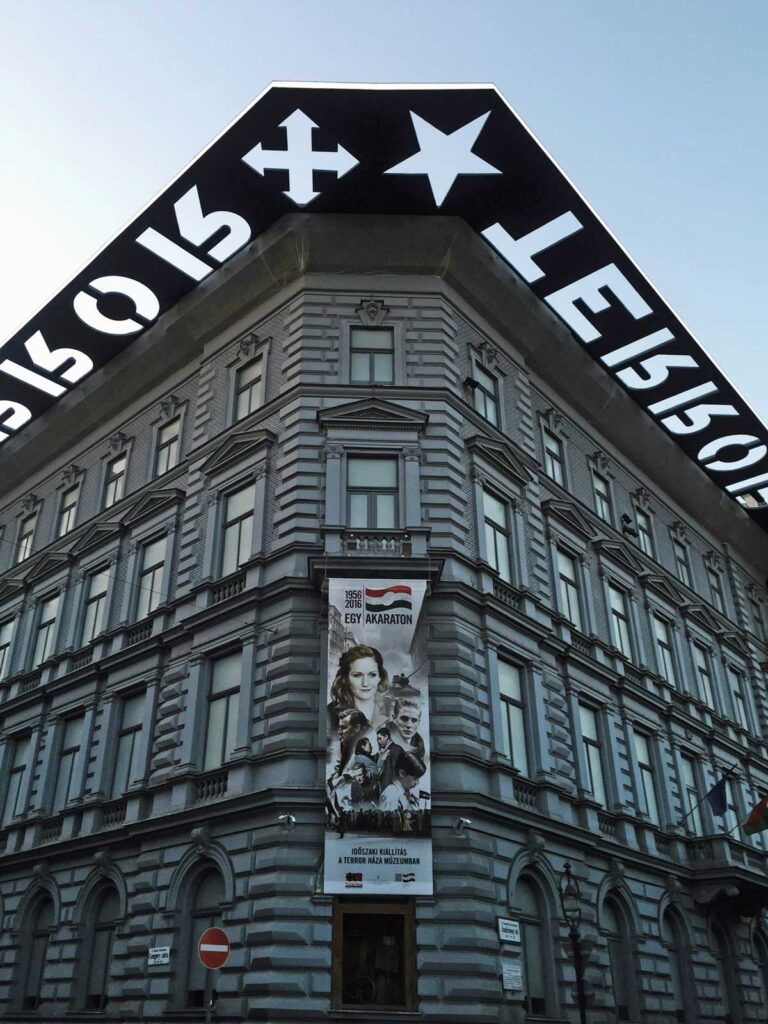
Inside / what to see at the House of Terror Museum
Inside the House of Terror Museum, visitors explore the former headquarters of both the Hungarian Nazi Arrow Cross Party and the subsequent Communist Secret Police (ÁVH). The museum acts as a powerful memorial dedicated to the victims of these two successive totalitarian regimes that dominated Hungary during the 20th century. The exhibits are highly visual and atmospheric, using striking design, low lighting, and sombre music to convey the oppressive nature of the eras.
The upper floors focus on the chronological history of the regimes, beginning with the Arrow Cross terror during World War II and the subsequent Soviet occupation. Visitors walk through heavily themed rooms that detail the aggressive state propaganda, the systemic surveillance of citizens, the show trials, and the brutal repression of the 1956 Hungarian Revolution. Key highlights include the “Changing Room,” illustrating the seamless transition of local enforcers between the two dictatorships, and a massive Soviet tank situated in the central atrium.
The final and most harrowing part of the visit takes place in the basement, where visitors descend in a slow-moving elevator while watching a video testimony of a former executioner. This underground level preserves the original prison cells, torture chambers, and solitary confinement boxes used by the secret police. The grim reality of these windowless rooms leaves a lasting impact, serving as a solemn tribute to the thousands who suffered within the building’s walls.
Practical visitor tips
| Category | Advice |
| Timing | Arrive right at opening time at 10:00 a.m. on a weekday to avoid the long queues that often stretch down Andrássy Avenue during the summer. |
| Crowds | The museum employs a strict one-way flow system, meaning narrow corridors can become congested behind large tour groups during peak afternoon hours. |
| Layout | Rent an audio guide or pick up the printed English information sheets in each room, as most of the visual exhibits lack direct English translations. |
| Entry process | Tickets cannot be purchased online in advance and must be bought in person at the front desk upon your arrival. |
| On-site logistics | Photography and video recording are strictly prohibited throughout the entire museum, including the basement prison cells. |
Frequently asked questions about the House of Terror Museum
| Question | Answer |
| Is the House of Terror Museum suitable for children? | No, the museum contains graphic and disturbing historical content and is not recommended for children under the age of 14. |
| Do you need to book tickets in advance for the House of Terror Museum? | No, advance booking is not possible; all general admission tickets must be purchased upon arrival at the cash desk. |
| Is the House of Terror Museum open on Mondays? | No, the museum is closed every Monday and operates its standard hours from Tuesday to Sunday. |
| Are bags allowed at the House of Terror Museum? | Large rucksacks and luggage are not permitted inside the exhibitions and must be left in the mandatory on-site cloakroom. |
| Can you take photographs inside the House of Terror Museum? | No, all personal photography, video, and audio recording are strictly banned inside the building and exhibition spaces. |
Things to do near the House of Terror Museum
- The Hungarian State Opera House is a magnificent neo-Renaissance building on Andrássy Avenue offering guided tours of its opulent, gold-leafed auditorium and grand staircases.
- Heroes’ Square is a monumental public plaza at the end of the avenue featuring massive statues of the Seven Chieftains of the Magyars and other national leaders.
- The Széchenyi Thermal Bath is a vast, iconic spa complex located in the nearby City Park, featuring 15 indoor pools and three large outdoor heated pools.
- The Museum of Fine Arts is a prestigious classical art museum located on Heroes’ Square, housing extensive collections of Egyptian artefacts and European old master paintings.
- St. Stephen’s Basilica is the largest church in Budapest, offering visitors the chance to view the mummified right hand of Hungary’s first king and climb the dome for city views.
What to visit tomorrow
- The Hungarian National Museum explores the comprehensive history of the Carpathian Basin from antiquity to the fall of communism through extensive archaeological and historical exhibits.
- The Hospital in the Rock Nuclear Bunker Museum is a fascinating subterranean Cold War medical facility located in the natural cave system beneath Buda Castle.
- The Holocaust Memorial Center is a moving architectural space and museum dedicated to the memory of the Hungarian Jewish victims of the Second World War.
- The Budapest History Museum is situated within Buda Castle and details the complex urban development and dramatic history of the city from Roman times to the present day.
- Memento Park is an open-air museum on the outskirts of the city that displays the monumental communist statues and monuments removed from the streets of Budapest after the fall of the Iron Curtain.
More Budapest travel
Other Budapest travel guides on Planet Whitley include:
- A first time visitor’s guide to Pest, Hungary.
- Why the Vasarely Museum is Budapest’s best art museum.
- 11 best things to do on a 3 day Budapest city break.
- Plan your visit to Budapest Zoo.
- Your handy guide to riding the Budapest Castle Funicular.