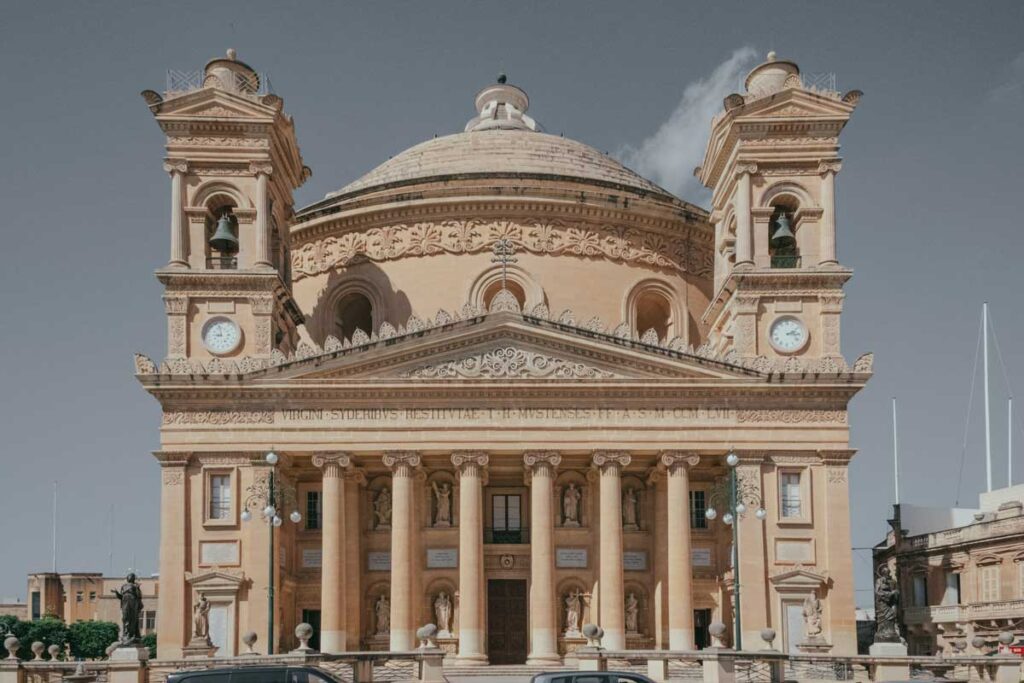
The Mosta Rotunda — formally the Sanctuary Basilica of the Assumption of Our Lady — is a neoclassical Roman Catholic church in the centre of Mosta, Malta, completed in 1860 after 27 years of construction. Its dome has an inside diameter of 39.6 metres and an internal height of 54.7 metres, ranking among the largest unsupported domes in the world.
This guide was updated in June 2026: The entrance fee is now €5, covering the basilica, the World War II shelter, the inner dome balcony, and a mobile audio guide. Many TripAdvisor reviews still cite the old price of €2 for the church alone or €3 with the shelter — the current all-inclusive price is higher, and those separate tiers no longer apply. You can book through GetYourGuide in advance.
Quick facts
| Detail | Information |
|---|---|
| Address | 1 Triq il-Bażilika, Mosta MST 2015, Malta |
| Hours (Mon–Fri) | 09:30–18:00 (last entry 17:30) |
| Hours (Saturday) | 09:30–16:30 (last entry 16:00) |
| Hours (Sunday) | 12:00–17:00 (last entry 16:30) |
| Closed | During religious services and occasional private events |
| Entrance fee | €5 (all-inclusive: basilica + WWII shelter + inner balcony + audio guide) |
| Dome outside diameter | 56.2 metres |
| Dome inside diameter | 39.6 metres |
| Internal height | 54.7 metres |
| Nearest bus routes | 41, 42, 44, 45, 48 (from Valletta); 45, 186, 31, 48, 280 (from Qawra) |
| Parking | Limited roadside near the church; designated accessible spaces available |
| Typical visit | 45–75 minutes |
Mosta Rotunda opening hours
Visitor hours differ significantly by day. Monday to Friday: 09:30 to 18:00 (last entry 17:30). Saturday: 09:30 to 16:30 (last entry 16:00). Sunday: 12:00 to 17:00 (last entry 16:30).
Sunday hours are substantially shorter, and visitors who arrive before noon on a Sunday will find the visitor entrance closed. The church may also close without notice during religious services, funerals, weddings, and major feast day events. The Feast of the Assumption (15 August) is one of the biggest events in the Maltese calendar and draws large crowds to Mosta — access for tourists is restricted during the principal services.
Mosta Rotunda admission prices
The €5 entrance fee is confirmed on the official homepage and covers access to the basilica interior, the World War II underground shelter, the inner balcony of the dome, and the mobile audio guide app. This is a single all-inclusive ticket — the previous tiered system (€2 for the church, €3 with the shelter) no longer applies, and TripAdvisor reviews citing those prices are out of date.
| Category | Price |
|---|---|
| All visitors (inclusive ticket) | €5 |
| What’s included | Basilica + WWII Shelter + Inner Balcony + Audio Guide |
Special rates are available for groups — contact the parish office in advance. The audio guide app is free to download before arrival and covers the dome’s history, architecture, and the 1942 bomb incident in multiple languages. Book your Mosta Rotunda ticket through GetYourGuide.
Why visit the Mosta Rotunda?
- 🏛️ One of the largest unsupported domes in the world: The interior diameter of 39.6 metres places the Mosta dome among the largest in Europe. Standing under it is a genuinely arresting experience in a way photographs do not convey.
- 🎟️ Five experiences in a single €5 ticket: The basilica interior, WWII shelter, inner dome balcony, sacristy with the bomb replica, and mobile audio guide are all included — among the best-value historic attractions in Malta.
- 💣 The 1942 bomb miracle: On 9 April 1942, a German bomb pierced the dome during Sunday Mass with 300 worshippers inside. It did not explode. The replica on display in the sacristy includes the original crater mark on the church wall.
- 📜 Built around the old church without demolishing it: One of the most unusual architectural achievements of 19th-century Malta — the rotunda was constructed as a shell around the earlier 1617 church, which remained standing inside until the new building was complete.
- 🌿 Mosta itself is worth the trip: The town’s historic centre, independent bakeries, and local market contrast sharply with the resort strip. The church sits at its heart and makes a natural base for exploring a genuinely Maltese town.
How to get to the Mosta Rotunda
By bus from Valletta, routes 41, 42, 44, 45, and 48 all serve Mosta. Journey time is approximately 30–40 minutes. The main bus stop in Mosta is a short, flat walk from the church entrance on Rotunda Square.
From Qawra/St Paul’s Bay, buses 45, 186, 31, 48, and 280 connect to Mosta. From Sliema, take bus 212 to Bugibba first, then connect; or take bus 103 which provides a more direct route. From Bugibba, bus 48 is the most direct option.
By car, Mosta is on the main Attard–Mosta road (TF10) in the centre of the island. The rotunda is in the middle of the town on Rotunda Square. Driving into the square itself is restricted; use the surrounding streets and walk to the entrance.
Parking at the Mosta Rotunda
Parking directly beside the church is very limited, with a small number of roadside spaces on the streets adjacent to Rotunda Square. Designated accessible parking spaces are available near the church entrance. The official access statement confirms limited parking beside the church, including accessible spaces, but does not provide a specific capacity. On feast days and weekends, finding a space close to the church is difficult; arriving by bus is the more reliable option.
How long to spend at the Mosta Rotunda
Allow 45 to 75 minutes for the complete visit: the basilica interior takes around 20–25 minutes; the sacristy with the bomb replica and a short video add 10–15 minutes; the inner dome balcony (via stairs) 10–15 minutes; and the WWII shelter 10–15 minutes. Visitors who engage closely with the audio guide will be at the upper end of that range. The Dome Visitors Centre next to the church screens a short film on the dome’s construction and is accessible by lift.
Accessibility at the Mosta Rotunda
The main entrance has a gently sloped ramp suitable for wheelchairs and mobility aids. The ground-level areas of the basilica — the nave, main altar, and sacristy via ramp — are fully accessible. The inner dome balcony and the WWII shelter are accessible only by stairs; no lift is available for these sections. Handrails are fitted on all stairways.
The Dome Visitors Centre (with construction video) is accessible by lift, and the sacristy historical video is shown in a ramp-accessible room. Accessible toilets are available at the Dome Visitors Centre. The audio guide app is available in multiple languages and is suitable for visitors with visual impairments. Printed leaflets in several languages are available at the entrance. Staff are available to assist visitors with additional needs — contact the parish office in advance for specific arrangements.
What to see at the Mosta Rotunda
The dome interior is the first and dominant impression. The 39.6-metre interior diameter and 54.7-metre height are experienced very differently in person than in photographs — the pale blue ceiling draws the eye upward across painted panels to the central oculus. The dome was completed in 1860 after 27 years of construction, during which the earlier 17th-century church remained standing inside the emerging structure.
The paintings and decoration are by Giuseppe Calì, Malta’s foremost religious painter of the 19th century. The apse behind the high altar contains one of his largest works; ceiling vaults and side chapels display further canvases and frescoes.
The sacristy and bomb replica are through a door on the right side of the nave. On 9 April 1942, a German bomb penetrated the dome during a packed Sunday Mass and rolled across the church floor without detonating. The replica bomb is displayed beside a scale model of the church, and the original impact crater on the rear wall is still visible. This is the most emotionally distinctive feature of the visit for most visitors.
The inner dome balcony requires a staircase climb and gives a close-up view of the dome’s interior construction as well as a bird’s-eye view down into the nave. On clear days the outer viewing opportunities extend to the surrounding Maltese countryside.
The WWII underground shelter was excavated beneath the church during the war to shelter Mosta residents from aerial bombardment. It is reached by stairs from inside the visitor circuit and preserves the original structure with interpretation on the wartime experience of the Maltese civilian population.
Practical tips for visiting the Mosta Rotunda
| Tip | Detail |
|---|---|
| Note the Sunday hours | The church opens to visitors at 12:00 on Sundays — not 09:30. Several guides and aggregators list the weekday hours only. Arriving at 10:00 on a Sunday means a two-hour wait. |
| Download the audio guide before arriving | The app is available in multiple languages on iOS and Android. Mobile internet connectivity inside the church can be unreliable — download pre-arrival. |
| The old €2/€3 pricing is gone | Many TripAdvisor reviews still cite the old split-ticket system. The current fee is €5 for all-inclusive access. |
| Dress modestly | As an active place of worship, the church requires covered shoulders and knees for entry. Scarves are available at the entrance for those who need one. |
| Book in advance | Walk-up entry is accepted during visitor hours, but booking ahead guarantees your visit and is useful during busy summer and public holiday periods. |
Mosta Rotunda FAQ
| Question | Answer |
|---|---|
| What is the entrance fee? | €5 all-inclusive, covering the basilica, WWII shelter, inner dome balcony, and mobile audio guide. Many reviews still show €2 or €3 — those are old, tiered prices no longer in use. |
| What time does it open on Sundays? | 12:00, with last entry at 16:30. Visitor access before noon on Sundays is not available. Weekday hours are 09:30–18:00. |
| Can I climb to the top of the dome? | Yes — the inner balcony is part of the standard ticket. It is accessible by stairs only; no lift is provided to this section. |
| What is the bomb miracle? | On 9 April 1942, a German bomb pierced the dome during Sunday Mass with 300 people inside. It failed to explode. A replica is displayed in the sacristy alongside a scale model of the church. |
| Is the church accessible by wheelchair? | The nave and ground-level areas are wheelchair accessible via a sloped entrance ramp. The inner balcony and WWII shelter are stairs-only. |
Things to do near the Mosta Rotunda
The Dome Visitors Centre is directly adjacent to the church and screens a short film on the dome’s construction history. It holds a small café and is accessible by lift — useful for visitors unable to climb to the inner balcony.
Mosta town centre surrounds the rotunda with a walkable historic core. The Maltese-owned bakeries, hardware shops, and unmarked bar-restaurants on the streets off Rotunda Square give a reliable sense of life in a working Maltese town that the resort areas do not.
Mdina (Silent City) is around 10 minutes south-west of Mosta by car or taxi and is Malta’s medieval walled capital. St Paul’s Cathedral, Palazzo Falson, and the city walls are all within the compact fortified perimeter. Bus connections from Mosta are available.
Naxxar Palace and Gardens (Palazzo Parisio) is around 5 km east of Mosta and is a privately owned Baroque palace with formal gardens open to the public. It houses a restaurant and hosts events; check for current opening before visiting.
San Anton Gardens, Attard is a public garden surrounding the President of Malta’s official residence, around 10 minutes south-east of Mosta by car. Entry to the gardens is free at all times and the planting is particularly good in spring.
Similar churches and domed monuments to visit in Malta
St John’s Co-Cathedral, Valletta is arguably Malta’s most important church interior and houses Caravaggio’s The Beheading of Saint John the Baptist — the only work the artist signed. Admission €15 (includes audio guide). Around 25 minutes from Mosta by bus.
Mdina Cathedral (Cathedral of Saint Paul), Mdina is the co-cathedral of the Archdiocese of Malta and is set within the medieval walls of Mdina. It holds an important collection of Mattia Preti frescoes and Dürer woodcuts. Around 10 minutes from Mosta by car.
Birgu (Vittoriosa) Parish Church of St Lawrence is one of Malta’s oldest parishes and was the seat of the Knights of Malta before Valletta was built. The church survived repeated bombardment and holds notable liturgical silver. Around 30 minutes south from Mosta.
Rotunda of Xewkija, Gozo is the Gozo equivalent of Mosta — a massive parish rotunda built by volunteer labour, completed in 1978, with an interior capacity of 3,000. Its exterior dome is larger than Mosta’s by external measurement, though the interiors are comparable. Around 1.5 hours from Mosta including the Gozo ferry.
Żebbuġ Parish Church of St Philip is a relatively unvisited Baroque church on the road between Qormi and Rabat with an elaborate façade and a well-preserved interior that rewards a detour for visitors interested in Maltese ecclesiastical architecture.