The Yria Archaeological Site (also spelled Iria; Greek: Ιερό Διονύσου Υρία) is an open-air sanctuary dedicated to Dionysus, located in the Livadi plain near the village of Glinado, approximately 3–5 km south of Naxos Town (Chora) and 1 km east of Naxos Airport, on the island of Naxos, Greece. This guide covers opening hours, ticket prices, how to reach the site, accessibility, and practical visitor tips.
Last updated: May 2026. The site is closed on both Tuesday and Wednesday in winter (November–March), not just Tuesday as at most Greek archaeological sites. The official Odysseus portal also shows that summer hours remain 08:30–15:30 — there is no extended evening opening. Several travel sources incorrectly state longer summer hours or a Monday closure.
Quick facts
| Detail | Information |
|---|---|
| Opening hours (summer, approx. April–October) | 08:30–15:30, Wednesday to Monday; closed Tuesdays |
| Opening hours (winter, approx. November–March) | 08:30–15:30, Thursday to Monday; closed Tuesdays and Wednesdays |
| Ticket prices | Full: €5 / Reduced: €3 |
| Address | Livadi, Naxos (Cyclades); near Glinado village |
| Telephone | +30 22850 42325 |
| Nearest public transport | KTEL Line 3 to Glinado; ~15–20 minute walk from stop |
| Parking | Free, on-site |
| Typical visit duration | 45 minutes to 1 hour |
Yria Archaeological Site opening hours
In summer (approximately April–October), the site is open Wednesday to Monday, 08:30 to 15:30. It is closed every Tuesday. In winter (approximately November–March), opening days reduce to Thursday to Monday, 08:30 to 15:30. The site is closed on both Tuesdays and Wednesdays during winter — an important difference from the majority of Greek Ministry of Culture sites, which are typically closed on Tuesdays only.
The last admission is 20 minutes before closing time. The site is closed on 1 January, 25 March, 1 May, Greek Orthodox Easter Sunday, 25 December, and 26 December. Free admission applies on 6 March (in memory of Melina Mercouri), 18 April (International Monuments Day), 18 May (International Museums Day), the last weekend of September (European Heritage Days), 28 October, and the first Sunday of each month from November through March.
The site opens free to the public on the August full moon each year, when evening access is permitted.
Yria Archaeological Site ticket prices
The standard (full) ticket costs €5. The reduced ticket costs €3 and applies to students, seniors, and other eligible groups under the Greek Ministry of Culture concessions policy. EU citizens under 25 years of age are admitted free of charge on presentation of a valid passport or identity card confirming age and EU nationality. Children under 18 from non-EU countries are also admitted free.
The ticket covers both the open-air sanctuary and the Archaeological Collection of Yria, a small on-site display of finds from the excavations. Tickets are purchased at the site entrance; no advance booking is available or required. Card payment facilities may be unreliable at this remote site — bring cash.
The Yria Archaeological Site is not included in any city pass or regional pass scheme such as Go City. There is no Naxos island pass covering multiple sites.
Opening hours and ticket prices were checked on the official Hellenic Ministry of Culture website and last updated in May 2026.
How to get to the Yria Archaeological Site
The site is in the Livadi plain, near Glinado village, approximately 3–5 km south of Naxos Town and 1 km east of Naxos Airport. The address is simply listed as Livadi, Naxos; search for “Sanctuary of Dionysus Yria Naxos” in map applications for accurate routing.
By car or scooter: The most practical option. The drive from Naxos Town takes approximately 10–15 minutes. The road is paved and signposted. Free parking is available at the site entrance.
By bus: KTEL Line 3 from the main bus station at Naxos Port runs to Glinado village. The ride takes approximately 12 minutes from the port. From the Glinado bus stop, the site is a walk of approximately 15–20 minutes through the valley. Bus frequency is seasonal; check current timetables at naxosdestination.com or the KTEL office at the port before travelling.
On foot or by bicycle: Visitors staying near Agios Georgios Beach or the southern edge of Naxos Town can reach the site in approximately 30–40 minutes on foot, or a shorter ride by bicycle, following rural roads south through the Livadi valley.
By taxi: Taxis from Naxos Town to the site cost approximately €10–20. Taxis on Naxos are not metered; agree a price before departure. Book a return journey in advance as there are no taxis at the site itself.
Parking at the Yria Archaeological Site
Free parking is available directly at the site entrance. The car park is small but sufficient outside peak summer months. The surrounding roads are narrow rural lanes; large vehicles should check access in advance.
How long to spend at the Yria Archaeological Site
Plan for 45 minutes to 1 hour to walk the site and view the on-site Archaeological Collection. The site is compact and well-presented. Visitors with a specific interest in early Greek architecture or the development of the Ionic order may prefer to allow 1.5 hours. The site can be combined with a visit to the Temple of Demeter at Sangri (~8 km away) in a single half-day trip.
Accessibility at the Yria Archaeological Site
The official Odysseus portal confirms that the site has ramps and accessible routes. The Livadi plain setting means the terrain is relatively flat compared to hilltop sites. The on-site Archaeological Collection is in a small building accessible from the same entrance. Visitors with specific mobility requirements should contact the site in advance on +30 22850 42325 or email efakyk@culture.gr.
Inside the Yria Archaeological Site: what to see
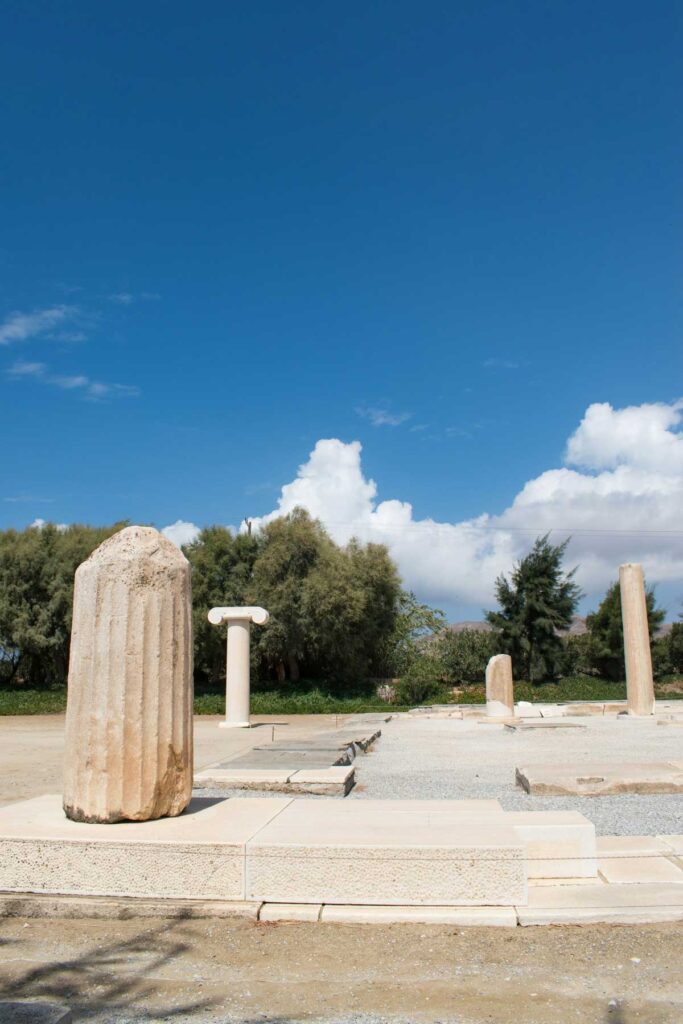
The site presents four successive sanctuaries built on exactly the same plot of ground between approximately 800 BC and the 6th century BC, each constructed on the foundations of its predecessor. The visible remains are those of the fourth and final temple, partially restored, with earlier structures and the intact clay hearth visible at lower levels.
The fourth temple (c. 580–550 BC) — the visible remains: The only temple of which substantial remains can be seen above ground. It is an Ionic hekatompedon — a temple approximately 100 feet long — and is notable as one of the earliest known examples of a monumental Ionic temple in marble. Built on a foundation of local granite-diorite, it features a marble portico (prostasis) with columns forming the entrance façade, an inner sanctuary (adyton) used for mystery rites, a marble altar, and two internal colonnades dividing the temple into three aisles. Several marble column drums and architectural members have been re-erected as part of a restoration programme carried out by the University of Athens and the Technical University of Munich between 1986 and 1996.
The clay hearth: Visible beneath the marble threshold of the adyton, a four-sided clay hearth from the late 7th century BC was found practically intact during excavations. It marks a period when worship was again conducted outdoors between the construction of the third and fourth temples.
The temenos wall: The sanctuary was enclosed within a large rectangular enclosure wall (temenos) measuring at least 70 × 58 metres, added in late antiquity. On the west side, this incorporated a stoa-like construction of two rooms with a covered colonnade.
The ceremonial dining hall (hestiatorion): Within the temenos, archaeologists identified successive phases of a building used for communal feasting during religious festivals. The earliest phase (7th century BC) was apsidal in plan; by the Classical period (4th century BC) it had been rebuilt as a rectangular hall accommodating at least eighteen reclining diners on couches, with additional worshippers dining outside. The extensive pottery assemblage from this area includes both cooking and tableware.
The Byzantine church of Agios Georgios: A small Byzantine church immediately adjacent to the ancient sanctuary, now still in active use, represents the continuation of religious practice at this site from Mycenaean times to the present — a period of more than 3,300 years.
The Archaeological Collection of Yria (on-site): A small display room within the site holds finds from the excavations, including votive offerings, ceramics, terracotta figurines, and architectural fragments. This collection provides context for what can be seen in the open-air sanctuary. More significant sculptural finds from the site are held in the Archaeological Museum of Naxos in Naxos Town.
Practical visitor tips
| Tip | Detail |
|---|---|
| Check the closure days before you go | The site is closed Tuesday in summer and Tuesday and Wednesday in winter. A significant number of visitor reviews describe arriving to find the site shut. Confirm opening days at odysseus.culture.gr before travelling. |
| Bring cash | The site is in a remote rural location. Card payment facilities are unreliable. The €5 entry fee must be paid in cash. |
| There are no on-site facilities | No café, shop, or toilets are available at the site. Bring water and use facilities in Naxos Town or Glinado before arriving. |
| The site closes at 15:30 throughout the year | Unlike most Greek state sites, there is no extended summer evening opening. The ticket office closes 20 minutes before 15:30. Plan to arrive no later than 14:30 to allow a comfortable visit. |
| Combine with the Temple of Demeter at Sangri | The Temple of Demeter is approximately 8 km away by road and open on a similar seasonal schedule. Both sites can be visited in one half-day trip by car. |
Frequently asked questions about the Yria Archaeological Site
| Question | Answer |
|---|---|
| Is the Yria Archaeological Site open on Sundays? | Yes. In both summer and winter seasons the site is open on Sundays. It is closed on Tuesdays year-round and also on Wednesdays in winter. |
| Do you need to book tickets in advance for the Yria Archaeological Site? | No. Tickets are sold at the entrance on the day. No advance booking system exists. Bring cash as card payment may not be available. |
| Is the Yria Archaeological Site suitable for children? | Yes. The site is compact and the flat terrain of the Livadi plain makes it manageable for young visitors. EU nationals under 25 and children under 18 from non-EU countries enter free. |
| Is the Yria Archaeological Site the same as the Archaeological Museum of Naxos? | No. The Naxos Archaeological Museum is a separate indoor museum in Naxos Town (Chora), located in the Kastro. Major finds from Yria are displayed there. The Yria site has a small on-site collection, but most significant objects are in Naxos Town. |
| How far is the Yria site from Naxos Airport? | Approximately 1 km east of the airport boundary. It is within walking distance of the terminal (approximately 15 minutes on foot), though there is no dedicated pedestrian route. |
Things to do near the Yria Archaeological Site
All five attractions can be reached from Yria by car in under 30 minutes and are practical to combine on the same trip.
- Temple of Demeter at Sangri (~8 km by road): A partially reconstructed Archaic temple dedicated to Demeter, set on a hilltop with views across the Tragaia valley. The only Greek Ministry of Culture site on Naxos comparable in age and significance to Yria. Separate entry fee applies.
- Archaeological Museum of Naxos, Naxos Town (~4 km): The island’s main museum, housed in a 17th-century Venetian mansion in the Kastro quarter, holds the most important finds from Yria and other Naxian sites, including Early Cycladic figurines and Archaic sculpture. Standard Greek Ministry of Culture admission applies.
- Portara of Apollo (Palatia islet, Naxos Town, ~4 km): The monumental marble gateway of an unfinished 6th-century BC Temple of Apollo, standing on a small islet at the entrance to Naxos harbour. Freely accessible at all times and a landmark of the Cyclades.
- Agios Georgios Beach (~3 km): The long sandy beach immediately south of Naxos Town, accessible by walking path or short drive. No entry charge.
- Venetian Kastro, Naxos Town (~4 km): The medieval fortified quarter of Naxos Town, with a well-preserved circuit of Venetian-era walls, mansions, and a Catholic cathedral. The Archaeological Museum is located within the kastro. Freely walkable at all times.
What to visit tomorrow: other ancient sanctuaries and archaeological sites in the Cyclades
All five are accessible by ferry from Naxos Port within two hours.
- Delos Archaeological Site and Museum (~45 min by ferry from Naxos): The island of Delos was the sacred birthplace of Apollo and Artemis and one of the most important pan-Hellenic sanctuaries. The site is exceptional in scale and preservation. Delos can only be visited as a day trip; no overnight stays are permitted on the island and it is closed in winter.
- Temple of Apollo at Paros (~35 min by ferry): The ancient Parian capital of Paroikia contains substantial remains of a large Ionic temple to Apollo, with an adjacent ancient cemetery. The island’s Cycladic marble quarries at Marathi are also accessible by road.
- Ancient Thera, Santorini (~1.5 hours by ferry): A Hellenistic and Roman town on a ridge above the caldera, with a theatre, sanctuary of Artemidoros, and sweeping views. Accessible by road or a steep trail from Perissa or Kamari.
- Akrotiri Excavations, Santorini (~1.5 hours by ferry): A Minoan-era town preserved under volcanic ash from the late Bronze Age eruption, presented under a purpose-built roof covering. One of the most significant prehistoric excavations in the Aegean.
- Despotiko Island Sanctuary, Antiparos (~1 hour by ferry to Antiparos, then short boat): An uninhabited island off Antiparos with an ongoing excavation of an Archaic sanctuary dedicated to Apollo, featuring partially re-erected marble structures. Accessible by organised boat trip from Antiparos; check seasonal availability.
More Cyclades travel
- The Mykonos to Delos ferry: Times, prices and departure point.
- How close is Mykonos Town to the cruise terminal?
- Where are the original Lions of Delos?
- Do you need a guided tour for Delos?
- Mykonos beach guides: What to expect when visiting Kalafati Beach.