The Museo Nazionale di Castel Sant’Angelo (National Museum of Castel Sant’Angelo) is a cylindrical fortress and museum on the right bank of the Tiber in central Rome, at Lungotevere Castello, 50. This guide covers opening hours, ticket prices, transport, parking, accessibility, and practical visitor tips to help you plan your visit.
Updated May 2026. The official ticket price is now €16 for adults – some older guides and third-party sites still list the previous price of €15. The Farnese Rooms remain temporarily closed for refurbishment.
Quick facts
| Opening hours | Tuesday–Sunday, 09:00–19:30 (last admission 18:30) |
| Closed | Mondays; 25 December; 1 January |
| Adult ticket | €16 |
| Reduced ticket | €2 (EU citizens aged 18–25 with valid ID) |
| Under 18 | Free |
| Address | Lungotevere Castello, 50, 00193 Roma |
| Nearest bus stop | Piazza Pia (5-minute walk) – buses 23, 40, 62, 64, 280 |
| Nearest metro | Lepanto (Metro Line A, approx. 15-minute walk) |
| Typical visit length | 1.5–2 hours |
Castel Sant’Angelo opening hours
Castel Sant’Angelo is open Tuesday to Sunday from 09:00 to 19:30, with last admission at 18:30. The museum is closed every Monday, on 25 December, and on 1 January.
Summer evening openings (Notti al Castello) run from early July to early September, typically 20:30 to 01:00. Dates and times are announced annually on the official website. On the first Sunday of each month, the museum opens free of charge to all visitors with no advance reservation required – expect significantly longer queues on these days.
Why book the Rome Angels and Demons Half-Day Tour?
- 🔍 The Path of Illumination: Retrace the steps of Robert Langdon through the “Four Elements”—Earth, Air, Fire, and Water—decoding the cryptic symbols of the Illuminati hidden within Rome’s grandest monuments.
- 🏺 Bernini’s Masterpieces: Gain expert insight into the works of Gian Lorenzo Bernini, including the breathtaking Ecstasy of Saint Teresa and the intricate details of the Chigi Chapel in Santa Maria del Popolo.
- ⛲ Piazza Navona & St. Peter’s: Explore the city’s most iconic public spaces, from the monumental Fountain of the Four Rivers to the symbolic heart of the Vatican, uncovering where history and fiction collide.
- 🏰 Castel Sant’Angelo & The Passetto: Step inside this massive 2nd-century fortress to see the legendary Passetto di Borgo—the secret elevated corridor used by Popes to escape the Vatican in times of peril.
- 🚐 Small-Group Comfort: Enjoy a personalized, 4-hour immersive experience with a professional guide and air-conditioned transport between sites, allowing you to maximize your time in the Eternal City.
Castel Sant’Angelo ticket prices
A standard adult ticket costs €16 and gives access to the full museum route, including all interior halls, the papal apartments, the Treasury, the Armoury, and the rooftop Angel Terrace.
| Ticket type | Price |
|---|---|
| Adult (full price) | €16 |
| EU citizens aged 18–25 | €2 (valid ID required) |
| Under 18 | Free |
| First Sunday of the month | Free (no reservation required) |
| Passetto di Borgo add-on (guided, booked separately) | Approx. €6 extra |
Tickets are nominative – each visitor must provide personal details at the time of purchase, and a valid identity document must be presented at the entrance. Access will be refused and no refund given if the name on the ticket does not match the document. A single name change is permitted if requested at least 24 hours in advance.
Tickets are sold on the official Musei Italiani platform and via CoopCulture. Booking in advance is strongly recommended, particularly at weekends and on public holidays.
Castel Sant’Angelo is included in the Roma Pass. The Roma Pass also covers entry to other major Rome attractions including the Colosseum, the Borghese Gallery, and the Capitoline Museums. It also includes unlimited public transport travel within Rome.
Why book the Roma Pass for your visit?
- Free entry to top attractions: Enjoy complimentary admission to many of Rome’s leading museums and archaeological sites with a Roma Pass.
- Public transport included: Use buses, trams and the metro across the city without needing separate tickets throughout the pass validity.
- Flexible duration options: Choose between 48-hour or 72-hour passes to suit how long you’re exploring Rome’s sights.
- Skip-the-line entry: Access select sites faster with priority or skip-the-line benefits where available.
- Cost-effective sightseeing: Save money compared with buying individual tickets, especially if you plan to visit several museums and landmarks.
Opening hours and ticket prices were checked on the official website and last updated in May 2026.
How to get to Castel Sant’Angelo
The most convenient way to reach Castel Sant’Angelo by bus is to alight at Piazza Pia, a 5-minute walk from the entrance. Bus lines 23, 40, 62, 64, and 280 all serve this stop.
- By metro: Take Metro Line A to Lepanto station (approx. 15-minute walk) or Ottaviano station (approx. 20-minute walk, useful if combining with a Vatican visit).
- On foot from the Vatican: Approximately 10–12 minutes. Walk straight down Via della Conciliazione from St Peter’s Square – the castle is visible at the far end.
- On foot from Piazza Navona: Approximately 10 minutes via Corso del Rinascimento.
- By train: Alight at Roma Termini, then take Metro Line A to Lepanto. The nearest mainline station to the castle is Roma San Pietro (approx. 20-minute walk).
5 great Rome experiences to book
- 🏛️ Skip the queues on a small group tour of the Vatican, Sistine Chapel and St Peter’s.
- 🍝 Discover the tastes of Trastevere on an expert-led food tour.
- 💀 See Rome’s darker side on a combo tour of the catacombs and Capuchin Crypt.
- 👩🍳 Learn how to make fettuccine, ravioli and tiramisu at a hands-on Roman cooking class.
- 🖼️ Explore a quieter side of the city on a small group tour of the Villa Borghese Gallery and Gardens.
Parking at Castel Sant’Angelo
There is no dedicated car park at Castel Sant’Angelo. The surrounding area is part of Rome’s Zona a Traffico Limitato (ZTL), meaning access is restricted for non-residents. Several paid car parks are available within a 10–15 minute walk, including options near Piazza Risorgimento and Lungotevere in Sassia. Public transport or walking from a nearby metro station is the recommended approach.
How long to spend at Castel Sant’Angelo
Most visitors complete the museum route in 1.5 to 2 hours. The visit to this Italian castle follows a six-level route connected by Hadrian’s original spiral ramp and a series of staircases.
Those who explore every floor in detail, spend time reading display materials, or linger on the rooftop terrace to take in the views should allow up to 2.5 hours. A brief visit covering only the main highlights and the terrace can be done in around 1 hour.
Accessibility at Castel Sant’Angelo
Access to Castel Sant’Angelo is partial. The lower floors and some interior galleries are accessible via Hadrian’s broad spiral ramp and, in part, by lift. However, many upper rooms and the rooftop terrace require climbing stairs over uneven stone surfaces.
Visitors with disabilities and one accompanying companion are entitled to free admission on presentation of valid documentation. Ongoing PNRR works to improve accessibility were in progress from December 2024; museum staff are available at the entrance to advise on the most accessible route available. Wheelchair access is possible along the main ramp and into some courtyards, usually with a companion’s assistance.
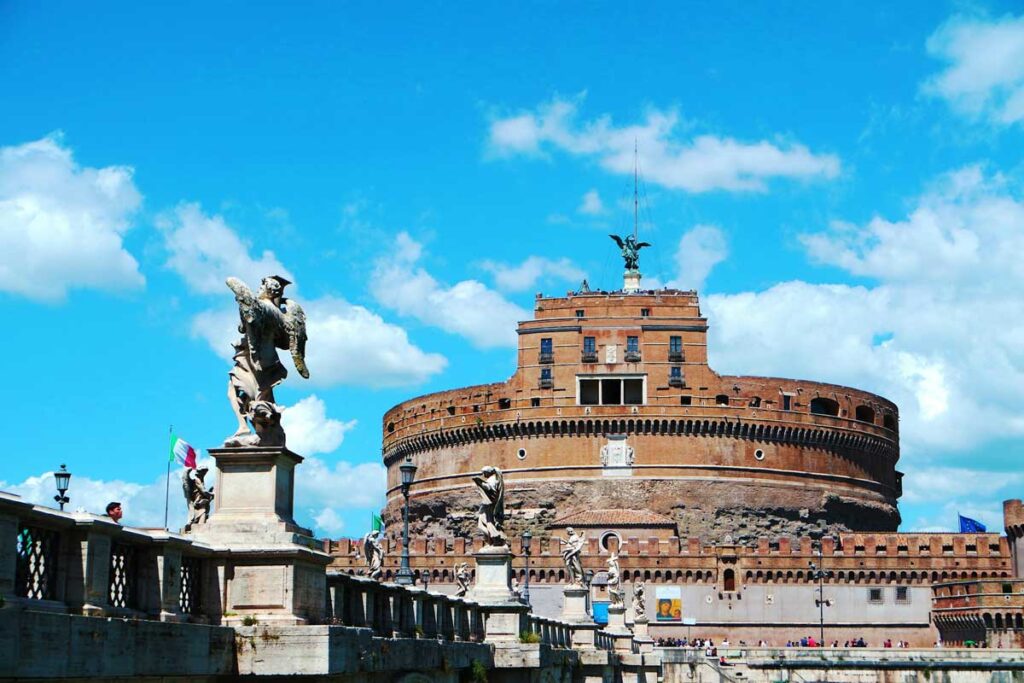
Inside Castel Sant’Angelo: what to see
The museum route follows the building from its original Roman foundations to the rooftop, passing through nearly 1,900 years of history.
The spiral ramp (Dromos): The visit begins with Hadrian’s helical ramp, built to carry imperial sarcophagi from the entrance to the upper mausoleum. It is the best-preserved element of the original 2nd-century structure and gives a clear sense of the building’s engineering scale.
The Courtyard of the Angel and papal courtyards: A series of Renaissance and medieval courtyards link the lower mausoleum levels to the papal apartments above. The Courtyard of the Angel contains the 16th-century marble statue of Archangel Michael, now replaced on the summit by a bronze version.
The papal apartments: The Sala Paolina and adjoining rooms were furnished as a luxurious residence under Pope Paul III (1534–1549). The rooms contain frescoes, ceramics, and sculptures, including work attributed to Perin del Vaga. Note: the Farnese Rooms are currently closed for refurbishment (since November 2025, no reopening date confirmed). The Room of Love and Psyche also remains closed for maintenance since September 2025.
The Armoury and Treasury: These rooms display historic weapons, uniforms, and armour from the 16th to 19th centuries, as well as objects associated with the castle’s role as a papal stronghold and prison.
The Angel Terrace: The highest point of the castle offers a 360-degree panorama over central Rome, including St Peter’s Basilica and dome to the west, the Tiber and Ponte Sant’Angelo below, and the Altare della Patria to the east. The bronze Archangel Michael statue by Peter Anton von Verschaffelt (1752) stands at the summit.
Passetto di Borgo: This 800-metre elevated corridor connecting the castle to the Vatican is accessible only via a separately booked guided tour (approx. €6 supplement). Guided slots run on selected days published on the Musei Italiani calendar; advance booking is recommended in high season.
Practical visitor tips
| Tip | Detail |
|---|---|
| Book in advance | During peak season (March–October), queues without a pre-booked ticket can exceed one hour. Online booking is strongly recommended, especially at weekends. |
| Arrive early or late in the day | The museum is quietest at opening (09:00) and after 17:00. The busiest period is between 10:00 and 15:00, when cruise and tour groups arrive in volume. |
| Bring valid ID | Tickets are nominative. You must present the identity document used when booking – access is refused without it and no refund is given. |
| Wear appropriate footwear | The spiral ramp and upper levels involve long sections of uneven stone and cobbled surfaces. Flat, closed shoes are advisable. |
| Check for current closures | Several rooms are under maintenance as of May 2026. Check the official website before visiting to confirm which areas are open. |
Frequently asked questions about Castel Sant’Angelo
| Question | Answer |
|---|---|
| Is Castel Sant’Angelo open on Mondays? | No. The museum is closed every Monday, as well as on 25 December and 1 January. |
| Do you need to book tickets in advance for Castel Sant’Angelo? | Advance booking is strongly recommended, particularly on weekends and in peak season (March–October). Slots can sell out on busy days. |
| Is Castel Sant’Angelo suitable for children? | Yes. Under-18s enter free regardless of nationality. The route involves stairs and uneven surfaces, so very young children may need to be carried in places. |
| Are large bags allowed at Castel Sant’Angelo? | Large bags and backpacks are not permitted inside the museum. A cloakroom is not currently available; visitors should plan accordingly. |
| Is Castel Sant’Angelo fully wheelchair accessible? | Only partially. The lower floors and some galleries are accessible via ramp and lift, but the upper rooms and Angel Terrace require stairs. Contact the museum in advance to discuss your requirements. |
Things to do near Castel Sant’Angelo
Ponte Sant’Angelo – The pedestrian bridge immediately in front of the castle, lined with ten marble angel statues designed by Bernini. One of the finest vantage points for photographing the castle.
St Peter’s Basilica – Approximately a 10-minute walk west via Via della Conciliazione. The largest church in the world, with Michelangelo’s dome, Bernini’s baldachin, and the Vatican Grottoes below.
Vatican Museums and Sistine Chapel – A 15-minute walk from the castle. Requires a separate ticket; advance booking is essential to avoid long queues.
Piazza Navona – Approximately a 10-minute walk east. One of Rome’s best-known baroque piazzas, featuring Bernini’s Fountain of the Four Rivers and several outdoor cafés.
The Pantheon – Approximately a 20-minute walk south-east. One of the best-preserved buildings of ancient Rome; entry requires a timed ticket booked in advance.
What to visit tomorrow: castles and fortresses near Rome
Castello Orsini-Odescalchi, Bracciano – A well-preserved 15th-century lakeside fortress approximately 40 km north-west of Rome (around 45 minutes by car). The interior rooms are partially open to visitors and contain original furnishings and armour.
Castello di Santa Severa, Santa Marinella – A medieval coastal castle approximately 60 km from Rome (around 1 hour by car). It stands on an Etruscan site, includes a museum, and is directly on the Tyrrhenian Sea.
Castello Caetani, Sermoneta – A medieval fortress in the hilltop town of Sermoneta, approximately 70 km south-east of Rome (around 1 hour by car). Managed by the Caetani Foundation, it is open for guided tours.
Rocca Albornoziana, Spoleto – A 14th-century papal fortress approximately 130 km north of Rome (around 1.5 hours by car). It houses the National Museum of Spoleto and offers views over the valley below.
Rocca dei Papi, Montefiascone – A medieval fortress in the volcanic lake town of Montefiascone, approximately 100 km north of Rome (around 1 hour 20 minutes by car). The tower is open for visits and gives panoramic views over Lago di Bolsena.
More Rome travel
Other Rome travel articles on Planet Whitley include:
- Why a private tour of the Colosseum and Roman Forum is often the best choice.
- A realistic guide to visiting the Pantheon in Rome.
- What to expect at the Baths of Caracalla and Circus Maximus.
- Plan your visit to the Palazzo Altemps in Rome.
- Rome cooking class vs food tour: Which is the best to book?