The Church of St Ignatius of Loyola at Campus Martius (Chiesa di Sant’Ignazio di Loyola in Campo Marzio) is a 17th-century Baroque church in the Campo Marzio district of central Rome, facing the Rococo Piazza di Sant’Ignazio, approximately five minutes’ walk from the Pantheon. This guide covers opening hours, entry, transport, accessibility, what to see inside, and practical visitor tips.
Updated May 2026. The official church website confirms opening hours of 09:00 to 23:30 daily – many third-party guides still list older hours of 07:30 to 19:30, which are no longer accurate. Entry is and has always been free; the church has also issued an updated warning about tour operators falsely charging for entry.
Quick facts
| Opening hours | Daily 09:00–23:30 (no closure during the day) |
| Entry | Free (no ticket required) |
| Address | Piazza di Sant’Ignazio, 00186 Roma |
| Secretariat address | Via del Caravita 8/A, 00186 Roma |
| Nearest bus stop | Largo di Torre Argentina (5–10 min walk) |
| Phone | +39 06 6794406 |
| Typical visit length | 30–60 minutes |
| Dress code | Shoulders and knees must be covered |
Church of St Ignatius of Loyola opening hours
The church is open every day from 09:00 to 23:30, with no break during the day. This applies year-round. There are no separate seasonal timetables.
Visitors should plan around Mass times, during which tourist visits are not permitted. Mass is celebrated Monday to Saturday at 18:30, and on Sundays and public holidays at 11:30 and 18:30. Confessions are heard daily from 10:30 to 12:30 and from 16:00 to 17:30. Allow at least 15 minutes either side of a Mass if you plan to arrive around those times.
5 great Rome experiences to book
- 🏛️ Skip the queues on a small group tour of the Vatican, Sistine Chapel and St Peter’s.
- 🍝 Discover the tastes of Trastevere on an expert-led food tour.
- 💀 See Rome’s darker side on a combo tour of the catacombs and Capuchin Crypt.
- 👩🍳 Learn how to make fettuccine, ravioli and tiramisu at a hands-on Roman cooking class.
- 🖼️ Explore a quieter side of the city on a small group tour of the Villa Borghese Gallery and Gardens.
Church of St Ignatius of Loyola entry
Entry to the Church of St Ignatius of Loyola is free. No ticket is required and no booking is necessary for individual visitors.
The church does not charge for entry and does not receive any payment from tour operators who arrange visits. The church has explicitly warned visitors about individuals and agencies falsely presenting entry fees or charging for self-guided access at the door. If anyone approaches you outside requesting payment for entry, this is a scam – walk past and enter directly.
A small donation (approximately €1) activates the illumination in the nave for a set period, which improves visibility of the ceiling fresco. This is voluntary.
The Church of St Ignatius of Loyola is not included in any Rome city pass scheme, as entry is already free of charge.
Opening hours and entry conditions were checked on the official church website and last updated in May 2026.
Why book the Roma Pass for your visit?
- Free entry to top attractions: Enjoy complimentary admission to many of Rome’s leading museums and archaeological sites with a Roma Pass.
- Public transport included: Use buses, trams and the metro across the city without needing separate tickets throughout the pass validity.
- Flexible duration options: Choose between 48-hour or 72-hour passes to suit how long you’re exploring Rome’s sights.
- Skip-the-line entry: Access select sites faster with priority or skip-the-line benefits where available.
- Cost-effective sightseeing: Save money compared with buying individual tickets, especially if you plan to visit several museums and landmarks.
How to get to the Church of St Ignatius of Loyola
The most practical way to reach the church is on foot from the Pantheon or Piazza Navona, both of which are within a five to ten minute walk. The church is located in the dense historic centre and has no nearby metro station.
- On foot from the Pantheon: Approximately 5 minutes. Turn right out of the Pantheon square and follow Via del Seminario, then Via di Sant’Ignazio into Piazza di Sant’Ignazio.
- On foot from Piazza Navona: Approximately 10 minutes east via Corso del Rinascimento and the lanes behind the Pantheon.
- On foot from Trevi Fountain: Approximately 12–15 minutes west via Via del Corso.
- By bus: Several lines serve Largo di Torre Argentina, a 5–10 minute walk from the church. Bus lines 40, 46, 62, 64, and 492 all stop in that area.
- By metro: The nearest Metro Line A stations are Spagna and Barberini, both approximately 20–25 minutes’ walk. The metro is not the recommended option for reaching this church.
Parking at the Church of St Ignatius of Loyola
There is no dedicated car park at the church. The surrounding streets in the Campo Marzio and Centro Storico districts are in a restricted traffic zone (ZTL), which limits vehicle access for non-residents. Visiting on foot or by bus from a point outside the ZTL is strongly advised. Paid car parks are available at the edge of the historic centre, including options near Via della Conciliazione and Piazza dei Risorgimento to the west, from where the church is reachable in around 20–25 minutes on foot.
How long to spend at the Church of St Ignatius of Loyola
Most visitors spend between 30 and 60 minutes inside. The church follows a straightforward layout that is easy to navigate without a map.
A brief visit to see the ceiling fresco, the fake dome, and the main altars can be done in 30 minutes. Those who read the information panels, visit each side chapel in detail, or attend a voluntary guided tour should allow 90 minutes to two hours. Free guided tours organised by the Jesuit association Pietre Vive run approximately once or twice a month; details are posted inside the church and on the Pietre Vive website.
Accessibility at the Church of St Ignatius of Loyola
The church is partially accessible to wheelchair users via two ramp entrances. The main nave floor is level and accessible once inside. Some of the side chapels may have a shallow step; staff are generally available to assist.
Modest dress is required for entry into this and all Catholic churches in Italy: shoulders and knees must be covered. Visitors without appropriate clothing may be refused entry. Scarves or cover-ups are available from vendors in the surrounding streets if needed.
Inside the Church of St Ignatius of Loyola: what to see
The interior is one of the most elaborately decorated Baroque church interiors in Rome, with three distinct highlights by the Jesuit artist Andrea Pozzo dominating the space.
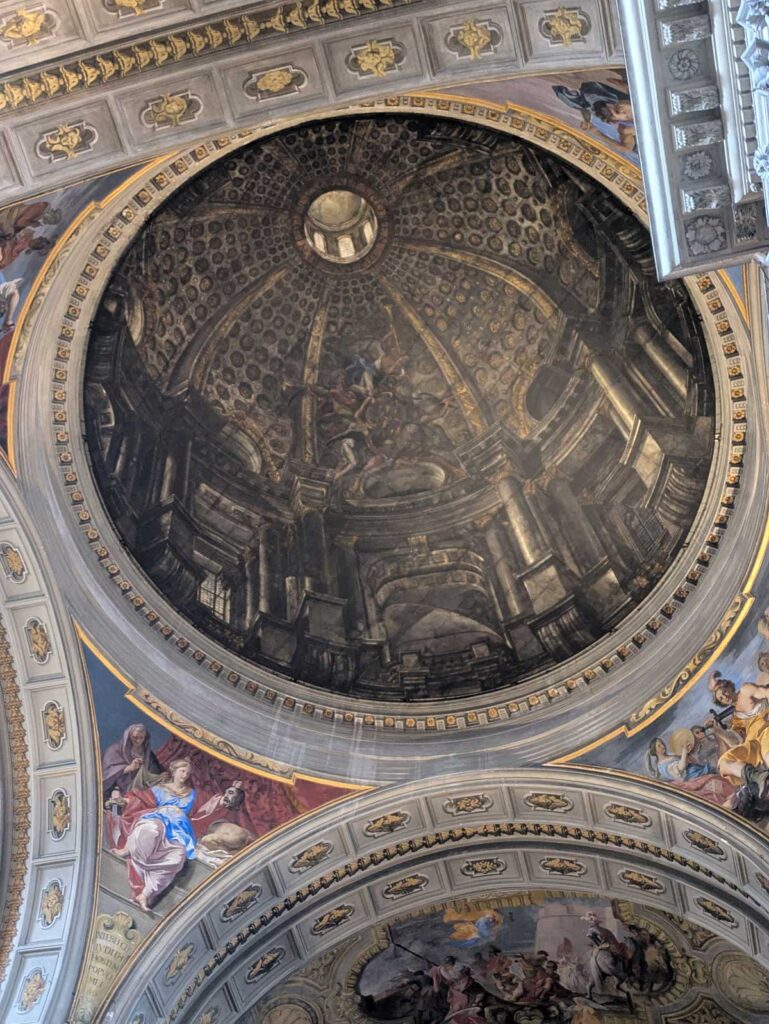
The nave ceiling fresco – The Apotheosis of Saint Ignatius (1685): The largest feature in the church is Pozzo’s vast trompe-l’œil ceiling fresco, which covers the entire vault of the nave. Using illusionistic perspective, Pozzo creates the impression of an open sky and soaring architecture above the flat ceiling surface. The central composition shows St Ignatius ascending to heaven, surrounded by allegorical figures representing Europe, Asia, Africa, and America – a reference to the global reach of the Jesuit missions. A large tilted mirror is positioned in the nave to allow visitors to view the ceiling without craning their necks; there is typically a queue to use it.
The fake dome: Where a real dome would normally sit at the crossing of a Latin cross church, Pozzo painted a trompe-l’œil dome on a flat canvas disc (around 17 metres in diameter) to simulate the visual effect of a genuine cupola. Standing on a marked disc on the nave floor, the illusion is convincing. Moving off the disc reveals the distortion. The dome was painted rather than built after funding ran short.
The presbytery and apse frescoes: Pozzo worked on the presbytery and apse between 1685 and 1701, creating a painted architectural surround that gives the concave apse wall the appearance of a deep, multi-faceted space. The scenes depict key moments from the life of St Ignatius and the founding of the Jesuit order.
The side altars and Jesuit tombs: The right transept holds the altar of St Aloysius Gonzaga, designed by Pozzo, with a lapis lazuli urn containing the saint’s relics beneath it. The Chapel of St Joachim contains the tomb of St Robert Bellarmino. The left Ludovisi Chapel is dedicated to St John Berchmans, with an altarpiece by Filippo della Valle. All three altars are finished in polychrome marble with extensive gilding.
Practical visitor tips
| Tip | Detail |
|---|---|
| Visit early morning or late evening | The church receives large numbers of visitors between 10:00 and 16:00. Arriving at opening (09:00) or after 19:00 substantially reduces queuing at the mirror. |
| Join the queue at the mirror | The tilted mirror is in the nave and always attracts a line. If the queue is very long, explore the side chapels first and return when it has shortened. |
| Entry is free – ignore anyone asking for payment | No agency or individual has the right to charge for self-guided entry. The church has publicly warned against this practice. |
| Dress appropriately before you arrive | Visitors in shorts or sleeveless tops will be refused entry. Keeping a light layer in your bag avoids delay at the door. |
| Do not visit during Mass | Masses at 18:30 on weekdays and at 11:30 and 18:30 on Sundays are not compatible with a tourist visit. Plan your timing around these. |
Frequently asked questions about the Church of St Ignatius of Loyola
| Question | Answer |
|---|---|
| Is the Church of St Ignatius of Loyola free to enter? | Yes. Entry is free with no ticket or booking required. Anyone charging for self-guided entry at the door is operating a scam. |
| Do you need to book in advance for the Church of St Ignatius of Loyola? | No. Individual visitors can enter freely without a reservation during visiting hours, outside of Mass times. |
| Is the Church of St Ignatius of Loyola open on Sundays? | Yes, every day from 09:00 to 23:30. Mass on Sundays is at 11:30 and 18:30; the church is not open to visitors during these times. |
| Is the Church of St Ignatius of Loyola suitable for children? | Yes. Entry is free and the ceiling fresco and fake dome are visually striking for visitors of all ages. The nave mirror is a particular draw for younger visitors. |
| What is the dress code for the Church of St Ignatius of Loyola? | Shoulders and knees must be covered for all visitors. This is enforced at the door and applies regardless of weather or time of day. |
Things to do near the Church of St Ignatius of Loyola
The Pantheon – Approximately a 5-minute walk west. One of the best-preserved buildings of ancient Rome, with a domed interior open to the sky. Entry requires a timed ticket booked in advance.
Santa Maria sopra Minerva – Approximately a 5-minute walk south-west. The only Gothic church in Rome’s historic centre, containing Michelangelo’s Christ the Redeemer sculpture and the tombs of several popes.
Chiesa del Gesù – Approximately a 10-minute walk south-west. The Jesuit mother church in Rome, with a similarly spectacular frescoed ceiling vault by Giovanni Battista Gaulli and the Chapel of St Ignatius of Loyola containing the saint’s remains.
Piazza Navona – Approximately a 10-minute walk west. One of Rome’s most intact Baroque piazzas, featuring Bernini’s Fountain of the Four Rivers and surrounded by outdoor cafés.
Galleria Doria Pamphilj – Approximately a 10-minute walk south-east via Via del Corso. A private art gallery in a palazzo, housing works by Raphael, Caravaggio, Titian, and Velázquez.
What to visit tomorrow: churches and cathedrals near Rome
Orvieto Cathedral (Duomo di Orvieto) – Approximately 1 hour 30 minutes by car north of Rome. A 14th-century Gothic cathedral with a celebrated polychrome mosaic facade and interior frescoes by Luca Signorelli in the Chapel of San Brizio.
Basilica of San Francesco, Assisi – Approximately 2 hours by car or fast train north of Rome. A UNESCO World Heritage Site consisting of upper and lower basilicas decorated with frescoes attributed to Cimabue, Giotto, and Simone Martini.
Sacro Speco Monastery, Subiaco – Approximately 1 hour by car east of Rome. A medieval Benedictine monastery built into the rock above the valley of Subiaco, containing frescoes from the 12th to 15th centuries.
Civita Castellana Cathedral – Approximately 1 hour by car north of Rome. A Romanesque cathedral with a 12th-century cosmatesque portico, considered one of the finest examples of that style in Lazio.
Cathedral of Viterbo (San Lorenzo) – Approximately 1 hour 20 minutes by car north of Rome. A medieval cathedral beside the Palazzo dei Papi (Papal Palace), where several 13th-century papal conclaves were held. Both are open to visitors.
More Rome travel
Other Rome travel articles on Planet Whitley include:
- The Capuchin Crypt – Rome’s most ghoulish attraction. But can you take photos inside Rome’s Capuchin Crypt?
- Guides to ancient sites in Rome: The Temple of Vesta in the Roman Forum, the Pantheon, the Baths of Caracalla, Castel Sant’Angelo and Circus Maximus.
- Why a private tour of the Colosseum and Roman Forum is often the best choice.
- Plan your visit to the Palazzo Altemps in Rome.
- Rome cooking class vs food tour: Which is the best to book?