Devil’s Dyke is a natural chalk valley and historic site situated on the South Downs in Sussex. This planning guide covers opening hours, ticket prices, transport or parking, accessibility, and practical visitor tips.
The site is a popular stop on Seven Sisters and South Downs tours from London.
This guide was updated in May 2026 to reflect the current £8 all-day car parking tariff and the seasonal operations of the 77 bus service.
Quick facts about Devil’s Dyke
| Feature | Details |
| Opening hours | The valley and coastal paths remain open 24 hours a day throughout the year. |
| Ticket prices | Free admission to the site, with all-day car parking costing £8. |
| Address | Devil’s Dyke Road, Near Brighton, West Sussex, BN1 8YJ. |
| Nearest public transport or parking | Devil’s Dyke Car Park is located adjacent to the main valley viewing area. |
| Typical time needed | Two to three hours for a standard visit. |
Devil’s Dyke opening hours
Devil’s Dyke is open 24 hours a day. You can visit the landscape at any time, allowing for early morning hikes or late evening walks regardless of the season.
The site does not have a formal visitor centre, meaning there are no buildings with restricted operating schedules to consider. An adjacent public house provides the only immediate local amenities. It operates independent hours, typically opening from late morning until late evening.
Why book the South Downs and Seven Sisters Explorer?
- 🏔️ Dramatic Seven Sisters Cliffs: Experience one of England’s most iconic coastal landscapes, featuring the series of seven undulating white chalk cliffs that have remained a symbol of the British coastline for centuries.
- 🌊 Beachy Head & Lighthouse: Stand atop the highest chalk sea cliff in Britain to witness breathtaking views of the English Channel and the distinctive red-and-white striped lighthouse situated at the base of the cliffs.
- 🌳 South Downs National Park: Journey through the rolling green hills and ancient woodlands of England’s newest National Park, exploring a diverse landscape that is home to rare wildlife and historic Sussex villages.
- ⛰️ Devil’s Dyke Vistas: Visit Britain’s longest, deepest, and widest dry valley, offering spectacular 360-degree panoramic views over the Weald and across to the sparkling waters of the south coast.
- 🚐 Small-Group Convenience: Escape the bustle of London in a comfortable minivan, allowing for a more personalized experience and access to hidden viewpoints and narrow lanes that larger tour coaches cannot reach.
Devil’s Dyke ticket prices
Devil’s Dyke is free to enter. Opening hours and ticket prices were checked and last updated in May 2026.
While site admission is free, visitors arriving by car must pay the necessary parking fees upon arrival.
How to get to Devil’s Dyke
To get to Devil’s Dyke, motorists should head two miles north of the A27 Brighton ring road, turning off the A281. Drivers using satellite navigation should use the postcode BN1 8YJ or the coordinates provided by the National Trust to locate the car park.
For public transport users, Brighton railway station is located six miles away. From the centre of Brighton, you can take the 77 bus service directly up to the site. This bus operates daily during the summer but runs only on weekends and bank holidays during the winter months.
Alternatively, visit as part of a day tour from London.
Parking at Devil’s Dyke
Parking at Devil’s Dyke requires using the main National Trust car park, which operates a pay and display system. The current vehicle tariffs are £1.65 for up to one hour, £3.30 for up to two hours, and £8 for an all-day ticket.
You must purchase a physical ticket from the machines or use the JustPark mobile application upon arrival. National Trust members and Blue Badge holders can park free of charge. Members must scan their membership cards at the machine to receive a free ticket to display on their dashboard.
How long to spend at Devil’s Dyke
You should plan to spend two to three hours at Devil’s Dyke to complete a standard visit. This timeframe allows you to view the main valley from the top, walk around the Iron Age hill fort ramparts, and explore the immediate grassy paths.
If you intend to hike further along the South Downs Way to Saddlescombe Farm or Ditchling Beacon, you must allocate four to five hours. The extended walking routes involve steep ascents and descents that increase physical exertion and slow down walking speeds.
Accessibility at Devil’s Dyke
Accessibility at Devil’s Dyke is challenging due to the natural geography, steep slopes, and uneven woodland terrain. The paths around the main valley consist of natural grass and soil, which can become deeply muddy and slippery after wet weather.
The steep gradients and lack of paved surfaces make the site difficult for wheelchairs, mobility scooters, and pushchairs. There is a designated Blue Badge parking space in front of the pub by the cycle racks, providing level access to the immediate viewing point.
Inside / what to see at Devil’s Dyke
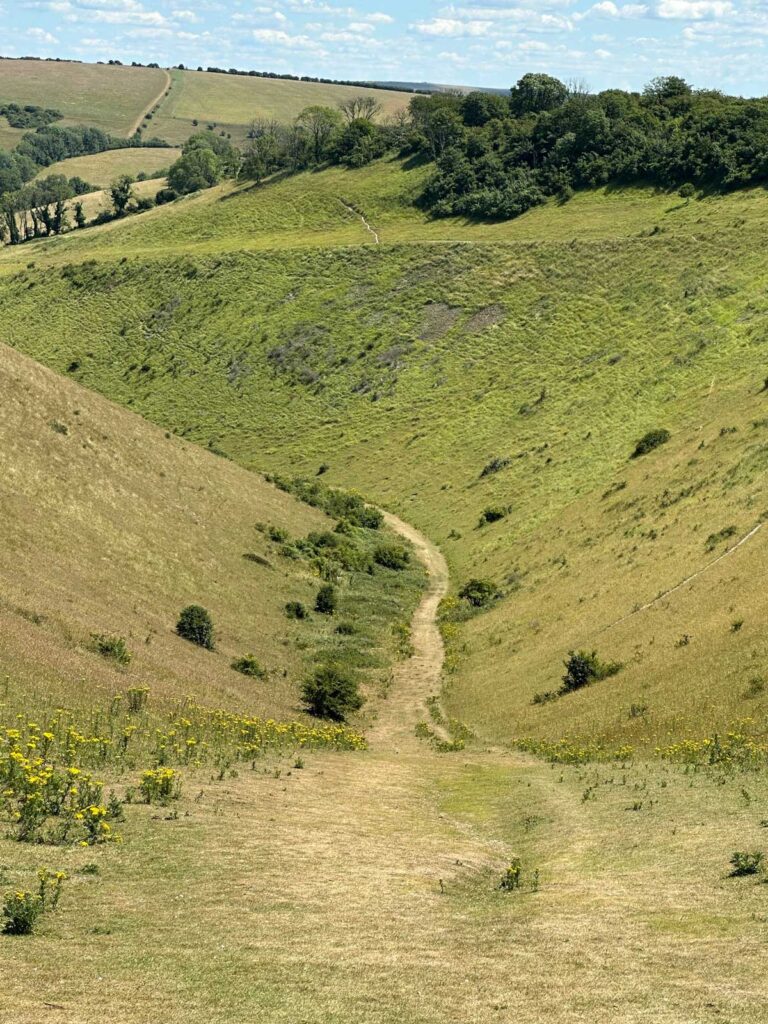
When visiting Devil’s Dyke, the primary feature is the V-shaped dry valley itself. At nearly a mile long, it is a prominent geological formation carved naturally into the chalk landscape during the last ice age.
Visitors walking the upper ridges will encounter the visible earthwork ramparts of an Iron Age hill fort. These ancient defensive walls encircle the top of the hill, offering elevated viewpoints over the surrounding Sussex Weald.
A short walk from the car park reveals the structural remains of a Victorian funfair. This late 19th-century attraction once featured a steep grade railway and a cable car system spanning the valley, though only concrete fragments remain today.
The chalk grassland habitat supports a diverse range of local wildlife and flora. During the spring and summer, visitors can observe rare butterfly species, such as the Adonis blue and chalkhill blue, alongside a living carpet of wildflowers.
Practical visitor tips
| Tip Category | Practical Advice |
| Timing | Arrive before 10:00 am on weekends to secure a parking space before the main car park fills up. |
| Crowds | Visit during weekday mornings in the autumn to experience the landscape with fewer tourists and quieter walking paths. |
| Layout | Wear sturdy walking boots with ankle support, as the descent into the valley involves steep and uneven ground. |
| Entry process | Bring physical coins or download the JustPark application in advance, as mobile signal around the payment machines can fluctuate. |
| On-site logistics | Use the public toilets located within the main car park, as there are no washroom facilities down in the valley. |
Frequently asked questions about Devil’s Dyke
| Frequently Asked Question | Answer |
| Is Devil’s Dyke suitable for children? | Yes, but the steep valley edges and uneven terrain require constant supervision during your visit. |
| Do you need to book tickets in advance for Devil’s Dyke? | No, there is no entry fee for the site, and you cannot reserve car park spaces in advance. |
| Is Devil’s Dyke open on Sundays? | Yes, the natural valley, coastal paths, and car park are open on Sundays throughout the year. |
| Are bags allowed at Devil’s Dyke? | Yes, there are no bag restrictions, but you must carry your possessions while walking the trails. |
| Are dogs allowed at Devil’s Dyke? | Yes, dogs are welcome but must be kept on short leads around grazing livestock and wildlife. |
Things to do near Devil’s Dyke
- Saddlescombe Farm: This historic National Trust farm features ancient buildings and a traditional donkey wheel, located a short walk away.
- Ditchling Beacon: This prominent hill is the highest point in East Sussex, offering extensive views and chalk grassland trails.
- Wolstonbury Hill: This natural landmark features ancient earthworks and extensive beech woodlands, situated a short drive to the east.
- Jack and Jill Windmills: These two restored traditional windmills stand on the South Downs above the nearby village of Clayton.
- Nymans: This National Trust property features extensive romantic gardens and partial house ruins, located further inland near Handcross.
What to visit tomorrow
- Seven Sisters Country Park: This coastal park features dramatic white chalk cliffs and the meandering Cuckmere River winding towards the sea.
- Birling Gap: This enclosed pebble beach sits at the base of the Seven Sisters cliffs, providing direct access to the water.
- Beachy Head: This sheer chalk headland near Eastbourne is the highest coastal cliff in Britain, featuring a prominent lighthouse below.
- Cissbury Ring: This historic site near Worthing contains the largest hill fort in Sussex and features ancient flint mines.
- High Weald Area of Outstanding Natural Beauty: This protected countryside zone offers wooded rolling hills and sandstone outcrops spread across Sussex and Kent.
More Sussex travel
Other Sussex travel guides on Planet Whitley include:
- How to find the Pooh Sticks Bridge in Ashdown Forest.
- How to find Winnie the Pooh’s Heffalump Trap in Ashdown Forest.
- What to see at Brighton’s Royal Pavilion – and what it’ll cost you.
- The crucial information you need before visiting Pevensey Castle in Sussex.
- Fishbourne Roman Palace in West Sussex: Plan your trip to one of England’s most impressive Roman sites.