Rome occupied Britain for nearly 400 years — from the Claudian invasion of AD 43 to the final withdrawal of the legions in AD 410. It left behind an extraordinary quantity of physical evidence: walls, floors, baths, forts, villas and roads that remain clearly legible nearly two millennia later. England has more accessible, high-quality Roman remains than anywhere outside Italy and the Balkans.
This list focuses on sites where genuine Roman fabric is the primary attraction — standing walls, in-situ mosaics, excavated fort interiors, painted plaster. Museums and reconstructions are noted where they add essential context, but the sites below are chosen because the Roman-era material itself is the thing worth travelling for.
1. Hadrian’s Wall, Northumberland
Hadrian’s Wall is the most dramatic Roman monument in Britain and one of the great engineering projects of the ancient world. Begun in AD 122 on the orders of Emperor Hadrian, it stretched for 73 miles across the width of northern England from the Solway Firth to the Tyne — a continuous barrier of stone and turf, punctuated by forts, milecastles and turrets, marking the northern limit of the Roman Empire.
The central section through Northumberland National Park, between Housesteads and Steel Rigg, is where the wall is most complete and the scenery most arresting. The dolerite escarpment of the Whin Sill carries the wall in long curves above a landscape of open moorland that has changed very little since the legions built here. This is a UNESCO World Heritage Site of exceptional integrity.
A guided four-mile walk along Hadrian’s Wall from Newcastle covers the most spectacular central section, including Housesteads Roman Fort, the Stanegate Road, Sycamore Gap and milecastles 37 and 39. The guide takes a historically costumed approach, sharing details — including a hidden Roman carving — that most independent visitors walk past. Walking poles and binoculars are provided. This is the only section of the wall where walking on the actual structure is permitted.
Visitors based in Edinburgh can join a small-group day tour from Edinburgh covering Steel Rigg, Vindolanda and Housesteads Fort with an expert guide — a popular option for those combining Scottish and northern English itineraries. Groups are capped at 16 and admissions to Vindolanda are included.
Other visitable Roman sites on or near the path of Hadrian’s Wall include Corbridge Roman Town and Chesters Roman Fort in Northumberland, plus Birdoswald Roman Fort in Cumbria.
2. Vindolanda, Northumberland
Vindolanda is technically a separate site from Hadrian’s Wall — it predates the wall by several decades, having been established as a series of temporary forts from around AD 85 — but it sits immediately south of the wall’s central section and is almost always visited alongside it. What distinguishes Vindolanda from every other Roman site in Britain is the extraordinary quality of its finds.
The waterlogged, anaerobic conditions beneath the successive fort floors have preserved organic material that normally survives only in desert climates. Leather shoes, wooden combs, textiles and, most famously, the Vindolanda writing tablets — the oldest surviving handwritten documents in Britain, recording everything from requests for leave to birthday party invitations — have emerged from the excavations in remarkable condition. The museum on site houses the best Roman finds collection outside London.
Vindolanda is also an active excavation site. Visitors in season can watch archaeologists at work. Given that only around 15 per cent of the site has been excavated so far, it continues to produce significant finds year after year. The combination of substantial visible fort remains, the museum and the living nature of the archaeology makes this one of the most rewarding Roman sites in the country.
For more detail, read my practical guide to visiting Vindolanda.
3. The Roman Baths, Bath (Aquae Sulis)
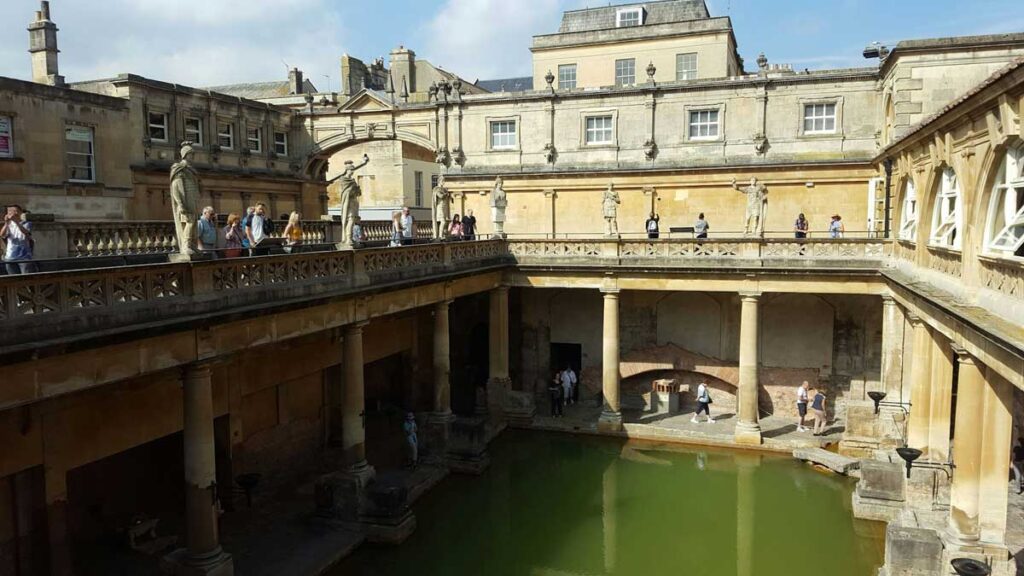
The Roman Baths at Bath are the finest surviving Roman structure in Britain. The great bath — a lead-lined pool fed by the natural hot spring, surrounded on three sides by a colonnade and open to the sky — was constructed in the late 1st century AD and is still filled by the same spring at exactly the same temperature it has maintained for 10,000 years. The spring at Bath issues 1.17 million litres of water per day at 46°C. The Romans built their sacred complex, dedicated to the goddess Sulis Minerva, directly over it.
The gilded bronze head of Sulis Minerva and the extraordinary pediment of the temple — carved with a gorgon’s head of unique ferocity — are among the finest pieces of Romano-British sculpture anywhere. The sacred spring itself, its water a deep, otherworldly green from the iron and other minerals, is visible in a chamber directly below the street level of Georgian Bath. You can stand at its edge and look at water that has been flowing continuously since before the Roman invasion.
A Blue Badge guided walking tour with fast-track entry to the Roman Baths covers the city’s Roman and Georgian heritage with a licensed guide before entering the baths complex — avoiding queues, which at peak season can be considerable. Reviewers note that sold-out days are not unusual; pre-booked entry is strongly advisable. For visitors travelling from London, a guided day trip combining Bath and Stonehenge from London includes optional Roman Baths entry alongside expert coach commentary.
If you’re planning to visit independently, my guide to the Roman Baths of Bath should help.
4. Fishbourne Roman Palace, West Sussex
Fishbourne Roman Palace near Chichester is the largest known Roman residence in Britain, and its mosaics are among the finest north of the Alps. The palace was built around AD 75, possibly for the pro-Roman British king Togidubnus, and its scale — covering an area equivalent to several football pitches — reflects a client kingdom operating at the very top of Roman imperial culture.
More than 20 mosaic floors survive in-situ and are accessible under a purpose-built museum structure that allows visitors to walk above them on raised walkways. The Cupid on a Dolphin mosaic in the north wing is the most celebrated, but the overall collection, ranging from simple geometric patterns to complex figured scenes, gives a more comprehensive picture of Roman floor art than any comparable site in England. The reconstructed Roman garden — laid out to the plan revealed by excavation — is the only one of its kind in northern Europe.
Fishbourne is managed by the Sussex Archaeological Society and sits on the western edge of Chichester, Sussex. The site is exceptionally well presented and the admission price is modest relative to the quality of what is on show.
For more information, read the full guide to Fishbourne Roman Palace.
5. Chedworth Roman Villa, Gloucestershire
Chedworth Roman Villa in the Gloucestershire Cotswolds is the most complete villa complex in Britain. Built in the 2nd century and extensively remodelled through the 4th, it includes two sets of bath houses, a nymphaeum (a water shrine), extensive ranges of rooms and four distinct mosaic floors — all set in a wooded combe that has protected the site from agricultural disturbance for centuries.
The 4th-century mosaics at Chedworth are remarkable for their survival and their quality. The Seasons mosaic, with its personifications of winter and spring in roundels, and the hunting scene visible in the west range are among the finest late-Roman floor decorations in the country. A new museum building, opened in 2012, provides all-weather access to the principal mosaics while the wider grounds — including the visible wall footings of numerous rooms — can be explored on foot.
Chedworth is a National Trust property, freely accessible to members. The rural setting is exceptional, and the combination of Roman archaeology and Cotswold woodland makes it a genuinely distinctive visit. It is best reached by car; public transport connections are limited.
6. Wroxeter (Viroconium Cornoviorum), Shropshire
Wroxeter was the fourth-largest city in Roman Britain — a full-scale provincial city of perhaps 15,000 inhabitants, with a forum, basilica, baths complex and the full infrastructure of Roman urban life. It was abandoned rather than built over after the Roman withdrawal, which is why its remains are so legible today.
The centrepiece of the site is the Old Work — a section of the municipal baths wall rising to approximately 8 metres, the largest freestanding piece of Roman masonry in England outside Hadrian’s Wall. It stands in open farmland with a directness that is almost shocking: a 2nd-century urban building facade, preserved by its own weight and by the absence of subsequent development. The English Heritage site around it includes extensive excavated remains of the basilica exercise hall and a small museum of finds from the city.
What Wroxeter offers that more visited sites do not is a sense of Roman urbanism in a rural setting — the impression of a city that simply stopped, was slowly absorbed by the landscape, and is now being read back out of it by archaeology. On a quiet day, it is one of the more contemplative Roman experiences in England.
Again, I’ve written a more detailed guide to visiting the Wroxeter Roman City site.
7. Richborough (Rutupiae), Kent
Richborough in Kent is where Roman Britain began. The Claudian invasion force of AD 43 landed near here, and the Romans built their first permanent supply base and triumphal monument on this low hill above what was then a tidal channel. For the first century of the occupation, Richborough was the principal port of entry to the province — the first thing most Romans saw of Britain and the last thing they saw on leaving it.
The massive walls of the Saxon Shore fort, built in the late 3rd century as coastal defence became critical, survive to considerable height — up to 8 metres in places — and enclose a substantial area. Within them, the outline of the enormous triumphal arch built in the late 1st century is marked in the ground: the central concrete core that supported the arch still rises several metres above the surrounding surface, the largest surviving piece of masonry from the early occupation period.
Richborough is managed by English Heritage and is relatively little visited despite its historical significance. The combination of the fort walls, the arch core, the foundation trenches of successive early forts visible in the turf and a small museum of extraordinary finds — including pieces of the marble facing stripped from the arch — makes this one of the most historically resonant sites in England.
To plan a trip, read my detailed visitor guide to Richborough Roman Fort and Amphitheatre.
8. The Roman Painted House, Dover
The Roman Painted House in Dover, Kent, is the finest example of in-situ Roman wall painting north of the Alps. Discovered during construction work in 1970, it preserves approximately 400 square metres of painted plaster in a room that formed part of a late 2nd-century mansio — a state guesthouse for officials crossing the Channel. The walls rise to around 2 metres and carry an elaborate architectural scheme of painted columns, panels and garden scenery in strong reds, greens and yellows.
The paintings have been enclosed in a purpose-built museum directly above the excavation, accessible year-round. The site is small and quietly extraordinary — it requires some effort of imagination to project these painted walls back into their original context, but the quality of the work, and the sheer improbability of its survival beneath 1,800 years of Dover development, makes the exercise worthwhile. The adjacent town defences include a section of Roman painted wall visible through a glass panel in the museum floor.
Dover also has the Roman Pharos — a lighthouse dating from the 2nd century — standing to much of its original height within the grounds of Dover Castle, making it possible to visit two quite different Roman structures in a single trip to the town.
9. Jewry Wall, Leicester (Ratae Corieltavorum)
The Jewry Wall in Leicester is one of the largest pieces of standing Roman masonry in England — approximately 9 metres high and 29 metres long, with three arched recesses that once opened into the exercise hall of the public baths. It has stood in the centre of Leicester since the 2nd century, embedded in the city’s subsequent development but never demolished. The adjacent medieval church of St Nicholas was built directly against it, treating the Roman wall as a pre-existing foundation.
The wall stands beside the Jewry Wall Museum, which houses an outstanding collection of Roman material from Leicester and the surrounding area — including mosaic floors recovered from elsewhere in the city and a remarkable range of finds that paint a picture of a prosperous Romano-British town. The museum is one of the strongest Roman collections in England outside London and is free to enter.
Leicester’s Roman remains are not limited to the Jewry Wall. The street plan of the modern city centre still largely follows the Roman grid, and substantial sections of the city wall foundations are visible at various points. For visitors with archaeological interests, a morning in Leicestershire is a more rewarding Roman experience than many better-known sites.
10. Roman London (Londinium)
Londinium was the commercial capital of Roman Britain — not the first city (that was Colchester), but by the 2nd century the largest and most important. The Roman city lies beneath the modern Square Mile, and fragments of it surface at intervals — in construction excavations, in museum basements and in stretches of the ancient wall that survived into the medieval period.
The most accessible Roman remains in the city include the London Wall fragments at Tower Hill and in the Barbican; the Temple of Mithras (London Mithraeum), reassembled in its original position beneath the Bloomberg building near Cannon Street, with an atmospheric free museum above; and the foundations of the Roman amphitheatre visible beneath the Guildhall Art Gallery. The amphitheatre’s outline is also marked in the cobbles of the Guildhall yard above.
A private Roman London walking tour navigates the nooks and layers of the City of London to connect the surviving fragments of Londinium into a coherent whole — Roman walls, baths, the amphitheatre footprint, the forum site and the river defences — with commentary from a specialist guide. This is the most efficient way to understand Roman London’s topography, which requires knowledge of what lies beneath rather than what stands above.
Practical tips for visiting Roman sites in England
English Heritage and National Trust membership
English Heritage manages Hadrian’s Wall (including Housesteads), Richborough, Wroxeter and the Roman Painted House at Dover — all covered by a single annual membership. Chedworth is National Trust. The Roman Baths in Bath are operated independently by Bath and North East Somerset Council and require a separate ticket. Fishbourne is managed by the Sussex Archaeological Society. Vindolanda is independently managed with its own admissions. The London Mithraeum and Guildhall are free.
Is it worth paying for English Heritage membership?
Entry prices for English Heritage sites, including Dover Castle, Stonehenge and Tintagel Castle, can seem extremely expensive. This is clearly a deliberate ploy to push visitors towards taking out annual English Heritage membership.
Membership gives free access to more than 400 sites across the country, and costs £82. That is, unless you get a special deal – there was a 25%-off Black Friday deal in November 2025, for example.
Whether that £82 is worth it depends on how many sites are near you (there are lots in the south of the country, not so many near me in Yorkshire). And, critically, whether you’re going to visit them with children.
Each member can take up to six children with them free of charge. Given the steep one-time entry fees, an adult member with two children is likely to recoup the cost of their membership by visiting just two or three sites within the year.
For an individual without children, I’d say English Heritage membership is worth it only if you’re planning to blitz a few sites in one year. For an individual with children, membership is a smart investment that will likely pay itself back within one school holiday. To me, it’s a no-brainer.
The real question is whether it’s worth renewing English Heritage membership after a year. That’s debatable, as you’re unlikely to go to many of these sites twice. I eventually renewed after I was offered 20% off the price. I’ll probably recoup the membership price visiting two sites in summer next year, even if I’ve ticked off most of the best ones near me.
If you buy membership through this link, I earn a small commission at no extra cost to you.
The best time to visit Hadrian’s Wall
The central section of the wall is exposed and cold from October to April, and the paths can be very muddy after rain. May to September gives the best weather and the longest daylight. The Hadrian’s Wall Bus (AD122) runs seasonally between May and September, connecting the main sites — an excellent option for walkers who do not want to retrace their steps. Housesteads car park fills by mid-morning on summer weekends; arriving by 9am avoids the worst congestion.
What to look for
Roman masonry is typically distinguished by its use of tile courses — bands of thin red Roman bricks built into stonework at regular intervals to level up courses and distribute weight. You can see this clearly in the Jewry Wall, in Richborough’s fort walls and throughout the surviving London Wall. Hypocaust systems — the underfloor heating that kept baths and wealthy rooms warm — are visible at Bath, Chedworth and Fishbourne: rows of tile pilae (small pillars) supporting a raised floor above a heated void. Once you know what you are looking for, these details become legible at virtually every Roman site in England.