Seven Sisters Country Park is a 280-hectare landscape consisting of chalk cliffs, a meandering river valley, and open chalk downland located in Exceat, Sussex. This planning guide covers opening hours, ticket prices, transport or parking, accessibility, and practical visitor tips.
The site is a key highlight on Seven Sisters and South Downs tours from London.
This guide was updated in May 2026 to reflect the current £7 all-day car parking tariff and the availability of pre-bookable mobility scooters at the visitor centre.
Quick facts about Seven Sisters Country Park
| Feature | Details |
| Opening hours | The country park remains open 24 hours a day, while the visitor centre opens at 10:00 am daily. |
| Ticket prices | Free entry to the site, with all-day car parking costing £7.00. |
| Address | Seven Sisters Country Park, Exceat, Seaford, East Sussex, BN25 4AD. |
| Nearest public transport or parking | Riverside (South) and Forest (North) car parks are located on-site. |
| Typical time needed | Three to four hours for a standard visit. |
Seven Sisters Country Park opening hours
Seven Sisters Country Park opening hours run continuously, as the natural parkland, river valley, and coastal paths remain open 24 hours a day throughout the year. You can walk the trails and access the beach at any time, allowing for early morning or late evening visits regardless of the season.
The visitor centre, which houses the main exhibitions, and the adjacent grab-and-go kiosk open daily at 10:00 am. During the peak summer months, these indoor facilities close at 5:00 pm, but they reduce their operating hours to close at 4:00 pm during the quieter winter season between November and March. The main public toilets are open from 7:00 am to 9:00 pm in summer, and close at 6:00 pm during the winter.
Why book the South Downs and Seven Sisters Explorer?
- 🏔️ Dramatic Seven Sisters Cliffs: Experience one of England’s most iconic coastal landscapes, featuring the series of seven undulating white chalk cliffs that have remained a symbol of the British coastline for centuries.
- 🌊 Beachy Head & Lighthouse: Stand atop the highest chalk sea cliff in Britain to witness breathtaking views of the English Channel and the distinctive red-and-white striped lighthouse situated at the base of the cliffs.
- 🌳 South Downs National Park: Journey through the rolling green hills and ancient woodlands of England’s newest National Park, exploring a diverse landscape that is home to rare wildlife and historic Sussex villages.
- ⛰️ Devil’s Dyke Vistas: Visit Britain’s longest, deepest, and widest dry valley, offering spectacular 360-degree panoramic views over the Weald and across to the sparkling waters of the south coast.
- 🚐 Small-Group Convenience: Escape the bustle of London in a comfortable minivan, allowing for a more personalized experience and access to hidden viewpoints and narrow lanes that larger tour coaches cannot reach.
Seven Sisters Country Park ticket prices
The chalk cliffs, river trails, and visitor centre are completely free to enter. Opening hours and ticket prices were checked on the official website and last updated in May 2026.
While you do not need an admission ticket, visitors travelling by car must pay the estate parking fees upon arrival.
How to get to Seven Sisters Country Park
To get to Seven Sisters Country Park, motorists should follow the A259 coastal road connecting Eastbourne and Seaford. Drivers using a satellite navigation system should use the postcode BN25 4AD to locate the main visitor car parks situated at Exceat.
For public transport users, the Coaster 12, 12A, and 12X bus routes operate frequently between Brighton and Eastbourne, stopping directly outside the park entrance. During weekends, the Sussex Arts Shuttle (route 39) also serves the park, providing convenient connections to nearby mainline railway stations at Seaford and Eastbourne.
Alternatively, visit as part of a day tour from London.
Parking at Seven Sisters Country Park
Parking at Seven Sisters Country Park requires using either the Riverside (South) or Forest (North) car parks, which operate an automatic number plate recognition system. The current vehicle tariffs are £3.50 for up to two hours, £5.00 for up to four hours, and £7.00 for an all-day stay.
You must pay for your parking before leaving the site using the payment machines located in the car parks, which accept both card and contactless payments. The revenue generated from these parking charges directly funds the conservation and maintenance of the landscape by the South Downs National Park Authority.
How long to spend at Seven Sisters Country Park
You should plan to spend three to four hours at Seven Sisters Country Park to complete a standard, unhurried visit. This timeframe allows you to walk from the visitor centre down to the shingle beach, view the chalk cliffs, and return via the inland valley trails.
If you intend to hike over the cliffs towards Birling Gap or explore the woodland trails within Friston Forest, you must allocate a full day for the combined experience. The extended walking routes involve steep coastal inclines and uneven terrain that significantly slow down your average walking speed.
Accessibility at Seven Sisters Country Park
Accessibility at Seven Sisters Country Park is well-supported by the dedicated Easy Access Trail, which provides a flat, two-kilometre concrete path suitable for wheelchairs and pushchairs. This designated route follows the valley floor directly from the visitor centre down to the shingle beach at the mouth of the River Cuckmere, meaning disabled visitors can reach the coast safely.
The visitor centre offers free mobility scooters for hire specifically to help visitors navigate this accessible path, though pre-booking is strongly advised. The site also features a fully equipped Changing Places toilet located near the visitor centre and the North Car Park, ensuring comprehensive washroom facilities for disabled visitors.
Inside / what to see at Seven Sisters Country Park
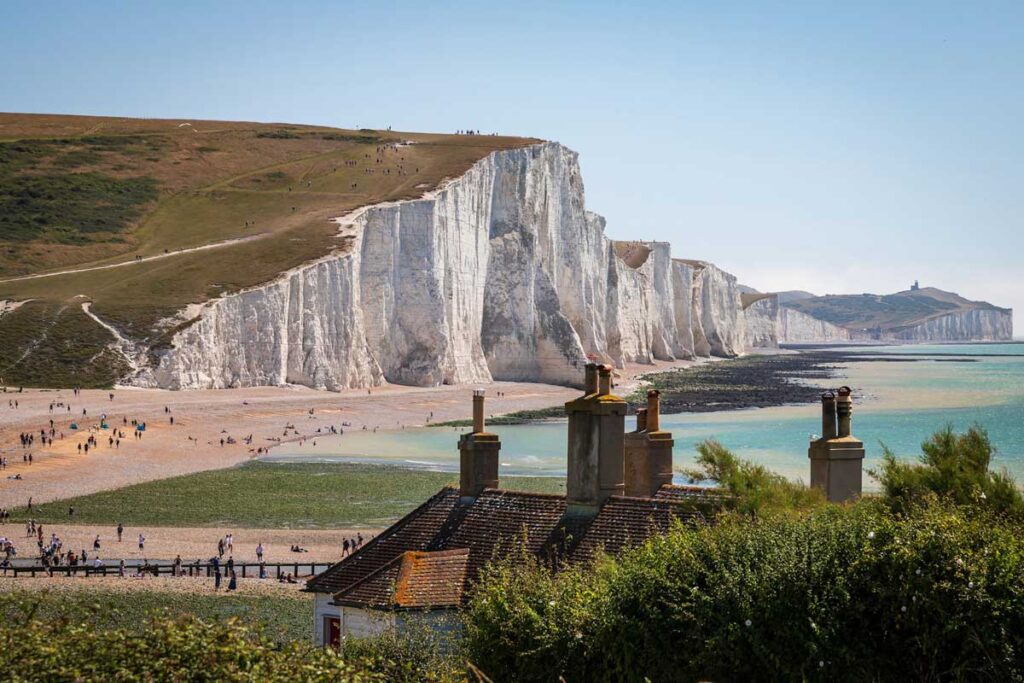
When visiting Seven Sisters Country Park, the primary attraction is the uninterrupted view of the white chalk cliffs. Visitors walking down to the shingle beach can look eastwards to see the sheer cliff faces, which formed at the bottom of the sea over 65 million years ago.
The River Cuckmere meanders through the centre of the park, creating a broad, flat valley floor before flowing out into the English Channel. This tidal river environment supports a diverse habitat of saltmarshes and lagoons, offering clear opportunities for birdwatching and wildlife photography.
The newly refurbished Visitor Centre contains educational exhibits detailing the natural geography, maritime history, and local wildlife of the South Downs. Interactive displays and tactile installations help explain how continuous marine erosion shapes the ever-changing coastline over time.
A network of distinct walking trails crisscrosses the landscape, including the South Downs Way, which runs directly over the top of the chalk cliffs. These elevated cliffside paths provide broad views across the English Channel and the rolling hills of the Sussex Weald.
Just across the main road from the visitor centre lies Friston Forest, a large area of mature beech woodland. This contrasting inland environment offers sheltered walking routes and dedicated cycling trails that navigate through the dense tree canopy and ancient flint walls.
Practical visitor tips
| Tip Category | Practical Advice |
| Timing | Arrive before 10:00 am during the summer holidays to secure a parking space in the popular Riverside car park. |
| Crowds | Visit during weekday afternoons in the spring or autumn to experience the valley trails with fewer tourists. |
| Layout | Wear sturdy walking boots if you plan to leave the concrete path, as the grassy valley floor becomes waterlogged. |
| Entry process | Remember your exact vehicle registration number when you park, as the automatic system requires it for payment upon exit. |
| On-site logistics | Use the public toilets located at the visitor centre, as there are no washroom facilities down by the beach. |
Frequently asked questions about Seven Sisters Country Park
| Frequently Asked Question | Answer |
| Is Seven Sisters Country Park suitable for children? | Yes, the flat valley floor is ideal for families, but sheer cliff edges require strict supervision. |
| Do you need to book tickets in advance for Seven Sisters Country Park? | No, there is no entry fee for the park, and you cannot reserve standard car park spaces in advance. |
| Is Seven Sisters Country Park open on Sundays? | Yes, the park grounds, the visitor centre, and the car parks are open on Sundays year-round. |
| Are bags allowed at Seven Sisters Country Park? | Yes, there are no bag restrictions, but you must carry all your possessions while walking the trails. |
| Are dogs allowed at Seven Sisters Country Park? | Yes, dogs are welcome but must be kept on short leads around grazing livestock and cliff edges. |
Things to do near Seven Sisters Country Park
- Cuckmere Haven: This pebble beach sits at the river mouth and offers direct views of the chalk cliffs without requiring visitors to hike over the steep hills.
- Friston Forest: This large beech woodland features dedicated walking and cycling trails directly adjacent to the country park, offering a sheltered alternative to the windy coastal paths.
- Seaford Head: This local nature reserve offers a prominent viewpoint looking back across the Seven Sisters cliffs, situated on the opposite side of the river mouth.
- Alfriston Clergy House: This historic 14th-century thatched timber-framed house was the first building ever purchased by the National Trust and features a classic cottage garden.
- Birling Gap: This enclosed pebble beach sits further east along the base of the cliffs, providing direct access to the sea and shallow rock pools during low tide.
What to visit tomorrow
- Beachy Head: This sheer chalk headland near Eastbourne is the highest coastal cliff in Britain, featuring a prominent red and white lighthouse standing in the sea below.
- Devil’s Dyke: This prominent V-shaped dry chalk valley on the South Downs features extensive walking trails, historic earthworks, and a traditional public house on the summit.
- Hastings Country Park: This large coastal nature reserve features sandstone cliffs, deep glens, and woodland trails overlooking the English Channel, located an hour’s drive east.
- Ditchling Beacon: This prominent hill is the highest point in East Sussex, offering chalk grassland trails and broad views over the surrounding Weald landscape.
- Cissbury Ring: This historic countryside site near Worthing contains the largest hill fort in Sussex and features ancient flint mines set within open chalk downland.
More Sussex travel
Other Sussex travel guides on Planet Whitley include:
- How to find the Pooh Sticks Bridge in Ashdown Forest.
- How to find Winnie the Pooh’s Heffalump Trap in Ashdown Forest.
- What to see at Brighton’s Royal Pavilion – and what it’ll cost you.
- The crucial information you need before visiting Pevensey Castle in Sussex.
- Fishbourne Roman Palace in West Sussex: Plan your trip to one of England’s most impressive Roman sites.