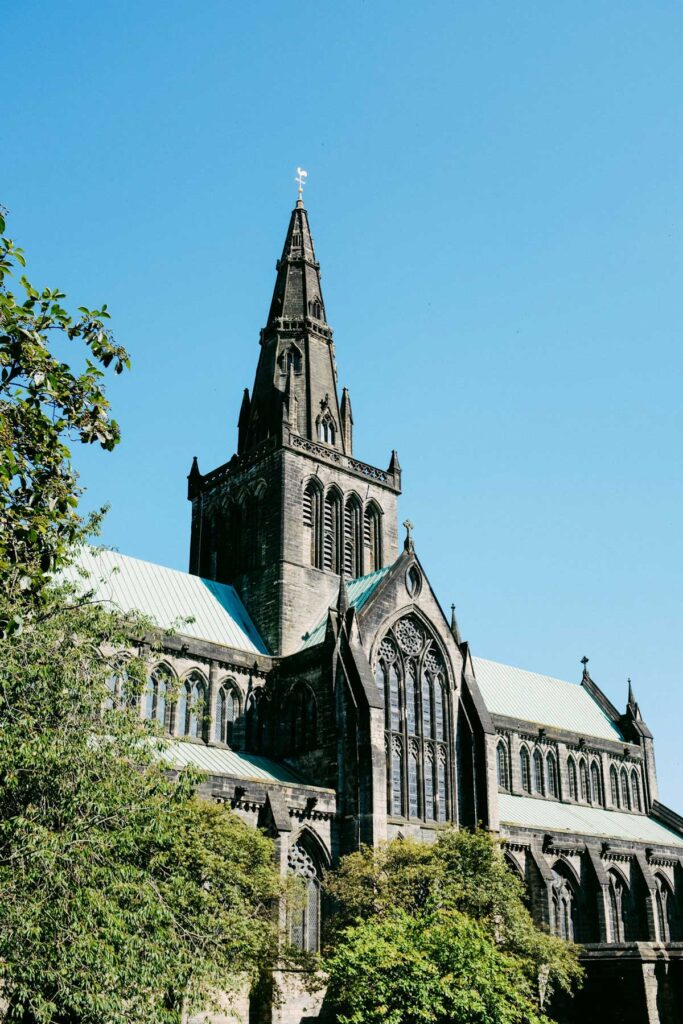
Glasgow Cathedral is a medieval gothic church and historic site located on Castle Street in the centre of Glasgow. This guide covers opening hours, ticket prices, transport or parking, accessibility, and practical visitor tips. This guide was updated in May 2026 to reflect current entry policies, noting the continuation of free walk-up entry without the need to book timed slots in advance.
Quick facts
| Opening hours | April to September: Mon-Sat 10am to 5pm, Sun 1pm to 5pm. October to March: Mon-Sat 10am to 4pm, Sun 1pm to 5pm. |
| Ticket prices | Free entry, with voluntary donations welcomed. |
| Address | Castle St, Glasgow G4 0QZ. |
| Nearest public transport | High Street train station (ten-minute walk). |
| Typical time needed | One to two hours. |
Glasgow Cathedral opening hours
Glasgow Cathedral opens to visitors from 10am to 5pm from Monday to Saturday, and from 1pm to 5pm on Sundays during the summer season running from April to September. During the winter months from October to March, the hours reduce slightly to 10am to 4pm from Monday to Saturday, while Sunday access remains 1pm to 5pm. Last entry is permitted 30 minutes before the stated closing time throughout the year.
The building completely closes to all sightseers every day between 12pm and 1pm for lunch. You should also check the official calendar before travelling, because the venue regularly closes to tourists for religious services, civic events, graduations, and choral rehearsals.
Glasgow Cathedral ticket prices
General admission to Glasgow Cathedral is completely free of charge for all visitors, which makes it one of the best Gothic cathedrals in the UK for visitors. The church and its historic structure are maintained by Historic Environment Scotland, and contactless donation points are positioned near the entrance if you wish to make a voluntary financial contribution towards ongoing conservation work.
Opening hours and ticket prices were checked on the official website and last updated in May 2026.
How to get to Glasgow Cathedral
The most straightforward way to get to Glasgow Cathedral is by using the local rail network, as the site sits a ten-minute walk from High Street train station. Visitors arriving at this station must exit and walk directly north up High Street and Castle Street. This route involves navigating a steady, moderate incline to reach the cathedral precinct. If you are arriving at Glasgow Queen Street or Glasgow Central stations, the walk takes approximately 20 to 25 minutes through the central city grid.
Visitors arriving by bus will find multiple local services that stop on Castle Street directly next to the adjacent Glasgow Royal Infirmary. These bus stops provide the most direct access for visitors who wish to avoid walking up the hill. If you are driving into the city, you should exit the M8 motorway at junction 15. This exit leaves you just a few hundred metres from the main cathedral grounds.
Parking at Glasgow Cathedral
There is no dedicated visitor car park directly on the grounds at Glasgow Cathedral, as the immediate precinct area is entirely pedestrianised. Visitors travelling by car should use the Cathedral Precinct public pay-and-display car park. This multi-storey facility is operated by the local council and located roughly 80 metres from the west door on Cathedral Street.
There are no designated on-street Blue Badge parking bays immediately outside the main entrance. However, visitors with mobility issues can use a designated drop-off point located directly within the Cathedral Square Precinct to avoid navigating the pedestrianised approach from the main road.
How long to spend at Glasgow Cathedral
Most visitors spend between one and two hours at Glasgow Cathedral to explore the main nave, view the architectural features, and descend the stone steps into the lower church. This timeframe provides enough time to read the provided historical plaques and use the free digital audio guide without feeling rushed.
If you plan to join a volunteer-led guided highlights tour or attend a choral evensong service, you should allow at least two hours. Visitors should also factor in additional time if they wish to explore the adjacent Glasgow Necropolis. This Victorian garden cemetery is situated on the hill immediately behind the cathedral grounds and requires extra time to walk.
Accessibility at Glasgow Cathedral
Glasgow Cathedral provides level access into the main nave via the western doors, though the main entrance features a small lip. A dedicated platform lift operated by staff members is available on the right side of the western doors to bypass the main entrance steps. A second stair lift provides level access up into the elevated choir area for wheelchair users.
The Blacader Aisle and the lower crypt are not accessible for wheelchair users or those with limited mobility. These historic areas are reached via steep medieval stone steps without lift access. The venue does not have public toilets inside the building, so visitors must use the accessible facilities located directly across the precinct at the St Mungo Museum.
Inside / what to see at Glasgow Cathedral
The lower church is a large 13th-century crypt that houses the tomb of Saint Mungo, the patron saint and historical founder of the city of Glasgow. This subterranean area features complex vaulted stone arches and remains a quiet space dedicated to reflection and private prayer.
The central nave features a highly detailed wooden timber roof, which was completely reconstructed following the end of the Second World War. The walls surrounding this main seating area are lined with a significant collection of post-war stained glass windows. This collection includes the large Millennium Window, which was installed in 1999 to mark the turning of the century.
The Blacader Aisle is a late 15th-century extension built directly over an earlier, older cemetery site. This distinct architectural section is named after Archbishop Robert Blackadder, who commissioned its construction and oversaw the installation of its impressive late Gothic stone ceiling vaulting.
The central quire sits elevated above the main nave floor and is visually separated by a detailed 15th-century carved stone screen known as the pulpitum. This elevated section features the main altar and dedicated seating for the professional choir, who perform during regular Sunday services.
The chapter house is a separate square room accessed via a small flight of steps, originally built for the cathedral clergy to hold formal meetings. This room features a central stone pillar that supports the vaulted ceiling above, representing traditional medieval ecclesiastical design.
Practical visitor tips
| Tip category | Advice |
| Timing | Arrive immediately after the daily lunch closure at 1pm to explore the lower church before it becomes congested. |
| Crowds | The narrow stone steps leading down to the tomb of Saint Mungo can become bottlenecks during peak weekend afternoons. |
| Layout | Purchase or download the digital audio guide on your mobile phone before you arrive to avoid relying on mobile data inside. |
| Entry process | You do not need to queue for a formal ticket, but volunteer stewards will welcome you at the main western doors. |
| On-site logistics | Bring a bottle of water with you, as there is no on-site café and only bottled water is permitted inside the main building. |
Frequently asked questions about Glasgow Cathedral
| Question | Answer |
| Is Glasgow Cathedral suitable for children? | Yes, the cathedral welcomes families and offers a fun fact-finding explorer quiz for younger visitors to complete. |
| Do you need to book tickets in advance for Glasgow Cathedral? | No, you do not need to book in advance for general admission, as walk-up entry is permitted throughout the day. |
| Is Glasgow Cathedral open on Sundays? | Yes, but general sightseeing access is restricted to the afternoon to accommodate morning worship services. |
| Are bags allowed at Glasgow Cathedral? | Yes, visitors can bring standard day bags, but large luggage should be avoided due to the lack of on-site lockers. |
| Are dogs allowed inside Glasgow Cathedral? | No, general pet dogs are not permitted inside the building, but registered assistance dogs are fully welcome. |
Things to do near Glasgow Cathedral
- St Mungo Museum of Religious Life and Art: A public museum exploring global religions through art and historical artifacts, located directly across the pedestrian precinct.
- Provand’s Lordship: The oldest remaining residential house in the city, originally built in 1471 and featuring 17th-century historic furniture.
- The Glasgow Necropolis: A large Victorian garden cemetery located on a steep hill behind the cathedral, offering panoramic views across the city skyline.
- Tennent Caledonian Breweries: A historic local brewery offering guided factory tours and beer tasting sessions located a short walk down the hill.
- Glasgow Green: A large historic public park featuring the terracotta Doulton Fountain and the People’s Palace social history museum.
What to visit tomorrow
- Stirling Castle: A large Renaissance royal palace and military fortress situated roughly 45 minutes northeast of the city.
- Edinburgh Castle: A historic fortress and royal residence dominating the skyline of the capital, located roughly one hour east of Glasgow. Book tickets in advance or a tour might be your only option to get in.
- Paisley Abbey: A 12th-century medieval abbey known for its Gothic architecture and royal tombs, located 25 minutes west.
- Dunfermline Abbey and Palace: The extensive ruins of a grand Romanesque church and royal mausoleum, situated one hour northeast.
- Melrose Abbey: The medieval ruins of a Cistercian monastery located in the Scottish Borders, roughly a two-hour drive away.
More Scotland travel
Other Scotland travel articles on Planet Whitley include:
- Guides to Edinburgh Old Town attractions: Dynamic Earth and St Giles’ Cathedral.
- Guide to Glasgow’s West End for first time visitors.
- What to expect when visiting St Machar’s Cathedral in Aberdeen.
- Live out your Outlander fantasies at Beauly Priory and the Clava Cairns.
- Guides to Scottish Highlands castles: Eilean Donan Castle, Dunrobin Castle, Inverness Castle and Urquhart Castle.