Lulworth Cove is a natural coastal formation situated on the Jurassic Coast in Dorset, England. This planning guide covers opening hours, ticket prices, transport or parking, accessibility, and practical visitor tips.
The cove is popular stop on day tours from Bournemouth that also include Durdle Door.
This guide was updated in May 2026 to reflect the current £20 all-day car parking tariff across the Lulworth Estate and the ANPR payment system.
Quick facts about Lulworth Cove
| Feature | Details |
| Opening hours | The beach is open 24 hours a day, while the visitor centre opens at 10:00 am daily. |
| Ticket prices | Free entry to the site, with all-day car parking costing £20. |
| Address | Lulworth Cove, West Lulworth, Wareham, Dorset, BH20 5RQ. |
| Nearest public transport or parking | Lulworth Cove Car Park is located on-site. |
| Typical time needed | Two to three hours for a standard visit. |
Lulworth Cove opening hours
Lulworth Cove remains accessible 24 hours a day. You can visit the shoreline at any time, allowing for early morning walks or evening visits regardless of the season.
The Lulworth Cove Visitor Centre provides local information and opens at 10:00 am daily. It closes at 5:00 pm from March to October, and at 4:00 pm from November to February. The centre shuts completely on Christmas Day. Most nearby amenities, such as public toilets and local cafes, align their operating schedules with the visitor centre and often close during the winter months.
Lulworth Cove ticket prices
Lulworth Cove ticket prices do not exist for general admission, as the beach and the visitor centre are free to enter. Opening hours and ticket prices were checked on the official website and last updated in May 2026.
While entry is free, visitors bringing a vehicle must pay parking fees upon departure.
Why book the Jurassic Coast, Lulworth Cove and Durdle Door Tour?
- 🌊 Durdle Door’s Iconic Arch: Marvel at the world-famous natural limestone arch, one of the most photographed landmarks in the UK, and enjoy a stroll along the shingle beach.
- 🐚 Lulworth Cove: Discover a near-perfect horseshoe-shaped bay, renowned for its unique geology and turquoise waters, perfect for a short walk or exploring the local visitor centre.
- 🦕 UNESCO World Heritage Beauty: Journey through 185 million years of history along the Jurassic Coast, England’s only natural World Heritage site, famous for its dramatic cliffs and fossil-rich shores.
- 🪨 Stair Hole & the “Crumple”: Get up close to fascinating geological formations, including the “Lulworth Crumple” and the sea caves of Stair Hole, located just a short walk from the main cove.
- 🚐 Stress-Free Half-Day Trip: Enjoy a seamless escape from Bournemouth with round-trip transport and expert local insights, allowing you to experience these natural wonders without the hassle of driving or parking.
How to get to Lulworth Cove
To get to Lulworth Cove, motorists should take the B3070 or B3071, which are the access roads leading into West Lulworth. Drivers using satellite navigation should use the postcode BH20 5RQ to locate the official car park.
An easy alternative is booking on a half day tour from Bournemouth, which also stops at Durdle Door.
For public transport users, the closest railway station is Wool on the South Western Railway network. From Wool station, you can take a local bus or a taxi for the remaining five miles. Walkers and cyclists frequently access the site via the South West Coast Path, which runs over the cliffs and down to the bay.
Parking at Lulworth Cove
Parking at Lulworth Cove requires using the main visitor car park, which operates an automatic number plate recognition system. The current vehicle tariffs are £3.10 for up to one hour, £12.40 for up to four hours, and £20 for an all-day stay.
You do not need a paper ticket; instead, you enter your registration number into the payment machines before leaving. You can also pay via the official mobile portal on the day of your visit. Your parking payment is valid across other Lulworth Estate car parks, meaning you can drive to Durdle Door or Lulworth Castle without paying twice.
How long to spend at Lulworth Cove
You should plan to spend two to three hours at Lulworth Cove to complete a standard, unhurried visit. This timeframe allows you to view the geological displays inside the visitor centre, walk down to the pebble shoreline, and take a brief walk up the nearby paths.
If you plan to hike over the coastal hill to see Durdle Door, you must allocate four to five hours for the combined experience. The walking route involves steep inclines that slow down progress. Visitors who intend to sit on the beach or dine at local restaurants should plan for a half-day itinerary.
Accessibility at Lulworth Cove
Accessibility at Lulworth Cove benefits from a paved, gently sloping road that leads from the village down to the back of the beach. The visitor centre is fully accessible by wheelchair, featuring step-free entrances, flat floors, and wide interior aisles for easy navigation.
However, the beach surface consists of large, loose pebbles, making it highly difficult for wheelchairs, mobility scooters, or pushchairs to move near the water. Disabled parking bays are clearly marked in the primary car park, though standard parking fees apply to all Blue Badge holders. Accessible public toilets are located near the visitor centre entrance.
Inside / what to see at Lulworth Cove
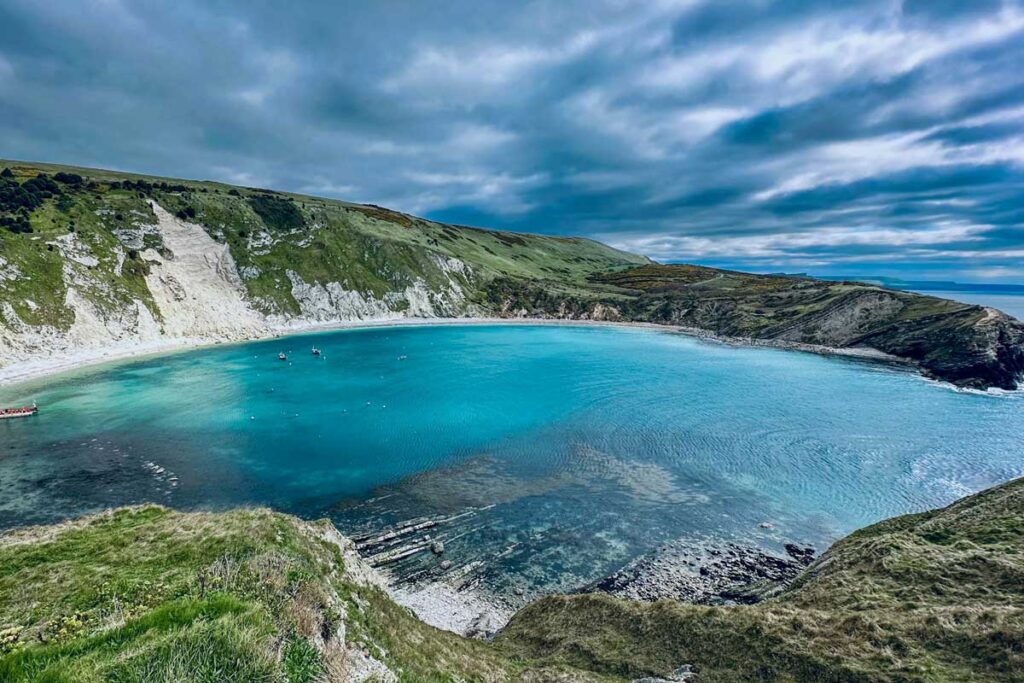
When visiting Lulworth Cove, the primary feature is the circular bay carved into the limestone coastline by marine erosion. Visitors can explore the pebble beach to examine the exposed rock strata, which include visible bands of Purbeck and Portland stone.
The Lulworth Cove Visitor Centre contains educational exhibits detailing the 150-million-year history of the Jurassic Coast. Interactive displays and short films illustrate how water pressure and shifting tectonic plates formed the local coastal geography over millennia.
A short walking trail from the main path directs visitors to Stair Hole, an adjacent smaller cove. This specific area features the Lulworth Crumple, a visible cross-section of folded limestone layers demonstrating the geological forces that shaped the region.
The elevated sections of the South West Coast Path provide broad viewpoints looking directly down into the circular bay. These cliffside vantage points offer clear visibility of the varied water depths and the narrow entrance where the sea meets the cove.
Practical visitor tips
| Tip Category | Practical Advice |
| Timing | Arrive before 10:00 am or after 4:00 pm during the summer months to secure a parking space more easily. |
| Crowds | Visit between November and March to experience the site with fewer tourists and less traffic on the local roads. |
| Layout | Wear sturdy walking boots with ankle support, as the path connecting the cove to nearby coastal sites involves steep inclines. |
| Entry process | Note your vehicle registration number when you park, as you will need to enter it into the payment machines. |
| On-site logistics | Use the public toilets located near the visitor centre, as there are no washroom facilities directly on the pebble beach. |
Frequently asked questions about Lulworth Cove
| Frequently Asked Question | Answer |
| Is Lulworth Cove suitable for children? | Yes, the cove offers calm waters, but the uneven pebble beach makes pushchair access difficult. |
| Do you need to book tickets in advance for Lulworth Cove? | No, there is no entry fee for the site, and you cannot reserve car park spaces in advance. |
| Is Lulworth Cove open on Sundays? | Yes, the beach, visitor centre, and most local facilities are open on Sundays throughout the year. |
| Are bags allowed at Lulworth Cove? | Yes, there are no bag restrictions, but you must carry your possessions with you at all times. |
| Are dogs allowed at Lulworth Cove? | Yes, dogs are permitted on the beach, provided they stay on the left-hand side of the slipway. |
Things to do near Lulworth Cove
- Durdle Door: This natural limestone arch stands on the coastline and is accessible via a steep walking path from the cove.
- Lulworth Castle: This 17th-century hunting lodge features extensive parkland and woodland walks, located a short drive inland from the coast.
- Man O’War Bay: This crescent-shaped beach features a mix of sand and shingle, situated just east of the Durdle Door arch.
- Tyneham Village: This abandoned coastal village was evacuated during the Second World War and is now accessible to the public on specific dates.
- The Etches Collection: This local museum houses an extensive collection of marine fossils and is located in the nearby village of Kimmeridge.
What to visit tomorrow
- Chesil Beach: This 18-mile-long barrier beach features prominent shingle ridges and a large saltwater lagoon behind the main bank.
- Old Harry Rocks: These three chalk formations stand isolated in the sea at the eastern end of the Jurassic Coast near Swanage.
- Portland Bill: This rugged, rocky promontory features a working lighthouse and marks the southernmost point of the Dorset coastline.
- Wookey Hole Caves: These natural limestone caverns in Somerset offer accessible underground tours and are located within a two-hour drive.
- Cheddar Gorge: This deep natural limestone gorge features accessible cave systems and vertical cliffs situated in the Mendip Hills.
More South-West England travel
Other South-West England travel guides on Planet Whitley include:
- Old Wardour Castle in Wiltshire: Opening times, ticket prices and visitor tips.
- Avebury Stone Circle visitor guide: What to expect at the free alternative to Stonehenge.
- What to know before visiting Cleeve Abbey in Somerset.
- Key information for those planning to visit Farleigh Hungerford Castle in Somerset.
- Exeter Cathedral visitor guide: When to visit, how much to pay and visitor tips.