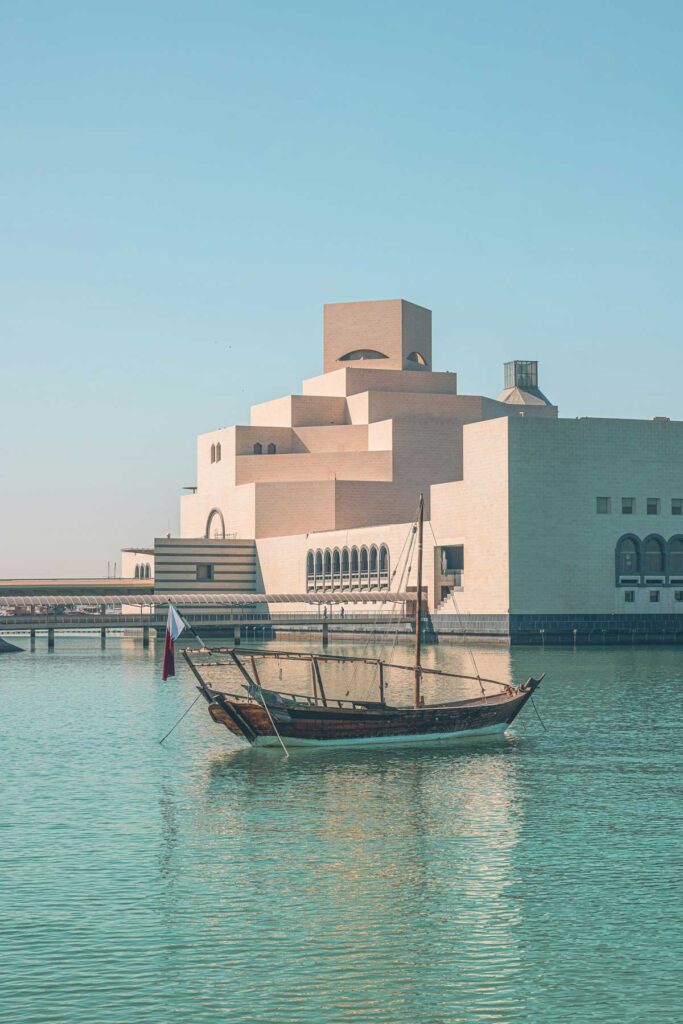
The Museum of Islamic Art (MIA) is Qatar’s flagship Islamic art museum, set on its own island along Doha’s Corniche.
This guide was updated in June 2026. MIA is closed on Wednesdays now, not Tuesdays as several older guides still state. Admission is no longer free either. Non-resident visitors now pay 50 Qatari riyals, while Qatar residents and children still enter free. You can book through GetYourGuide to secure your slot before you travel.
Quick facts
| Detail | Information |
|---|---|
| Address | Off Al Corniche St, Doha, Qatar |
| Hours | Sun, Mon, Tue, Sat 9am–7pm; Wed closed; Thu 9am–9pm; Fri 1:30pm–7pm |
| Non-resident adult admission | QAR 50 |
| Non-resident student admission | QAR 25 |
| Qatar and GCC resident admission | Free |
| Children (16 and under) | Free |
| Nearest metro | National Museum Station (Gold Line), 15-minute walk |
| Typical visit | 2 hours |
Why book Museum of Islamic Art tickets?
- 🏛️ 18 world-class galleries: a journey through 1,400 years of Islamic art, from Spain to Southeast Asia.
- 🎟️ Free for Qatar residents: only non-resident visitors pay the QAR 50 admission fee.
- 🌿 An I.M. Pei masterpiece: the Pritzker Prize-winning architect’s final major work, on its own purpose-built island.
- 📜 See the Blue Qur’an: one of the rarest illuminated manuscripts in Islamic art history.
- 💰 Children always free: under-16s never pay, whatever their residency status.
Opening hours
MIA’s opening hours run from 9am to 7pm on Sundays, Mondays, Tuesdays and Saturdays. The museum is closed every Wednesday, a change from the Tuesday closure many older guides still list. On Thursdays, MIA stays open later, until 9pm. Friday hours are shorter, from 1.30pm to 7pm. MIA Park, the green space surrounding the museum, stays open around the clock.
Ticket prices
| Ticket | Price |
|---|---|
| Non-resident adult | QAR 50 |
| Non-resident student | QAR 25 |
| Qatar and GCC resident | Free |
| Children (16 and under) | Free |
These are the official admission prices in Qatari riyals. The website doesn’t separate out tax, so the figures above are what you’ll pay at the gate. There’s no online discount for non-residents, though booking in advance through GetYourGuide guarantees your spot on busy days. Qatar and GCC residents, along with children aged 16 and under, enter free of charge, but everyone still needs a ticket. A separate multi-museum pass covering several Doha venues is also sold by Qatar Museums, worth considering if you’re visiting more than one site.
How to get there
By car or taxi: MIA is reachable by car or taxi, with a taxi stand inside the museum’s car park. You can also hail a taxi on the Corniche outside the front gate.
By metro: The nearest stop is National Museum Station on the Gold Line, about a 15-minute walk along the Corniche.
By shuttle bus: A free shuttle links MIA with Mathaf, the Qatar National Library and the National Museum of Qatar.
On foot: Souq Waqif and the Corniche promenade both sit within easy walking distance of the museum.
Parking
MIA’s car park is small and fills up quickly, especially at weekends. During major events in MIA Park, the car park closes altogether. If you can’t find a space, use the free shuttle bus or take a taxi instead.
How long to spend
Qatar Museums recommends allowing at least two hours for a visit to MIA. Visitors keen to see all 18 galleries in depth should plan closer to three hours, especially if stopping at the café.
Accessibility
MIA’s public areas are wheelchair accessible throughout, with lifts connecting every floor. A limited number of wheelchairs are available to borrow from the Visitor Service desk. The museum has a security check at the entrance, and large bags must be stored in lockers before you enter the galleries.
What to see inside the museum
The Permanent Collection Galleries: MIA’s 18 galleries trace Islamic art across three continents and more than 1,400 years. They move chronologically and geographically, from the earliest caliphates to the Ottoman, Safavid and Mughal empires.
The Blue Qur’an: This rare 9th or 10th-century manuscript uses gold Kufic script on indigo-dyed parchment. It’s one of the most celebrated objects in MIA’s collection, displayed in the gallery dedicated to the Qur’an.
The Damascus Room: A fully restored 19th-century Ottoman reception room from Damascus sits inside one of the upper galleries. Painted wooden panels and gilded calligraphy cover almost every surface.
The Astrolabe Collection: MIA holds one of the world’s finest groups of astrolabes, instruments used by Islamic scholars to track time and the stars. Several are displayed alongside other scientific instruments in the Knowledge, Science and Technology gallery.
Arms and Armour: This gallery showcases Ottoman horse armour and weapons crafted as much for display as for battle. It traces how military technology shaped the Ottoman, Safavid and Mughal “Gunpowder Empires.”
IDAM Restaurant: On MIA’s top floor, chef Alain Ducasse’s restaurant IDAM serves contemporary Mediterranean cuisine with Arabian influences. Floor-to-ceiling windows look out over Doha’s skyline and the bay.
Practical visitor tips
| Tip | Detail |
|---|---|
| Visit on a Thursday evening | MIA stays open until 9pm, giving you cooler hours and quieter galleries. |
| Dress modestly before you arrive | Shoulders and knees should be covered, or entry may be refused. |
| Book ahead in peak season | Book tickets in advance through GetYourGuide to avoid the entrance queue. |
| Skip the car at weekends | The car park fills fast; the free shuttle bus or a taxi is more reliable. |
| Save time for the café | The MIA Café has some of the best skyline views in Doha. |
FAQ
| Question | Answer |
|---|---|
| Is MIA open on Tuesdays? | Yes. MIA is closed on Wednesdays, not Tuesdays as some older guides suggest. |
| Is admission to MIA free? | Only for Qatar and GCC residents and children 16 and under; non-residents pay QAR 50. |
| Do I need to book in advance? | It’s not compulsory, though booking in advance through GetYourGuide avoids queuing at peak times. |
| Is MIA wheelchair accessible? | Yes. All public areas are accessible, and a limited number of wheelchairs can be borrowed. |
| How does MIA compare to the National Museum of Qatar? | MIA covers global Islamic art; the National Museum tells Qatar’s own national story. |
Things to do nearby
National Museum of Qatar: A roughly 15-minute walk or short drive along the Corniche, this “Desert Rose” building tells Qatar’s national story.
Souq Waqif: Doha’s restored traditional market is a short drive away, filled with restaurants, spice stalls and falconry shops.
MIA Park: The green space surrounding the museum stays open 24 hours, with skyline views and waterfront paths.
Flag Plaza: Next to MIA Park, this public space displays flags from around the world and hosts community events.
Doha Corniche: The seven-kilometre waterfront promenade runs past MIA, ideal for an evening stroll or a dhow boat ride.
What to visit tomorrow
Purpose-built Islamic art museums within easy reach of Doha are limited, but the Gulf has a handful worth the short flight.
Sharjah Museum of Islamic Civilization: About an hour’s flight to Dubai or Sharjah, this museum holds more than 5,000 artefacts across seven themed galleries, including a folio of the Blue Qur’an.
Beit Al Quran, Manama: A roughly 50-minute flight to Bahrain brings you to this museum, devoted entirely to Qur’anic manuscripts and Islamic calligraphy.
Tareq Rajab Museum, Kuwait City: About an hour’s flight away, this private collection covers Islamic calligraphy, ceramics, metalwork and jewellery.
Louvre Abu Dhabi: A roughly 75-minute flight away, this universal museum displays Islamic art alongside work from every other culture and era.
Topkapi Palace Museum, Istanbul: The natural next stop for serious collectors of Islamic art, though at around four hours by air it sits well beyond a two-hour journey.