The National Museum of Qatar (NMoQ) is Qatar’s national history museum, built around a restored royal palace on Doha’s Corniche.
This guide was updated in June 2026. Some of NMoQ’s galleries are currently closed for enhancement, a detail that won’t appear in older guides written before the works began. The museum is closed every Tuesday, not Wednesday as visitors sometimes assume from the nearby Museum of Islamic Art’s schedule. You can book through GetYourGuide to secure your slot before you travel.
Quick facts
| Detail | Information |
|---|---|
| Address | Museum Park Street, Doha, Qatar |
| Hours | Sun, Mon, Wed, Sat 9am–7pm; Tue closed; Thu 9am–9pm; Fri 1:30pm–7pm |
| Non-resident adult admission | QAR 50 |
| Non-resident student admission | QAR 25 |
| Qatar resident admission | Free |
| Children (16 and under) | Free |
| Nearest metro | National Museum Station (Gold Line), adjacent |
| Typical visit | 3 hours |
Why book National Museum of Qatar tickets?
- 🏛️ 11 immersive galleries: Qatar’s full story, from 700-million-year-old fossils to the present day.
- 🎟️ Built around a real palace: the museum wraps Sheikh Abdullah bin Jassim Al Thani’s restored 1900s home.
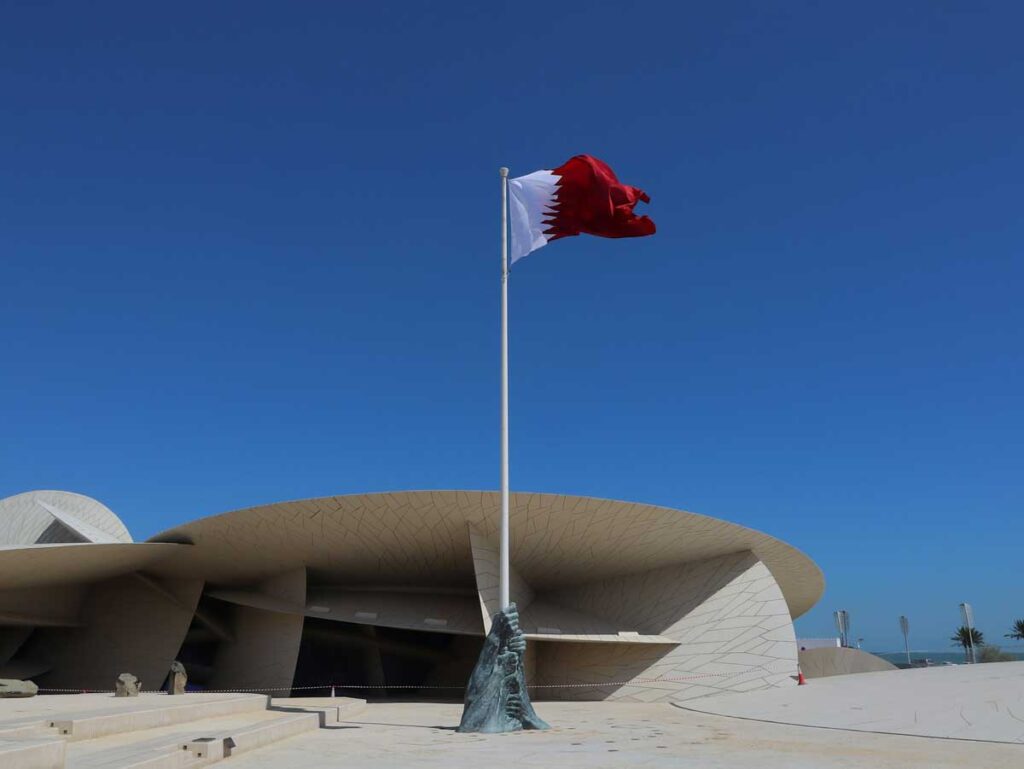
- 🌿 A “Desert Rose” design: Jean Nouvel’s interlocking discs are inspired by a real desert crystal formation.
- 📜 Films by award-winning directors: large-scale cinematic installations bring each gallery’s story to life.
- 💰 Children always free: under-16s never pay, whatever their residency status.
Opening hours
NMoQ’s opening hours run from 9am to 7pm on Sundays, Mondays, Wednesdays and Saturdays. The museum is closed every Tuesday, not Wednesday as you might expect after visiting MIA. Thursdays run later, until 9pm, and Friday opening starts at 1.30pm. Last entry is 45 minutes before closing, and staff begin clearing the galleries at that point too. Some galleries are temporarily closed for enhancement, so check the website for the current gallery list before you visit.
Ticket prices
| Ticket | Price |
|---|---|
| Non-resident adult | QAR 50 |
| Non-resident student | QAR 25 |
| Qatar resident | Free |
| Children (16 and under) | Free |
These are the official admission prices in Qatari riyals. As with MIA, the figures above are the total payable at the gate, since the website doesn’t list tax separately. Qatar residents and children aged 16 and under enter free, but everyone still needs a ticket to get in. Non-resident students get a 50% discount on the adult rate. Booking in advance through GetYourGuide is worth doing in peak season, when slots can sell out.
How to get there
By car: NMoQ has its own on-site car park, reached from the roundabout at Mathaf and Museum Park Streets.
By metro: The nearest stop, National Museum Station on the Gold Line, sits right next to the museum entrance.
By bus: Local buses also stop close to the museum; check current routes before you travel.
On foot: NMoQ is roughly a 15-minute walk from the Museum of Islamic Art along the Corniche.
Parking
Unlike MIA, NMoQ has its own dedicated car park on site. Vehicle and pedestrian access is from the roundabout at Mathaf and Museum Park Streets. Wheelchair-accessible golf carts run between the car park and the main entrance.
How long to spend
Most visitors spend around three hours exploring NMoQ’s 11 galleries, including time for the immersive films. Add longer if you’re visiting with children, since several galleries have hands-on family exhibits.
Accessibility
NMoQ offers some of the most developed accessibility features of any museum in the Gulf. Lifts connect every floor, and wheelchair-accessible golf carts run from the car park to the entrance. Visitors who are blind or have low vision can use multisensory stations with braille text and tactile models. A sensory room near the main entrance gives visitors with sensory processing needs a quiet space to regulate. Outdoor cobblestones and uneven floors in two galleries, Archaeology of Qatar and Life on the Coast, can still pose a challenge.
What to see inside the museum
The Old Palace: At the heart of NMoQ sits Sheikh Abdullah bin Jassim Al Thani’s original palace, his home and seat of government for 25 years. The restored building anchors the museum’s curving “Desert Rose” galleries around it.
Beginnings: This first gallery traces Qatar’s geological formation over 700 million years, paired with a large-scale art film by Christophe Cheysson. Fossils from a borehole nearly four kilometres deep are displayed alongside the film.
Life in Al Barr: A poetic film by Abderrahmane Sissako brings a day in a desert encampment to life across three walls. Surrounding displays include falconry equipment, woven sadu textiles and the tools of traditional coffee-making.
Pearls and Celebrations: This gallery traces Qatar’s pearling history through jewellery, sorting equipment and the Baroda carpet, embroidered with thousands of Gulf seed pearls. A companion film, Nafas, follows a pearl diver’s hardships at sea.
The Coming of Oil: A multi-channel installation by artist Doug Aitken marks the discovery of oil, the turning point in Qatar’s modern development. Nearby displays include early radios, televisions and the personal possessions of past rulers.
Qatar Today: The final gallery covers the reign of the current Emir, including the 2017 blockade and its aftermath. An immersive digital installation shows how Qatar emerged from that period.
Practical visitor tips
| Tip | Detail |
|---|---|
| Allow extra time near closing | Galleries start clearing 45 minutes before closing, so don’t leave the best for last. |
| Check which galleries are open | Some galleries are currently closed for enhancement; check the website before you visit. |
| Borrow an abaya or shayla if needed | A limited number are available to borrow if your clothing doesn’t meet the dress code. |
| Book ahead in peak season | Book tickets in advance through GetYourGuide to avoid the entrance queue. |
| Park on-site and use the golf carts | Wheelchair-accessible golf carts run from the car park to the main entrance. |
FAQ
| Question | Answer |
|---|---|
| Is NMoQ open on Tuesdays? | No. NMoQ is closed on Tuesdays, not Wednesdays as MIA is — easy to mix up. |
| Is admission free? | Only for Qatar residents and children 16 and under; non-residents pay QAR 50. |
| Are all the galleries open? | Not always. Some galleries are temporarily closed for enhancement; check before visiting. |
| Is NMoQ wheelchair accessible? | Mostly, yes, though cobblestones outdoors and uneven floors in two galleries can be challenging. |
| How does NMoQ compare to MIA? | NMoQ tells Qatar’s national story; MIA covers global Islamic art across 1,400 years. |
Things to do nearby
Museum of Islamic Art: A roughly 15-minute walk or short drive along the Corniche, MIA showcases 1,400 years of Islamic art on its own island.
Souq Waqif: Doha’s historic market is a short drive away, busy with restaurants, spice stalls and falconry shops.
The Park at NMoQ: NMoQ’s surrounding park has playgrounds, gardens and public artwork, free to enter without a museum ticket.
Doha Corniche: The waterfront promenade passes close to NMoQ, good for a walk or an evening dhow boat ride.
Katara Cultural Village: A short drive away, this cultural district has galleries, an amphitheatre and a public beach.
What to visit tomorrow
National and heritage museums within easy reach of Doha are limited, but the Gulf has several worth a short flight.
National Museum of Saudi Arabia, Riyadh: About a 70-minute flight away, this museum charts the Arabian Peninsula’s history from prehistory to the kingdom’s founding.
Bahrain National Museum, Manama: A 50-minute flight brings you to Bahrain’s flagship history museum, built around the ancient Dilmun civilisation.
Etihad Museum, Dubai: Roughly an hour’s flight away, this museum tells the story of the UAE’s founding and its first president.
Sharjah Heritage Museum: Also about an hour’s flight away, this museum traces Emirati life and traditions inside a restored historic quarter.
Kuwait National Museum: A roughly 70-minute flight away. The building itself is currently under a rehabilitation project, with its Islamic art collection on temporary display at the nearby Amricani Cultural Centre.