Discover how to get to Melk Abbey, what to expect from opening hours, ticket prices, parking, and quiet times—plus tips for combining nearby attractions—without any fluff.
This guide was updated in October 2026 to check ticket prices and opening hours. The increased guided tour and audio guide prices may not be reflected in guides elsewhere.
How to get to Melk Abbey and where to park
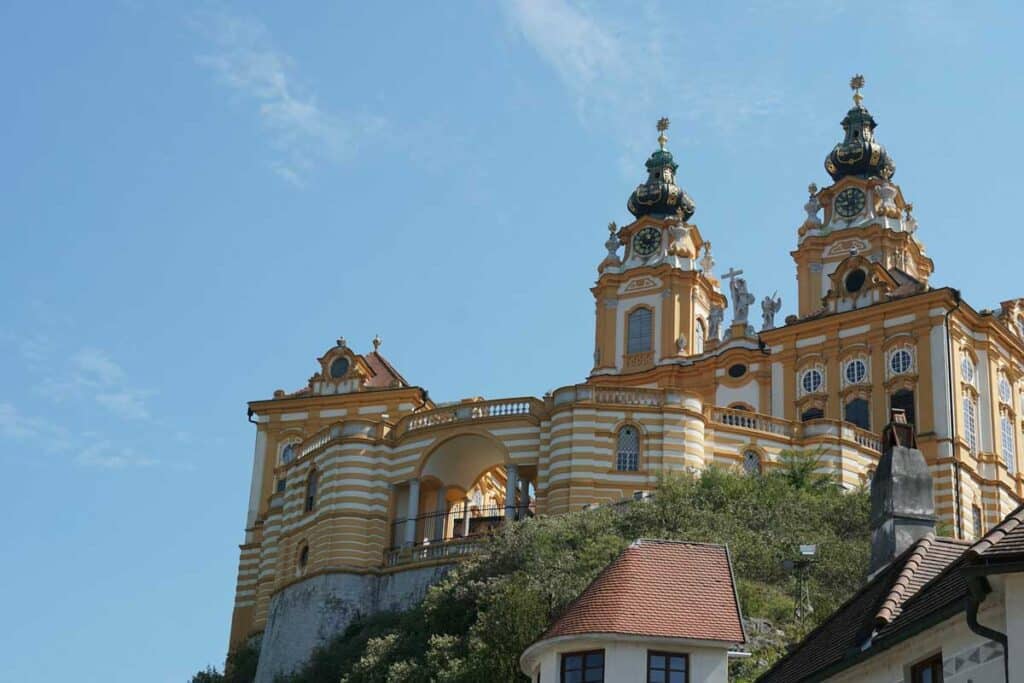
Melk Abbey sits atop a rocky outcrop overlooking the Danube in Austria‘s Wachau Valley. By train, take the ÖBB Westbahn line from Vienna or Salzburg to Melk; from the station it’s a roughly 10-minute walk to the Abbey.
By car, drive via the A1 motorway to the Melk exit. Vehicles of visitors who buy an admission ticket may use the Abbey’s free parking, but you must validate your parking ticket at the ticket office in the first courtyard. Visitors can exit within 15 minutes without validation.
Danube Valley day tours from Vienna are also available for those not wanting to drive or take the train.
For those needing wheelchair-friendly access, be aware that the car park is gravel and can cause some difficulties. Most of the rest of the abbey is wheelchair-friendly, however.
Opening hours and ticket prices you need to know
Opening hours:
- From 1 April to 31 October, the Abbey is open 9:00 am to 5:30 pm, last admission at 5:00 pm.
- Outside of this peak season, opening hours are variable. Check the abbey website for exact timings.
Ticket prices (checked in October 2026):
- Adults €16
- Family ticket (parents + children up to 16) €32
- Students/pupils (up to 27, with ID) €8
Abbey Park alone:
- Adults €5.50, students (17–27) €4.00, children (6–16) €1.50
An audio guide is available for €4, and adding a guided tour costs €4 more.
Why book the Danube Valley day trip from Vienna?
- 🚌 Comfortable round-trip coach transport from Vienna, with all logistics handled for you
- 🌳 Explore the UNESCO-listed Wachau Valley, with vineyards, forests and medieval towns
- ⛴ In summer, enjoy a boat ride along the Danube River from Spitz to Melk
- ⛪ Visit the baroque Melk Abbey, famous for its ornate interiors and vast library
- 🏰 Stop in historic towns like Dürnstein and Krems, known for castles, ruins and riverside charm
- ⏱ Total duration: 8–9 hours, giving you a full but well-paced day
Short history and what you’ll see
Founded in 1089, when Margrave Leopold II granted a castle to Benedictine monks, Melk Abbey became a centre of spiritual and cultural learning.
The soaring Baroque abbey you see today was built between 1702 and 1736, designed by Jakob Prandtauer. Highlights include:
- The Abbey Church with frescoes by Paul Troger and Johann Michael Rottmayr.
- The famous library with medieval manuscripts.
- The Imperial Staircase and guest rooms (now museum).
- The Abbey Park, featuring the Baroque pavilion, Paradise and Oriental gardens, and the Benedictine Path.
Best times for a smoother visit
It’s wise to arrive right at opening, especially on weekdays, to avoid crowds and enjoy quieter conditions.
Within the Abbey Park, keep to paths and be cautious—there are no safety railings, and historical water reservoirs are unfenced.
Melk Abbey FAQ
Are the paths wheelchair-friendly?
Most of the site is wheelchair-friendly, but beware of the gravel car park.
Is there accessible parking close to the entrance?
Yes, visitors can park for free and validate tickets; the small carpark offers barrier-free access.
Are audio guides available?
Yes—audio guides are available for around €3.49, plus guided tours cost approximately €3.50 extra.
When are the quietest hours or days to visit?
Early morning at opening on weekdays tend to be quietest.
Are photos allowed everywhere?
Photos and videos for private use are permitted in the Abbey Park. For the Abbey building, rules may vary; check staff instructions and signage—commercial shoots require a permit.
Are there cafés or restaurants onsite?
Yes—the Abbey includes a café and restaurant as well as a souvenir shop within the grounds.
Is the terrain steep or difficult?
The Abbey stands on a hill, but the walk from the train station is straightforward. Gardens have level paths, though visitors should take care due to historic features.
Things to do near Melk Abbey
- Melk Old Town – The historic centre below the abbey has narrow streets, traditional buildings, cafés and shops that are easy to explore on foot.
- Melk Abbey Park – The abbey’s gardens include landscaped paths, historic garden buildings and quieter areas to explore after visiting the monastery.
- Danube riverfront – The riverside area offers views of the Danube and the abbey above the town, with opportunities to walk beside the water.
- Melk Memorial – This memorial site commemorates prisoners held at the Melk subcamp of Mauthausen during the Second World War.
- Danube boat trips from Melk – Seasonal cruises offer views of the Wachau Valley’s vineyard slopes, riverside villages and historic buildings from the water.
Alternative attractions
- Göttweig Abbey – This Benedictine monastery south-east of Melk has Baroque architecture, a monumental staircase and views across the Danube region.
- Dürnstein Abbey and Old Town – The blue-and-white abbey tower is a landmark in this Wachau village, whose historic streets lead towards the ruins of Dürnstein Castle.
- Aggstein Castle Ruins – Perched above the Danube, these medieval castle remains have courtyards, defensive walls and views across the Wachau Valley.
- Schallaburg Castle – This Renaissance castle near Melk is known for its arcaded courtyard, gardens and changing exhibitions.
- Artstetten Castle – This castle and museum explore the history of Archduke Franz Ferdinand and his family, with landscaped grounds overlooking the surrounding countryside.
More Austria travel
Other Austria travel articles on Planet Whitley include:
- Linz travel guide for first time visitors.
- The incredible range of strudels at Innsbruck’s Kroll café.
- What is the big golden ball artwork in Salzburg?
- How Salzburg was built on salt.
- Vienna to Ljubljana: Direct train vs indirect train vs bus.