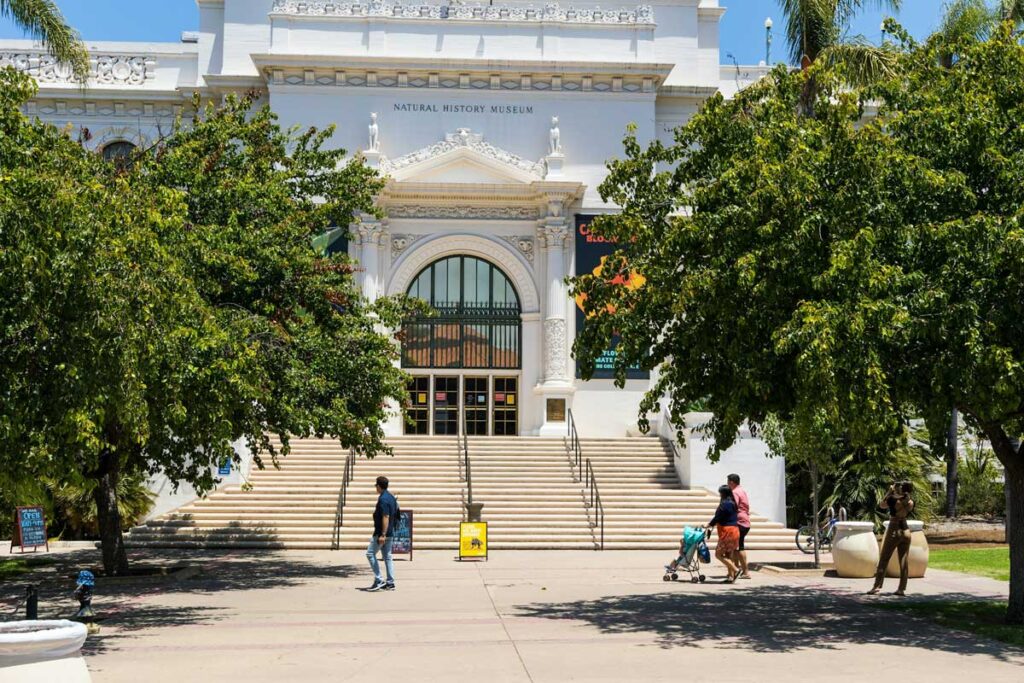
The San Diego Natural History Museum is a scientific institution and public museum located on El Prado within Balboa Park in San Diego, California. This guide covers opening hours, ticket prices, transport or parking, accessibility, and practical visitor tips to help you effectively plan your visit.
This guide was updated in May 2026 to reflect the new paid parking programme implemented across all public lots within Balboa Park earlier this year.
Quick facts
| Feature | Details |
| Opening hours | Daily 10:00 am – 5:00 pm |
| Ticket prices | $24 (Adult); $20 (Senior, student, military); $14 (Youth 3-17) |
| Address | 1788 El Prado, San Diego, CA 92101, USA |
| Nearest public transport or parking | MTS Bus Route 7 / Balboa Park East Lot |
| Typical time needed to visit | 2 to 3 hours |
San Diego Natural History Museum opening hours
The San Diego Natural History Museum operates on a consistent daily schedule, opening to the public from 10:00 am until 5:00 pm from Monday to Sunday. The attraction maintains these standard daytime hours throughout the entire year, closing entirely only on Thanksgiving Day and Christmas Day.
There is one notable seasonal variation during the year known as Nat at Night. On select Fridays, the museum extends its operating hours and remains open until 11:00 pm. During these specific evening openings, visitors can explore the exhibits and access the rooftop area for food and drinks at half the regular admission price after 5:00 pm.
San Diego Natural History Museum ticket prices
Opening hours and ticket prices were checked on the official website and last updated in May 2026. General admission for adults costs $24. Discounted entry is available at $20 for seniors over 62, university students, and active military personnel with valid identification, while youth tickets for ages three to 17 cost $14.
The museum is included in the Go City San Diego pass scheme. This digital pass provides consolidated entry to the museum alongside several other cultural institutions and activities. Other major attractions included in this pass are the San Diego Zoo, the USS Midway Museum, and the Fleet Science Center.
Five great things to do in San Diego
- 🦁 Visit one of the greatest zoos in the world – with a San Diego Zoo day pass.
- 🇲🇽 Take a day tour to Tijuana – for a taste of Mexico.
- 🐋 See whales and dolphins – on a three hour wildlife cruise.
- 🍸 Enjoy a food and drink tour – of the Gaslamp Quarter.
- 🛶 Explore the sea caves of La Jolla – on a guided kayaking adventure.
How to get to the San Diego Natural History Museum
Visitors can reach the San Diego Natural History Museum using the Metropolitan Transit System (MTS) bus network. The most direct public route is the MTS Bus Route 7, which frequently travels along Park Boulevard from downtown San Diego. You should disembark at the pedestrian overpass stop situated immediately after the zoo, which leads directly to the museum’s north entrance.
If you are travelling via the San Diego Trolley, you can alight at the City College station in downtown San Diego. From this station, you can quickly transfer to the outbound Route 7 bus on the nearby corner of 11th Avenue and C Street. Ride-hailing services also operate extensively throughout the city and can drop passengers off near the intersection of Park Boulevard and Village Place.
Parking at the San Diego Natural History Museum
Drivers visiting the San Diego Natural History Museum will find public parking directly adjacent to the building. The closest parking option is the lot situated on the east side of the museum, accessible via Village Place. An additional lot is located nearby at the South Carousel area, just a short walking distance from the main doors.
As of January 2026, the City of San Diego implemented a mandatory paid parking programme across all premium public lots within Balboa Park. Non-resident visitors must now pay a standard daily rate of $16, or $10 for four hours, using the automated kiosks or the official mobile application. To secure up to three hours of free parking, visitors can utilise the larger Inspiration Point lot and take the complimentary park tram.
How long to spend at the San Diego Natural History Museum
A standard visit to the San Diego Natural History Museum typically requires between two and three hours. This duration provides enough time to explore the four primary floors of permanent exhibitions and view the extensive fossil displays. It also allows visitors to comfortably engage with the interactive science stations at a steady walking pace.
If you intend to watch a documentary in the giant screen theatre or thoroughly read the detailed informational plaques, allocate an additional hour to your itinerary. Families with young children often spend up to four hours fully exploring the building, particularly if they take a designated break at the ground floor cafe.
Accessibility at the San Diego Natural History Museum
The San Diego Natural History Museum is designed to accommodate visitors with mobility requirements, featuring flat surfaces and lifts connecting all floors. The north entrance near the giant fig tree is entirely wheelchair accessible, and complimentary manual wheelchairs can be requested at the Visitor Services Desk upon arrival. Registered carers or escorts accompanying a visitor with disabilities are entitled to free general admission.
The institution provides specific resources for neurodivergent individuals, including comprehensive social stories available online to help prepare for the visit. Assistive listening devices are provided upon request for use during films and lectures in the main theatre. Note that some older exhibits, such as Coast to Cactus, feature wheelchair lifts that require a key from the admissions desk to operate.
Inside / what to see at the San Diego Natural History Museum
The core exhibitions inside the San Diego Natural History Museum focus heavily on the unique biodiversity and geological history of Southern California and the Baja California Peninsula. The Coast to Cactus exhibition demonstrates the diverse ecosystems of the region, allowing visitors to walk through detailed dioramas representing local deserts, mountains, and coastal habitats.
The Fossil Mysteries exhibition occupies a significant portion of the museum, showcasing prehistoric life that once thrived in the area. You will encounter large dinosaur skeletons, interactive digging stations, and preserved marine fossils demonstrating how the local landscape has shifted over millions of years. This section provides a hands-on look at the deep palaeontological history of the region.
On the upper levels, the Skulls exhibition features an expansive wall displaying over 200 animal skulls. This comparative anatomy exhibit highlights the diverse evolutionary adaptations of different species, ranging from tiny rodents to massive marine mammals. It allows you to closely observe the varied shapes and biological functions of bone structures.
The Living Lab provides a safe environment to observe live animals native to the surrounding desert and coastal regions. Visitors can view non-venomous snakes, nocturnal lizards, and stinging scorpions within secure, climate-controlled terrariums. This area helps to dispel common myths about misunderstood local wildlife.
Another major highlight is the Extraordinary Ideas from Ordinary People exhibition, which explores the historical impact of citizen science. This gallery displays rare books, intricate botanical illustrations, historical photographs, and original plant and animal specimens. It highlights how amateur naturalists have contributed significantly to the global understanding of biology and environmental science.
Practical visitor tips
| Tip Category | Practical Advice |
| Timing | Arrive precisely at 10:00 am on a weekday morning to explore the dinosaur exhibits before local school groups arrive. |
| Crowds | Avoid visiting during the Resident Free Tuesdays programme, as the museum experiences maximum capacity and significant congestion. |
| Layout | Start your visit on the top floor and work your way down the stairwells to avoid waiting for the busy central lifts. |
| Entry process | Bring a physical or digital copy of your valid identification to quickly claim military, student, or senior discount rates at the desk. |
| On-site logistics | Request the designated keys at the admissions desk when you arrive if you require the use of internal wheelchair lifts. |
Frequently asked questions about the San Diego Natural History Museum
| Question | Answer |
| Is the San Diego Natural History Museum suitable for children? | Yes, the museum is highly suitable for children and features numerous interactive displays and designated hands-on areas. |
| Do you need to book tickets in advance for the San Diego Natural History Museum? | No, advance booking is not strictly required, and general admission tickets can be purchased at the front desk upon arrival. |
| Is the San Diego Natural History Museum open on Sundays? | Yes, the museum is open every Sunday from 10:00 am until 5:00 pm, maintaining its regular operating hours. |
| Are bags allowed at the San Diego Natural History Museum? | Standard day bags and small backpacks are permitted, but large travel luggage may be refused entry at the discretion of security staff. |
| Does the San Diego Natural History Museum have food available? | Yes, the museum operates a cafe on the ground floor, and numerous outdoor dining options are located a short walk away in the park. |
Things to do near the San Diego Natural History Museum
- San Diego Zoo: A world-renowned wildlife sanctuary housing thousands of rare animals across expansive, naturally landscaped habitats.
- Fleet Science Center: An interactive educational facility offering hands-on physical science exhibits and a large dome theatre screening immersive documentaries.
- The San Diego Museum of Art: The region’s largest fine art institution, featuring an extensive permanent collection of Spanish old masters and South Asian paintings.
- Spanish Village Art Center: A vibrant collection of colourful courtyard studios where local artists publicly demonstrate their crafts and sell original artwork.
- Balboa Park Carousel: A meticulously restored antique menagerie carousel built in 1910, featuring hand-carved wooden animals and original brass ring games.
What to visit tomorrow
- Birch Aquarium at Scripps: A public exploration centre in La Jolla showcasing Pacific marine life, coral reefs, and interactive tide pools overlooking the ocean.
- Living Coast Discovery Center: An environmental education centre in Chula Vista focusing strictly on the native coastal wildlife and marine ecosystems of San Diego Bay.
- San Diego Zoo Safari Park: A massive wildlife preserve in Escondido where large herds of African and Asian animals roam freely across vast open plains.
- Natural History Museum of Los Angeles County: A major scientific institution housing massive dinosaur skeletons and millions of historical artefacts, located approximately two hours north.
- California Science Center: A sprawling, family-friendly museum featuring interactive technology exhibits and the retired Space Shuttle Endeavour, situated in Los Angeles.
More Southern California travel
I’ve created a guide to the best tours and experiences in San Diego. Other Southern California travel guides on Planet Whitley include:
- What to see at Cabrillo National Monument in San Diego.
- The best places to see sea lions in California.
- How to save money on the Palm Springs Aerial Tramway.
- Plan your visit to the Los Angeles County Museum of Art, Petersen Automotive Museum, La Brea Tar Pits and Museum of Tolerance.
- Why Descanso Gardens is an easy escape from LA.