The California sea lion is one of the most abundant and adaptable marine mammals on the Pacific coast. Intelligent, vocal and apparently unbothered by human attention, it has colonised harbour walls, marina pontoons and rocky outcrops from the Mexican border to the Oregon state line. California has more reliably accessible sea lion viewing than anywhere else in the continental United States.
Sea lions are present year-round at most California locations. Numbers peak from autumn through spring, when animals gather in large groups along the coast. In summer, many males head to breeding rookeries on offshore islands. The sites in my wildlife-spotting guide below offer encounters ranging from free harborside viewing to kayaking and snorkelling among wild animals.
La Jolla, San Diego
La Jolla Cove, a small protected bay carved into the sandstone cliffs north of San Diego, is one of the most reliably productive sea lion sites on the West Coast. The La Jolla Ecological Reserve surrounding the cove is one of California’s richest marine areas, with kelp forests, sea caves and a permanent population of California sea lions hauled out on the rocks above the water.
From the clifftop path, sea lions are visible year-round at close range — often within a few metres. The cove itself is a designated ecological reserve. Swimmers share the water with the animals, which are accustomed to human presence and frequently approach snorkellers with curiosity.
A tandem kayak tour of La Jolla’s sea caves explores the reserve from the water, paddling through kelp beds and into sea caves along the sandstone coastline. Sea lions, leopard sharks, Garibaldi and occasional dolphins are commonly encountered. A naturalist guide provides commentary throughout. No kayaking experience is necessary and wetsuits are available for rental.
For an underwater perspective, a guided snorkel tour of La Jolla Cove puts you in the water alongside the resident sea lions. The animals regularly investigate snorkellers at close range. The two-hour tour is suitable for all experience levels and snorkel gear is provided. Reviewers consistently describe sea lions approaching within arm’s reach.
Monterey and Elkhorn Slough
Monterey Bay, a federally protected National Marine Sanctuary, is among the most biodiverse stretches of ocean off the US coast. The submarine canyon running through the bay creates an upwelling of cold, nutrient-rich water that supports enormous concentrations of marine life. California sea lions are present throughout the year, hauled out on the rocks at Fisherman’s Wharf and visible from the famous Cannery Row waterfront.
A short drive north of Monterey, Elkhorn Slough is the most significant coastal wetland in California. The slough — a tidal estuary threading through the agricultural Salinas Valley — holds one of the largest concentrations of sea lions and sea otters in the state. Animals haul out on the sandbanks and channel edges in large numbers, often within a few metres of passing boats.
An electric catamaran wildlife tour of Elkhorn Slough navigates the estuary with a naturalist guide on board, spotting sea lions, sea otters, harbour seals and a remarkable variety of shorebirds and wading birds. The electric engine keeps the boat quiet and unobtrusive. Morning and afternoon departures are available. Reviewers regularly describe seeing multiple sea lions hauled out just metres from the boat.
Out on the open bay, a whale watching cruise from Monterey ventures into the sanctuary with a marine scientist on board. Sea lions, dolphins, sea otters and sea turtles are regular sightings alongside the whales. The operator reports a 99% whale sighting success rate, and departures run year-round.
San Francisco and Pier 39
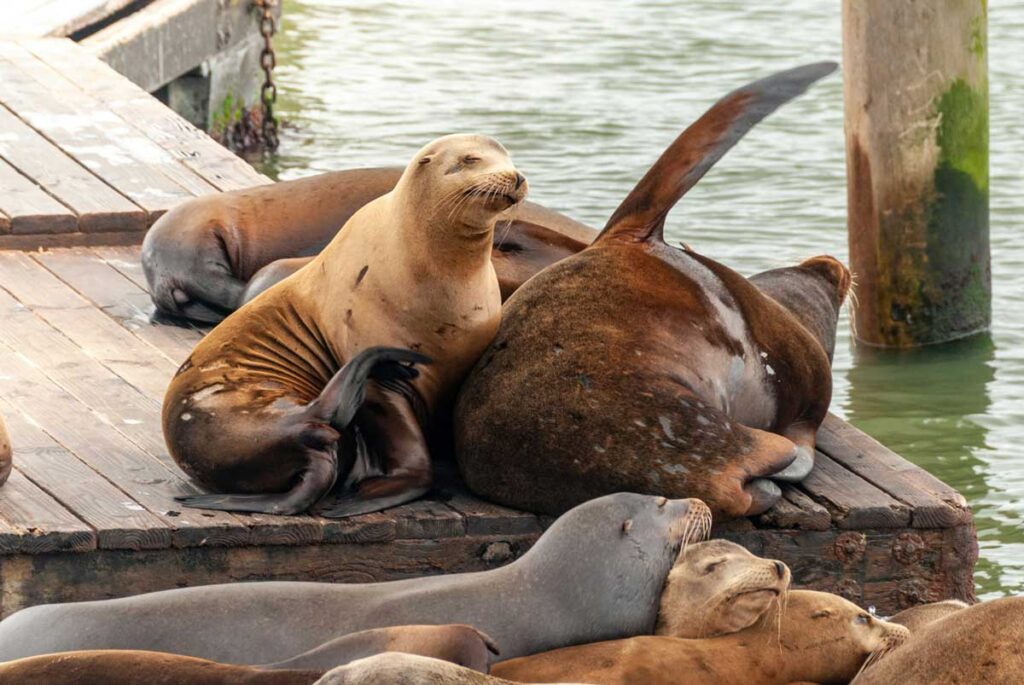
In January 1990, a small group of California sea lions hauled out onto the floating docks at Pier 39 in San Francisco‘s Fisherman’s Wharf. Nobody moved them on. By the following winter, there were hundreds. Today, up to 900 animals occupy the docks at peak season, from autumn through spring, making this one of the largest and most accessible urban sea lion colonies anywhere in the world.
5 San Francisco experiences worth booking
- 🌉 Combine the Golden Gate Bridge, Muir Woods, Sausalito and Alcatraz on a packed day tour.
- 🌲 Take a day trip to the Giant Sequoias and the highlights of Yosemite National Park.
- 🌃 See the city lights at night on a San Francisco Bay cruise.
- 🍷 Go wine-tasting in the Napa and Sonoma Valleys on a full day wine tour.
- ✌️ Hit the hippie hotspots in a colourful VW bus on the San Francisco Love Tour.
The viewing decks at Pier 39 are free and open daily. The Sea Lion Center on the pier provides interpretation on the colony’s natural history and the story of how this extraordinary urban coexistence came about. The barking carries across the waterfront from some distance — you will hear the colony before you see it.
The Pier 39 sea lions are best seen from the water as well as from land. A whale watching cruise from Pier 39 departs through San Francisco Bay and under the Golden Gate Bridge into the open Pacific, with sea lions, dolphins, harbour porpoises and — seasonally — humpback and grey whales alongside the route. An onboard naturalist provides commentary. The best whale season is June to November; sea lions are present year-round.
Santa Barbara and the harbour
Santa Barbara Harbour holds a resident sea lion population that has colonised the marina’s boat ladders, dock edges and breakwater rocks. The animals are habituated, conspicuous and — to the occasional frustration of boat owners — entirely at home in the harbour environment.
A sea lion kayak tour of Santa Barbara Harbour paddles through the marina and along the coastline, with sea lions a near-guaranteed sighting alongside pelicans, cormorants and harbour seals. The guide covers the harbour’s natural and maritime history. No kayaking experience is necessary. This is a calmer, more sheltered experience than open-ocean kayaking, and well suited to families and beginners.
The waters offshore are outstanding. The Santa Barbara Channel separates the mainland from the Channel Islands and is one of the most biologically productive stretches of the California coast, supporting 30 species of cetaceans alongside the resident sea lion population.
Channel Islands National Park
The Channel Islands, a chain of five national park islands lying between 20 and 70 miles off the Southern California coast, are sometimes called the Galápagos of North America. The description is not entirely fanciful. The islands are home to 145 species of plants and animals found nowhere else on earth, and the surrounding waters support sea lions in enormous numbers — particularly on San Miguel Island, which holds one of the largest pinniped rookeries on the Pacific coast.
A full-day sea cave kayaking trip from Ventura reaches the islands by high-speed ferry before paddling through remarkable sea caves along the coastline, with sea lions, dolphins and — during migration season — whales among the regular sightings. All gear, ferry transport and entrance fees are included. The guide’s knowledge of where sea lions congregate makes a significant difference to the quality of the day.
For a less strenuous approach, a snorkel and kayak tour of Santa Cruz Island combines snorkelling in the Scorpion State Marine Reserve — kelp forest, Garibaldi, sea lions — with a kayak paddle along volcanic sea caves. The catamaran crossing takes an hour from the mainland and is itself a good opportunity to spot marine life.
Morro Bay
Morro Bay, halfway between Los Angeles and San Francisco on the central coast, is one of California’s most productive estuarine habitats. The bay’s shallow, sheltered waters and sandflats attract large numbers of sea lions, sea otters and harbour seals, particularly in winter. Morro Rock — the volcanic plug at the mouth of the bay — is a designated State Historic Landmark and a reliable haul-out point for sea lions year-round.
The waterfront embarcadero in the town of Morro Bay gives close views of the animals from dry land without any booking or cost. Sea otters float in the kelp beds immediately offshore, and the combination of rock, bay and open coast makes this one of the most scenic marine mammal viewing spots on the central California coast. Kayak rentals are available locally for those who want to explore the bay independently.
Practical tips for seeing sea lions in California
Year-round or seasonal?
Sea lions are present at all California sites year-round, but numbers and distribution vary by season. Autumn through spring sees the largest haul-outs at most mainland locations, including Pier 39. Summer sees many males depart for offshore breeding rookeries on the Channel Islands. Year-round residents — juveniles, females and non-breeding males — remain at coastal sites throughout.
Keeping a respectful distance
Federal law prohibits approaching marine mammals within 50 metres in the wild. In practice, sea lions regularly approach kayakers and snorkellers on their own terms — this is permitted provided the human has not initiated the approach. Never attempt to touch, feed or herd sea lions, and give hauled-out animals space on rocks and beaches. Licensed tour operators are familiar with the regulations and will guide behaviour accordingly.
What to bring
On kayak and snorkel tours, operators typically provide wetsuits or confirm water temperature in advance. California coastal water is cold year-round — the Pacific here is considerably cooler than the Atlantic at equivalent latitudes. Polarised sunglasses cut glare and make spotting animals in the water much easier. On open-ocean boat tours, motion sickness medication is worth considering — the waters outside San Francisco Bay and Monterey Bay can be rough.
More California travel
Other California travel articles on Planet Whitley include:
- Guides to the top spots in Yosemite National Park: Tunnel View, Tuolumne Grove, Bridalveil Fall, Yosemite Falls, Mariposa Grove, Sentinel Beach and El Capitan Meadow.
- Lake Tahoe kayak tours vs Emerald Bay cruises: What’s the best way to see the lake?
- Guides to the top spots in Yosemite National Park: Tunnel View, Tuolumne Grove, Bridalveil Fall, Yosemite Falls, Mariposa Grove, Sentinel Beach and El Capitan Meadow.
- Complete guide to day tours to Monterey and Carmel from San Francisco.
- What to see at Cabrillo National Monument in San Diego.