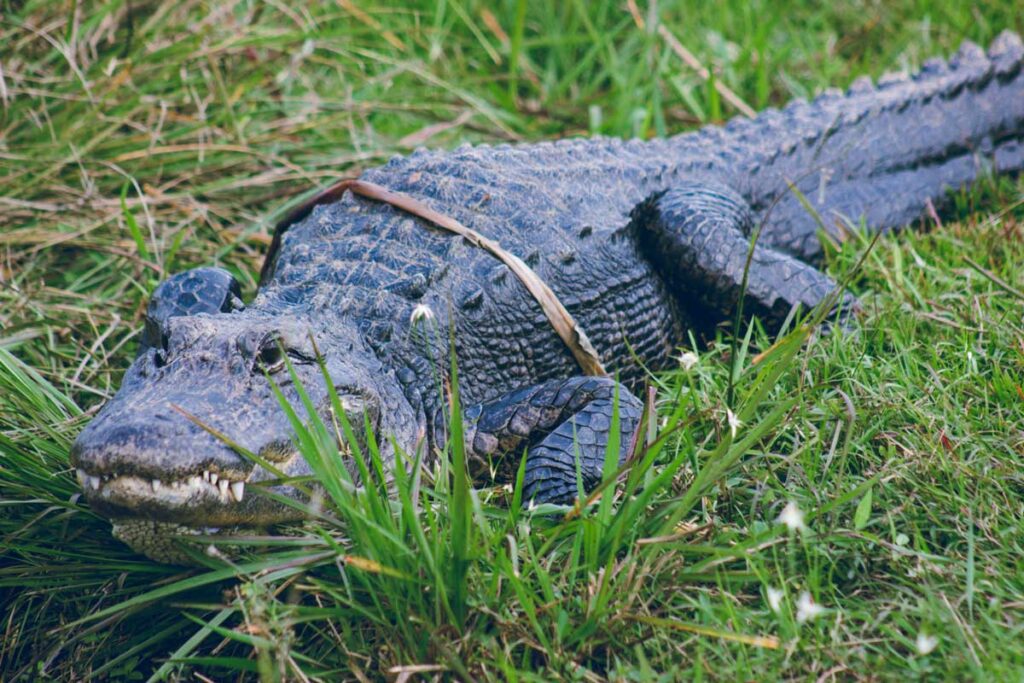
Florida has more American alligators than any other state — an estimated 1.3 million of them, living in virtually every freshwater habitat in the peninsula. They occupy lakes, rivers, marshes, roadside ditches and, occasionally, suburban golf courses. Seeing an alligator in Florida is not difficult. Seeing them in properly wild settings, from a boat or boardwalk, with some sense of the ecosystem they inhabit, is a more rewarding pursuit.
Alligators are most active from spring through autumn, when warm temperatures keep them feeding and mobile. In cooler winter months they become lethargic but remain visible, often basking on sunny banks. The sites below offer the full range — from the orchestrated drama of Everglades airboat rides to the quiet, unhurried pleasure of a Myakka River canoe.
The Everglades, Miami and Fort Lauderdale
The Florida Everglades — a vast, slow-moving river of grass covering some 4,000 square miles of southern Florida — is the defining alligator habitat in North America. The numbers here are extraordinary. Alligators are present in virtually every body of open water, from the roadside canals of Alligator Alley to the remote mangrove channels of the Ten Thousand Islands. The Everglades is also home to the far rarer American crocodile, one of the few places in the world where alligators and crocodiles share the same habitat.
The standard way to see the Everglades is by airboat — a flat-bottomed vessel propelled by an aircraft engine and propeller, capable of skimming across the sawgrass prairie at speed. Earplugs are standard issue. The noise is considerable. But the access the boats provide — into shallows no conventional vessel can reach, stopping on a dime when an alligator appears — is genuinely thrilling.
From Fort Lauderdale, an Everglades airboat adventure and wildlife encounter at Sawgrass Recreation Park includes the airboat ride, a guided alligator and reptile exhibit, and a wildlife encounter area with turtles and iguanas. The park is a short drive from downtown Fort Lauderdale and offers a well-organised introduction to the ecosystem.
From Miami, an airboat and alligator tour with hotel pickup includes a live alligator show with guides from the Animal Planet series Gator Boys. Hotel pickup from Miami and Miami Beach is included. Captains find alligators in their natural habitat throughout the ride, with the show adding an educational dimension on return. Multiple reviewers cite their captain’s ability to locate animals in seemingly empty water as a highlight.
Central Florida Everglades, near Orlando
The headwaters of the Florida Everglades extend surprisingly far north — to within an hour of Orlando, in Osceola County. The Wild Florida facility at Kenansville sits at the centre of 100,000 acres of protected wetlands, rivers and marshes that are every bit as wild as the more famous southern reaches.
An Everglades airboat tour and wildlife park from Orlando combines a 30-minute or one-hour airboat ride with admission to the Wild Florida Wildlife Park — home to over 200 animals including lemurs, sloths, bobcats and a white alligator exhibit. The optional upgrade to a barbecue lunch and photo with an alligator is popular with families. The airboat captains here have an exceptional track record for locating wildlife, with baby crocodiles and nesting herons among the regular non-gator sightings.
This is the most practical Everglades option for visitors based in Orlando who don’t want to make the three-hour drive south to the traditional Everglades access points. The 4,200 acres of protected wetlands around the park feel genuinely remote — the Disney World skyline is not visible from the sawgrass.
St Augustine and the St Johns River
5 great experiences in St Augustine to book now
- 🏛️ Learn the past of the oldest city in the US on a history walking tour.
- 🚤 Take an airboat adventure – spotting alligators and manatees on the way.
- ⛵ See St Augustine from the water on a sunset cruise.
- 🍷 On a food and wine tour, taste St Augustine’s top flavours
- 👻 Hear spooky historic tales on a St Augustine ghost tour.
The St Johns River, one of the few rivers in the United States that flows north, winds through the interior of northeast Florida in a series of wide, shallow lakes and marshy backwaters. Alligators are abundant throughout. The river is also home to manatees, snakes, soft-shelled turtles, ospreys and bald eagles — making any wildlife tour here considerably richer than the alligator count alone suggests.
An airboat safari on the St Johns River near St Augustine skims through a maze of shallow freshwater tributaries with personal headsets providing the captain’s commentary directly rather than through the roar of the engine. Reviewers consistently highlight the captain’s eye for wildlife and the river’s biodiversity beyond the alligators. St Augustine itself, the oldest European settlement in the continental US, makes an excellent base for a couple of days.
Why book the St. Augustine Attractions Pass?
- 🚌 Old Town Trolley Tour: Navigate the nation’s oldest city with ease on an iconic orange-and-green trolley, featuring 22 convenient stops and entertaining live narration from expert conductors.
- 👮 The Old Jail: Step back to 1891 inside this Romanesque Revival-style prison, where costumed “inmates” lead immersive tours through the sheriff’s quarters and original maximum-security cells.
- 📜 Oldest Store Museum: Experience a living history recreation of a 1908 general store, filled with over 100,000 authentic vintage items—from antique elixirs to a goat-powered washing machine.
- 🏛️ St. Augustine History Museum: Explore 400 years of Florida’s past through exhibits on Spanish sunken treasure, indigenous Timucuan villages, and the opulent era of industrialist Henry Flagler.
- 💸 Incredible Value & Perks: Save significantly by combining three premier museums with a full day of transport, plus a bonus beach shuttle to the Alligator Farm and the scenic St. Augustine Beach.
Myakka River State Park, Sarasota
Myakka River State Park, east of Sarasota, covers nearly 37,000 acres of ancient Florida landscape — pine flatwoods, prairies, wetlands and the Upper Myakka Lake, one of the state’s most productive alligator habitats. During the dry season, falling water levels concentrate alligators in the lake and river channel in numbers that can be startling — dozens of animals visible simultaneously from the park’s boardwalks and boat landings.
The park offers its own boat tours on the lake, and canoe and kayak rentals are available for independent exploration of the river. This is quieter and more atmospheric than the Everglades airboat experience — a slow drift down a river flanked by alligators, great blue herons and the occasional river otter, without engine noise or tour-group commentary. Myakka is among the finest state parks in Florida and is often missed by visitors focused on the southern Everglades.
The park is also notable for its canopy walk — a suspension bridge through the treetops above a floodplain forest — and for the bobcats, wild turkeys and Florida sandhill cranes that roam the upland areas. Entry to the park is straightforward; no advance booking is required for independent visits, though the popular boat tours should be reserved in advance in peak season.
Fakahatchee Strand, Big Cypress and the western Everglades
The Fakahatchee Strand Preserve State Park, in the Big Cypress region of southwest Florida, is one of the least visited and most extraordinary wild places in the state. The strand — a linear swamp forest of royal palms, bald cypress and rare epiphytic orchids — is home to Florida panthers, black bears, wood storks and very large alligators in the dark, tannin-stained water beneath the canopy.
Visiting Fakahatchee requires some commitment. The main boardwalk at Janes Scenic Drive is well-maintained and free. The deeper hiking and wading experiences are best undertaken with a guide. This is not a conventional tourist destination — there are no airboats, no gift shops, no alligator shows — but the wildlife encounters here have a quality of wildness that the busier Everglades sites cannot match.
Adjacent Big Cypress National Preserve is similarly remote, with alligators visible from the Tamiami Trail and the various elevated boardwalks along the route. The H.P. Williams Roadside Park near Ochopee is reliably productive for alligators visible from the roadside — a useful stop for visitors driving the Tamiami Trail between Miami and Naples.
Practical tips for seeing alligators in Florida
When to go
Alligators are most active between March and October, when warm temperatures keep them feeding and mobile. The dry season (November to April) concentrates animals in remaining water bodies, often producing the highest sighting numbers at sites like Myakka. Summer sees the most active behaviour — feeding, courtship, nesting — but also the most intense heat and mosquitoes.
Safety
Alligators are wild animals and should be treated as such. Never feed an alligator — it is illegal in Florida and conditions the animal to associate humans with food, which invariably ends badly for the alligator. Maintain a distance of at least 15 feet from any alligator on land, and never swim in fresh or brackish water in Florida unless it is a designated swimming area. Most attacks occur when this simple rule is ignored.
Airboat versus boardwalk
Both have merits. Airboats provide access to areas unreachable by other means and are exhilarating. Earplugs are essential and are provided by operators, but the noise does disturb wildlife in the immediate vicinity. Boardwalks and slow boats — at Myakka, Fakahatchee or along the Anhinga Trail in Everglades National Park — produce more natural animal behaviour at closer range. The quieter approach is often the more rewarding one.
The Anhinga Trail, Everglades National Park
Visitors prepared to venture beyond the airboat operators should not miss the Anhinga Trail at Royal Palm, just inside the park boundary on the main road south from Homestead. This short boardwalk through a freshwater slough is one of the finest wildlife-watching experiences in the United States — alligators resting immediately below the boardwalk, anhingas drying their wings at arm’s reach, herons and egrets feeding in the shallows. It is free with park admission and requires no booking.
More Florida travel
Other Florida travel guides on Planet Whitley include:
- Florida state park guides: Manatees and water sports at Blue Spring State Park between Orlando and Daytona Beach and Investigating the giant sinkhole while visiting Devil’s Millhopper Geological State Park in Gainesville.
- First time visitor’s guides to the Castillo de San Marcos, Fort Matanzas and Mission Nombre de Dios in St Augustine.
- Guides to key Miami cultural attractions: Frost Science Museum, Perez Art Museum, Vizcaya Museum and Gardens, Graffiti Museum, HistoryMiami Museum.
- How to spend three days in Key West – including the Hemingway Home and Museum, Harry Truman’s Little White House and a cruise to Dry Tortugas National Park.
- Guide to the Marine Science Center and Ponce de Leon Inlet Lighthouse at Ponce Inlet.