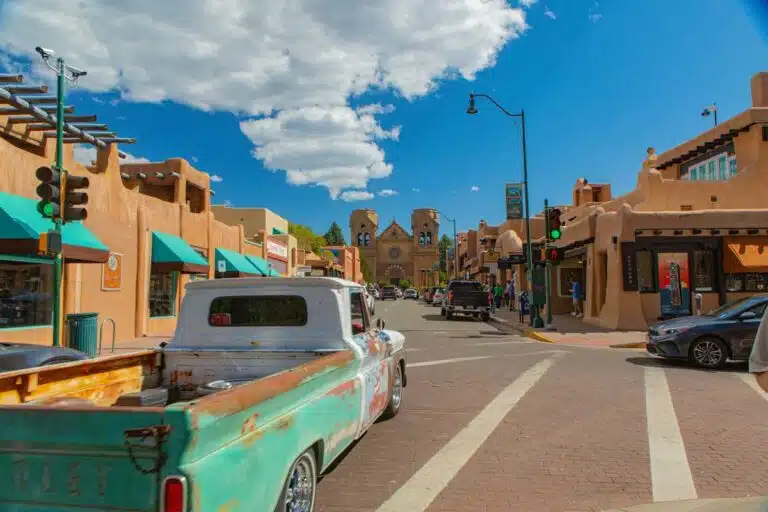
Santa Fe is the oldest state capital in the United States and one of its most distinctive cities — a place where adobe architecture has been the rule rather than the exception for four centuries, where the Georgia O’Keeffe Museum draws art pilgrims from across the world, and where the Palace of the Governors on the historic Plaza has been continuously occupied since 1610, making it the oldest public building in America. At 7,000 feet elevation in the Sangre de Cristo Mountains, Santa Fe has a clarity of light that has attracted painters, sculptors and collectors since the early 20th century, and the concentration of galleries, museums and cultural institutions here is remarkable for a city of fewer than 100,000 people. These guides cover Santa Fe’s key attractions with practical information on ticket prices, opening hours and what to expect on arrival, alongside road trip guides for the most popular routes to and from the city.
Historic landmarks and architecture
Santa Fe’s historic core — the Plaza and the streets radiating from it — contains some of the oldest continuously inhabited buildings in North America alongside the city’s most famous architectural curiosity. Both sites here are within a short walk of each other and can be combined in a single morning.

- Palace of the Governors, Santa Fe: practical guide with hours, prices and tips — the oldest continuously occupied public building in the United States, built in 1610 as the seat of Spanish colonial government in New Mexico, now a state history museum on the Santa Fe Plaza covering four centuries of Native American, Spanish, Mexican and American history, with the famous Portal programme outside where Pueblo artisans sell handmade jewellery and crafts daily.
- Loretto Chapel, Santa Fe: practical guide with hours, prices and tips — a small Gothic Revival chapel built in 1878, famous for the Miraculous Staircase — a 20-step spiral wooden staircase with no central support column and no nails, attributed by some to St Joseph and by others to an unidentified master carpenter, still the subject of genuine architectural and religious debate.
Art museums, galleries and gardens
Santa Fe is one of the most significant art markets in the United States — third only to New York and Los Angeles by some measures — and its museums reflect that concentration. The Georgia O’Keeffe Museum is the obvious draw, but the Museum of International Folk Art is one of the most surprising and rewarding specialist art museums in the country, and the Museum of Indian Arts and Culture is the finest institution of its kind in the Southwest. The four museums below are grouped within the Museum Hill area and the downtown historic district, making it practical to visit two or three in a single day.
- Georgia O’Keeffe Museum, Santa Fe: practical guide with hours, prices and tips — the world’s largest collection of work by Georgia O’Keeffe, the artist who spent the second half of her life in New Mexico and drew the desert landscape — its bones, its flowers and its vast skies — into the American artistic imagination, with the museum covering her full career from her early New York years to her final decades at Ghost Ranch.
- New Mexico Museum of Art, Santa Fe: practical guide with hours, prices and tips — the oldest art museum in New Mexico, established in 1917 in a building that helped define the Santa Fe Style of Pueblo Revival architecture, with a strong permanent collection of New Mexico Modernism and works by artists connected to the state’s long tradition of attracting creative talent.
- Museum of Indian Arts and Culture, Santa Fe: practical guide with hours, prices and tips — one of the finest museums of Native American art and culture in the United States, on Museum Hill, covering the Pueblo, Navajo and Apache peoples of the Southwest with permanent collections of pottery, textiles, jewellery and painting spanning a thousand years of artistic tradition.
- Museum of International Folk Art, Santa Fe: practical guide with hours, prices and tips — the world’s largest museum dedicated to folk art, also on Museum Hill, with a permanent collection of over 130,000 objects from more than 100 countries displayed in the celebrated Girard Wing — a vast room crammed with handmade objects from every corner of the globe in a presentation that is itself a work of art.
- Santa Fe Botanical Garden, New Mexico: practical guide for first-time visitors — a high-desert botanical garden at Museum Hill showcasing the plants of the Sangre de Cristo Mountains and the Chihuahuan Desert, with a steppe garden, an orchard and exhibition spaces that make it a natural complement to an afternoon on Museum Hill.
Road trips to and from Santa Fe
Santa Fe sits at the end of I-25 from the south and the east, at the intersection of routes connecting Albuquerque, the Rio Grande corridor, Texas and the Arizona desert cities. The drive from Albuquerque is the most direct approach and one of the shortest; the drives from El Paso, Dallas and Amarillo cross some of the most dramatic desert and high plains landscapes in the Southwest. These guides cover nine of the most popular routes, with best stops, distances and realistic drive times.
- Albuquerque to Santa Fe drive: best stops, distance and drive time — the short drive north along I-25 through the Rio Grande Valley, less than an hour on the direct route, with the more scenic Turquoise Trail alternative along NM-14 through Madrid and Cerrillos well worth the extra time.
- Las Cruces to Santa Fe road trip: best stops, distance and drive time — the drive north through the Rio Grande Valley from southern New Mexico, passing through Truth or Consequences and the Jornada del Muerto desert, with the Very Large Array radio telescope as a worthwhile detour to the west.
- El Paso to Santa Fe road trip: best stops, distance and driving time — the drive north along I-25 through the Rio Grande corridor, connecting the Texas border city to the New Mexico capital with White Sands National Park and Albuquerque as the main stops on a journey of around four hours.
- Amarillo to Santa Fe road trip: best stops, drive time and distance — the drive west and south from the Texas Panhandle through New Mexico, dropping from the flat Llano Estacado into the dramatic Sangre de Cristo foothills as the landscape transforms toward the high desert of Santa Fe.
- Dallas to Santa Fe road trip: best stops, distance and driving time — the long drive northwest from North Texas through Amarillo or via Lubbock and Roswell, crossing the Texas-New Mexico border and climbing from the Chihuahuan Desert into the mountains around Santa Fe.
- Phoenix to Santa Fe road trip: best stops, distance and drive time — the drive northeast from Arizona through Flagstaff, the Navajo Nation and the high desert plateau, crossing from the Colorado Plateau into the Sangre de Cristo foothills on one of the most scenically varied drives in the Southwest.
- Flagstaff to Santa Fe road trip: best stops, distance and drive time — the drive east across the Colorado Plateau through Winslow, the Petrified Forest and Gallup, crossing the Continental Divide into New Mexico before arriving in the historic capital.
- Sedona to Santa Fe road trip: best stops, distance and drive time — the drive northeast from Arizona’s red rock country through Flagstaff, the Painted Desert and Gallup, one of the most visually dramatic approaches to Santa Fe as the landscape shifts from sandstone canyon country to high mountain desert.
- Santa Fe to Tucson road trip: best stops, distance and drive time — the drive south through Albuquerque and the Rio Grande Valley, crossing into the Chihuahuan Desert and through southern New Mexico before arriving in the Sonoran Desert city of Tucson.
Planning your Santa Fe visit
Santa Fe’s 7,000-foot elevation means noticeably cooler temperatures than Albuquerque, Phoenix or Tucson — a welcome relief in summer, but worth packing for in spring and autumn when evenings can be cold. The historic centre is compact and walkable; Museum Hill, which houses four of the city’s major museums and the botanical garden, is a short drive or taxi ride from the Plaza. Most of Santa Fe’s museums participate in the New Mexico Museum Pass, which offers access to four state museums for a single fee and represents good value for those planning to visit more than one. The Santa Fe Farmers Market and the Canyon Road gallery district — the city’s most concentrated stretch of commercial galleries — are both worth building into any itinerary alongside the formal museum visits.
How many days do you need in Santa Fe?
Two full days covers Santa Fe’s main attractions without rushing. A first day suits the historic centre — the Palace of the Governors, the Loretto Chapel, the Georgia O’Keeffe Museum and a walk along Canyon Road in the afternoon. A second day works well for Museum Hill — the Museum of Indian Arts and Culture, the Museum of International Folk Art and the Botanical Garden are within easy walking distance of each other on the hill. A third day allows a day trip to Taos, a drive along the High Road to Taos through the mountain villages, or a visit to the Bandelier National Monument cliff dwellings west of the city.
What is Santa Fe best known for?
Santa Fe is best known for its Adobe Pueblo Revival architecture — building codes require the distinctive terracotta adobe style throughout the historic centre, giving the city a visual consistency found nowhere else in the United States. It is also known for its art scene, the Georgia O’Keeffe connection, the Santa Fe Opera (which performs in an open-air theatre in the mountains north of the city), and the Palace of the Governors. The city’s Native American and Spanish colonial heritage is more present and tangible here than in almost any other American city, and the Portal programme on the Plaza — where Pueblo artisans sell directly to the public daily — is one of the most authentic cultural experiences available from any Southwest destination.