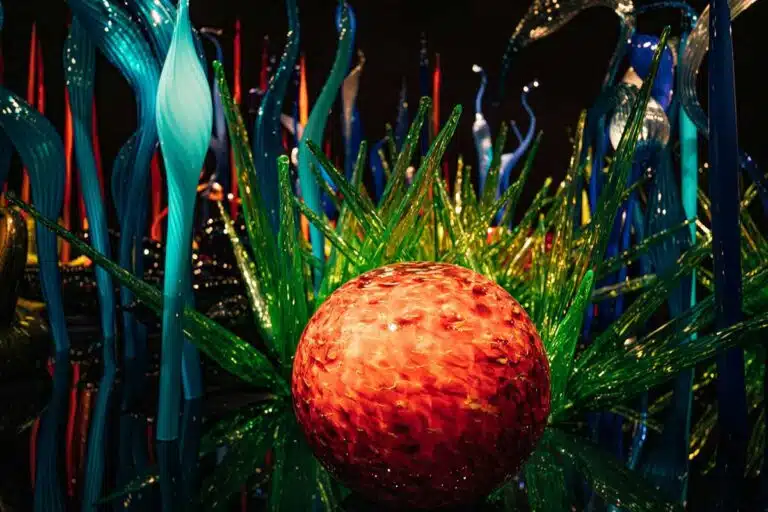
Seattle offers considerably more than the Space Needle and Pike Place Market — though both justify the visit. The city’s real character emerges in its relationship with water: a ferry to Bainbridge Island that doubles as the finest budget cruise on the Pacific Coast; the Ballard Locks, one of the most significant and undervisited engineering sites in the Northwest; and an Aquarium on the waterfront that takes conservation as seriously as spectacle. The cultural offer runs from Dale Chihuly’s extraordinary glass installations to the only museum in the United States dedicated to Nordic American heritage, and from a Smithsonian-affiliated Gold Rush history park to one of the world’s largest aviation museums at Boeing Field. And the city’s local landmarks — a concrete troll under a bridge, a hilltop park with the definitive city photograph, a 1914 tower that was once the tallest building on the West Coast — reward those who venture beyond the tourist circuit. These guides cover Seattle’s key attractions with practical information on ticket prices, opening hours, transport and what to look for on arrival.
The waterfront and Seattle from the water
Seattle is ringed by water — Puget Sound, Lake Washington, Lake Union and the Ship Canal — and the city’s character is inseparable from it. These four attractions each reveal a different dimension of that relationship, and taken together they make a strong case for spending at least a full day on or near the water.
- Seattle to Bainbridge Island ferry: essential guide for first-time visitors — the 35-minute Washington State Ferry crossing to Bainbridge Island, which delivers the finest views of the Seattle skyline, the Olympic Mountains and the Puget Sound islands for the price of a transit fare — one of the great waterborne bargains in America.
- Seattle Aquarium: practical guide for first-time visitors — a waterfront conservation aquarium on Pier 59 with resident sea otters, harbour seals and the impressive Window on Washington Waters — a 120,000-gallon tank displaying the full marine ecosystem of Puget Sound in ecological context.
- Hiram M. Chittenden (Ballard) Locks: salmon, ships and Seattle’s overlooked soul — the 1917 engineering complex in Ballard where the Lake Washington Ship Canal meets Puget Sound, with pleasure boats and commercial vessels locking through daily and the famous fish ladder where salmon can be watched navigating upstream in season.
- Olympic Sculpture Park: a guide to Seattle’s outdoor art on the waterfront — a free award-winning waterfront park on Elliott Bay where large-scale contemporary sculptures by Alexander Calder, Richard Serra and others are set against views of the water and the Olympic Mountains, open at all hours and at its most atmospheric at sunrise and sunset.
Art, science and cultural institutions
Seattle’s cultural offer punches well above the city’s size — the Chihuly Garden and Glass is one of the most technically accomplished permanent exhibitions in America, the Wing Luke Museum is the finest Asian Pacific American cultural institution in the country, and the Museum of Flight at Boeing Field holds one of the most significant aviation collections in the world. The Klondike Gold Rush museum in Pioneer Square is free and consistently underrated.

- Chihuly Garden and Glass, Seattle: practical guide and booking tips — Dale Chihuly’s spectacular permanent installation of blown glass sculptures in the Seattle Center complex, with a glasshouse, gallery spaces and an outdoor garden where the sculptures are designed to be experienced against the backdrop of the Space Needle — one of the most technically extraordinary permanent exhibitions in the United States, and one that requires advance booking at busy periods.
- Pacific Science Center, Seattle: visitor guide with prices, hours and must-know tips — a landmark science institution in the Seattle Center with a Tropical Butterfly House, a planetarium, an IMAX theatre and multiple floors of interactive exhibits, housed in a complex of arched concrete buildings designed by Minoru Yamasaki for the 1962 World’s Fair.
- Klondike Gold Rush National Historic Park: Seattle’s best free attraction — a free National Park Service museum in Pioneer Square telling the story of the 1897 Klondike Gold Rush that transformed Seattle from a regional port into a major Pacific city, with well-curated exhibits on the stampeders, the outfitters and the fortunes made and lost on the Trail of ’98.
- Museum of History and Industry (MOHAI), Seattle: practical visitor guide — Seattle’s main civic history museum on the shores of Lake Union, in a converted Naval Reserve Armory, with permanent exhibitions covering the city’s development from Indigenous history through the timber and fishing industries to the rise of Boeing and Amazon.
- Wing Luke Museum of the Asian Pacific American Experience, Seattle: practical visitor guide — a Smithsonian-affiliated museum in the Chinatown-International District presenting the history, art and culture of Asian Pacific Americans in the Pacific Northwest, with historically significant preserved spaces including a 1910 hotel room and a community association hall serving as primary sources within the exhibition.
- National Nordic Museum, Seattle: practical visitor guide — the only museum in the United States dedicated to the Nordic American experience, in a striking contemporary building in Ballard — the Seattle neighbourhood historically shaped by Norwegian and Scandinavian fishing communities — with collections spanning five Nordic countries and their contribution to Pacific Northwest life and culture.
- Museum of Flight, Seattle: practical visitor guide — one of the largest air and space museums in the world, at Boeing Field south of downtown, with over 175 aircraft and spacecraft including the first Air Force One presidential jet, a Concorde, a Space Shuttle Full Fuselage Trainer and aircraft spanning from the Wright Brothers era to the space age.
- Seattle Art Museum visitor guide: With hours, ticket prices and what to focus on.
Viewpoints, local landmarks and Seattle’s character
The most distinctively Seattle experiences often don’t require a ticket. Kerry Park delivers the city’s most reproduced photograph. The Fremont Troll is the best expression of a neighbourhood that has made an art form of not taking itself entirely seriously. And the Smith Tower Observatory offers the most historically resonant elevated view in the city — from the building that was the tallest on the West Coast for 32 years.
- Kerry Park, Seattle: how to get the city’s best view — the small park on Queen Anne Hill that delivers the classic Seattle skyline photograph — the Space Needle in the foreground, the city and Elliott Bay behind it, and on clear days the snow-capped summit of Mount Rainier rising above everything — with practical advice on the best time to visit and how to avoid the busiest periods at sunset.
- The Fremont Troll: guide to Seattle’s quirkiest landmark — the massive concrete troll clutching a Volkswagen Beetle under the Aurora Bridge in Fremont, created in 1990 as part of a neighbourhood arts initiative, free to visit at any hour and at its most atmospheric before the weekend crowds arrive mid-morning.
- Smith Tower Observatory, Seattle: practical visitor guide — the 1914 skyscraper in Pioneer Square that was the tallest building west of the Mississippi for over three decades, with a restored Chinese Room observation deck offering views over Elliott Bay, the Olympic Mountains and the lower-rise streets of Seattle’s original commercial district below.
Planning your Seattle visit
Seattle’s compact core — Downtown, Pike Place, Pioneer Square and the Seattle Center — is walkable, and the Link Light Rail connects the airport directly to downtown in under 40 minutes. Outlying attractions like the Museum of Flight at Boeing Field, the National Nordic Museum in Ballard and the Ballard Locks are best reached by rideshare or the city’s bus network. The Bainbridge Island ferry departs from Colman Dock at the waterfront — arrive 20 minutes early on weekends to secure a good deck position for the skyline views. Seattle’s famous reputation for rain is only partially deserved: the city receives less annual rainfall than New York or Miami, but it arrives in persistent grey drizzle rather than heavy downpours.
- Seattle vs Vancouver: how Pacific Northwest weather shapes the way we judge cities — an insightful comparison of how the similar climates of Seattle and Vancouver affect visitor experience and city perception, and what the difference in how each city is talked about reveals about how we form judgements about places.
How many days do you need in Seattle?
Three days covers Seattle’s main attractions comfortably. A first day suits the Seattle Center cluster — Chihuly Garden and Glass, the Pacific Science Center and the Space Needle, followed by Kerry Park for the classic view at sunset. A second day works well for Pioneer Square — the Klondike Gold Rush museum and Smith Tower Observatory — followed by an afternoon in Fremont for the troll and the neighbourhood character. A third day suits the waterfront — the Aquarium, the Olympic Sculpture Park and the Bainbridge Island ferry in the afternoon for the skyline view from the water. A fourth day allows the Ballard Locks and National Nordic Museum in the morning and the Wing Luke Museum or Museum of Flight in the afternoon.
What is Seattle best known for?
Seattle is best known internationally for the Space Needle, Pike Place Market, Starbucks (the original on Pike Place), Boeing, Microsoft and Amazon. Among culturally focused visitors it is known for Chihuly Garden and Glass, the Museum of Flight and for being the city that produced Jimi Hendrix, Nirvana and the grunge movement. The Bainbridge Island ferry view of the skyline and the Kerry Park viewpoint together define the city’s visual identity for visitors who seek out more than the obvious.