Exploring the surprising story behind Mt Kosciuszko’s name at a tiny memorial to a Polish patriot in Philadelphia. This article was updated in October 2026.
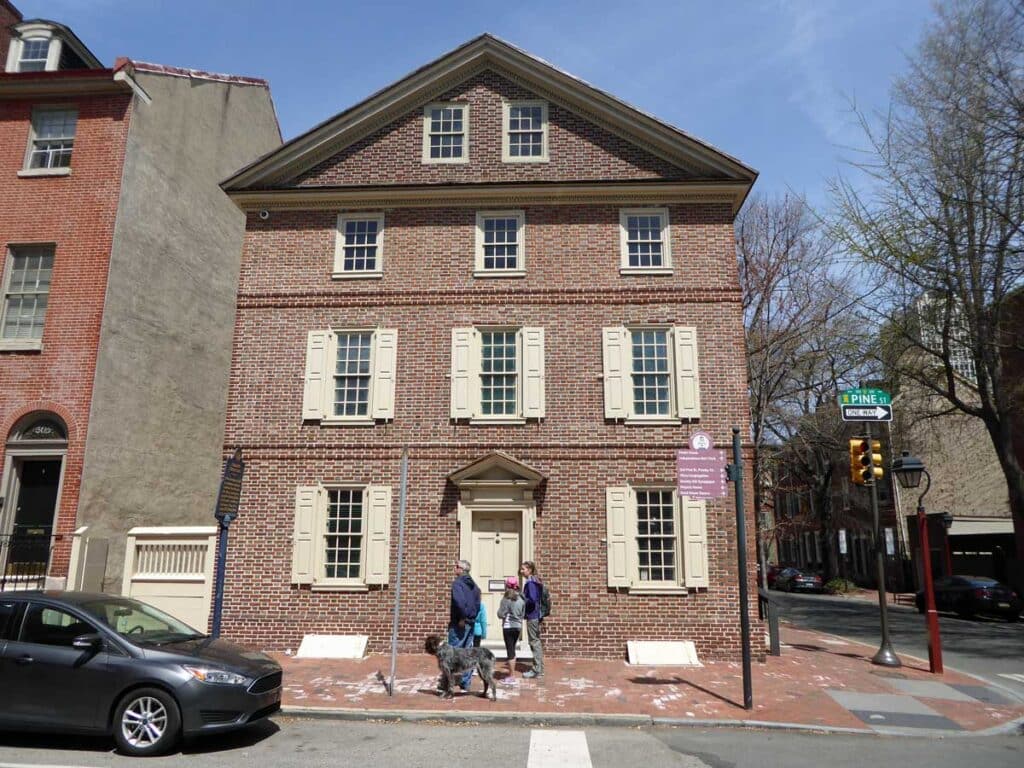
Ann Relf’s boarding house is a handsome but unshowy kind of place. It has a clean, red brick worthiness that looks proudly maintained without dressing up in unnecessary gaudiness. It is also more than 16,000 km away from the place I’m trying to find out about.
The name behind Australia’s highest peak
Australia’s highest mountain, and premier spelling bee nightmare, is Mt Kosciuszko. It seemingly defies most other Australian naming conventions – which usually borrow from British colonialism, Aboriginal terms or near-cartoonish literalism. It is named in honour of a man who even visited Australia, let alone climbed the mountain. And it’s fair to say that most Australians know nothing about Tadeusz Kościuszko.
A Philadelphia memorial for Kościuszko’s stay
Which is why discovering the Thaddeus Kosciuszko National Memorial (the Americans anglicised his first name) in Philadelphia’s historic centre comes as a bit of a surprise. It is the smallest unit in the entire US National Parks system.
The memorial takes over Ann Relf’s boarding house – where Tad stayed between November 1797 and May 1798 – turning into a small museum about a very curious character who became a war hero on two continents.
Kościuszko’s American revolutionary role
It was the Declaration of Independence, signed in Philadelphia, that drew Kosciuszko to the States. He was the first of several highly trained European military officers who were quite taken by the lofty ideals of liberty, and sailed out to fight the impending Revolutionary War. In that war, Kościuszko made quite a name for himself, his military engineering skills coming to the fore in the victory at Saratoga and the defence of geographically critical West Point.
A few of his drawings for defensive positions are on show, but most were destroyed so that the British couldn’t get their hands on them. After the war, he returned to Poland, where he soon turned a 5,000-strong excuse for an army into a force of 150,000 that included peasants armed with scythes. This new war of independence against Russia was unsuccessful, and he ended up seriously wounded and imprisoned.
5 great things to do in Philadelphia
- 🥖 Taste the best of Philly on a food tour – including historic Reading Market.
- 🏛️ Get to know Philadelphia’s heritage sites – on a guided walking tour.
- 🍻 Go on a pub crawl – but learn the history between beers.
- 🎨 Let a guide show you Philadelphia’s best murals and street art – including Magic Gardens.
- 🌙 Discover Philly’s dark side – on an adults-only night tour.
His return to the United States and debt claim
The boarding house comes into play after this, when Kościuszko not unreasonably decided he wanted his wages for fighting the Revolutionary War. He got a hero’s welcome in Philadelphia, and future president Thomas Jefferson – who later called Kościuszko “as pure a son of liberty as I have ever known” – signed on as his lawyer. He got his cash, and an extensive land grant before returning to Europe and dying in exile in Switzerland.
Legend, legacy and naming a mountain
The legend, though, is almost more interesting than the man. The Memorial shows off his bedroom and tells his story, but otherwise has very little belonging to him – partly because his birthplace is now in Belarus and the Belarussians want Kościuszko recognised as Belarussian before releasing artefacts.
So the most interesting part of the museum ends up being a touchscreen, which shows just how many monuments, streets and landmarks have been named after Kościuszko. They’re mapped – an island in Alaska, a road in Belgrade, a horseback statue at Wawel Castle in Krakow, a street in Rio de Janeiro, the town in Mississippi where Oprah Winfrey was born… And, of course, the highest mountain in Australia.
How Mt Kosciuszko got its name
For this, we have to thank fellow Pole Pawel Strzelecki, who came out to Australia, surveyed Gippsland in Victoria, then set out for the Australian Alps. He was the first to climb Kosciuszko, and he decided to name it after his heroic compatriot. But, as the Memorial in Philadelphia shows, Kosciuszko doesn’t really belong to Australia. He doesn’t really belong to the US or Poland, either – he’s a man whose rather romantic legend and principles have led to him being indistinctly remembered all over the world.
Visitor information for the Kosciuszko National Memorial
| Question | Answer |
|---|---|
| What are the opening hours? | The Memorial is open Saturdays and Sundays from 12:00 pm to 4:00 pm. It closes during the winter months. |
| Is there an admission fee? | No. Admission is free, and no tickets are required. |
| Where is it located? | 301 Pine Street, Philadelphia, PA 19106, just blocks from Independence Hall and the Liberty Bell. |
| What parking options are nearby? | There is no on-site parking. Visitors can use the Independence Visitor Center garage at 6th & Market or the 2nd Street garage between Chestnut and Walnut. |
| Why visit this memorial? | It preserves the house where Kościuszko recuperated and educates visitors on his revolutionary work across the US and Europe. |
This information was checked and updated in October 2026.
Things to do near the Thaddeus Kosciuszko National Memorial
- Betsy Ross House – This historic Old City house is associated with the story of Betsy Ross and the first American flag, with period-furnished rooms and displays about colonial life.
- Independence Hall – This landmark is where the Declaration of Independence and the US Constitution were debated and adopted, making it central to Philadelphia’s Revolutionary-era history.
- Liberty Bell Center – See the famous cracked bell and learn how it became a symbol of American independence and later civil rights movements.
- Christ Church Burial Ground – This historic cemetery is the burial place of Benjamin Franklin and several other signatories of the Declaration of Independence.
- Museum of the American Revolution – Exhibitions, personal accounts and historical artefacts trace the Revolutionary War, including a reconstruction of George Washington’s military tent.
Alternative attractions
- National Liberty Museum – Close to Independence Hall, this museum explores the meaning of liberty through exhibitions about human rights, civic responsibility and individual courage.
- Benjamin Franklin Museum – Interactive displays and historical objects explore Franklin’s work as a scientist, inventor, writer, printer and statesman.
- National Constitution Center – This museum examines the US Constitution and its influence through interactive exhibits and presentations on American government.
- Independence Seaport Museum – On the Delaware River waterfront, this museum covers Philadelphia’s maritime history and offers access to historic vessels including the cruiser USS Olympia.
- Eastern State Penitentiary – This former prison in Fairmount is now a historic site with preserved cellblocks and exhibitions on the development of the American penitentiary system.
More Philadelphia travel
Other Philadelphia travel articles on Planet Whitley include:
- Review of the Benjamin Franklin Museum in Philadelphia.
- Review of the very weird Mutter Museum in Philadelphia.
- Guides to Philadelphia’s Parkway attractions – the Rodin Museum, the Barnes Foundation, the Franklin Institute and the Rocky Steps at the Philadelphia Museum of Art.
- Review of the Eastern State Penitentiary in Philadelphia.