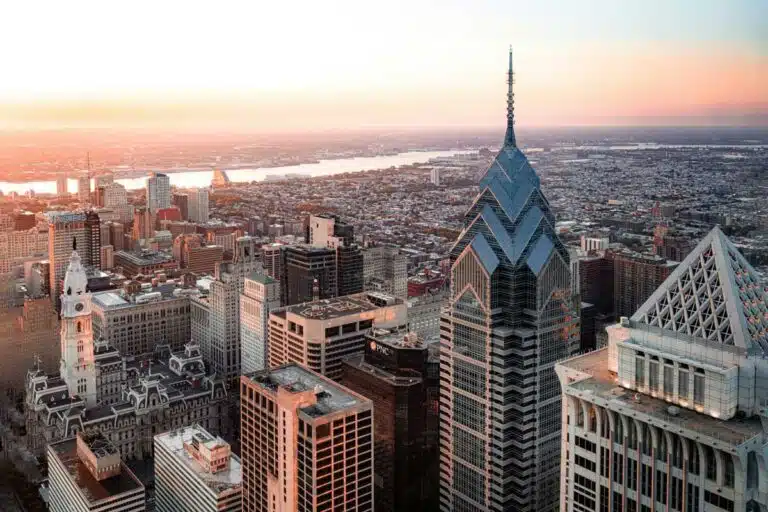
Philadelphia is the most historically significant city in the United States — the place where the Declaration of Independence was signed, where the Liberty Bell cracked, and where Benjamin Franklin lived, worked and died. But the city offers considerably more than its revolutionary credentials: the Benjamin Franklin Parkway is lined with world-class museums, the Barnes Foundation houses one of the great private art collections ever assembled, and the Eastern State Penitentiary and Mütter Museum are among the most extraordinary visitor experiences on the East Coast.
Philadelphia rewards those who stay long enough to explore beyond the Independence National Historical Park — the food, the neighbourhoods and the cultural institutions make a compelling case for three or four days. For a broader argument, six great reasons to visit Philadelphia covers the ground in full.

Colonial history, independence and Benjamin Franklin
The Independence National Historical Park and its surrounding streets form one of the most concentrated assemblages of Revolutionary War history in the world — almost all of it free to enter and most within easy walking distance of each other. Benjamin Franklin is woven into the fabric of the city at almost every turn: the museum bearing his name, his burial ground and the Parkway itself all carry his legacy.
- Philadelphia’s historic attractions: an introduction to America’s past — a strategic overview of the Independence National Historical Park area, covering what to visit, what’s free, and how to plan a first visit to the city’s Revolutionary-era landmarks without getting overwhelmed by the density of significant sites.
- Liberty Bell Center, Philadelphia: opening hours, prices and visitor tips — America’s most famous cracked symbol, displayed in a glass pavilion on Market Street directly opposite Independence Hall, free to enter and best visited early morning before the queues build, with security procedures worth knowing about in advance.
- Museum of the American Revolution, Philadelphia: ticket prices, hours and visitor guide — a serious and well-designed museum telling the full story of the Revolutionary War from its causes through the constitutional settlement, with George Washington’s campaign tent among the most significant original artefacts on display.
- Benjamin Franklin Museum, Philadelphia: why it’s worth visiting — an underground museum on the site of Franklin’s former home in Franklin Court, covering the full breadth of his career as printer, scientist, diplomat, writer and founding father with interactive exhibits and original artefacts.
- Christ Church Burial Ground, Philadelphia: visitor guide with prices and hours — the 18th-century churchyard where Benjamin Franklin and his wife Deborah are buried alongside four other signatories of the Declaration of Independence, with the long-standing tradition of tossing a penny onto Franklin’s grave for good luck.
- Betsy Ross House, Philadelphia: opening hours, tickets and how to plan your visit — the Georgian rowhouse in the Old City neighbourhood where Betsy Ross is said to have sewn the first American flag in 1776, with a self-guided tour through period-furnished rooms and an exhibition on the legend’s disputed history.
- National Liberty Museum, Philadelphia: ticket prices, hours and visitor guide 2026 — a museum dedicated to the meaning and fragility of American liberty, with exhibitions on heroes of conscience, glass art and the ongoing struggle to realise the ideals of the Declaration of Independence, housed steps from Independence Hall.
- Thaddeus Kościuszko National Memorial: the Revolutionary War hero and Australia’s highest mountain — the boarding house where Polish military engineer Tadeusz Kościuszko lived during his second American visit, and the unexpected story of how a hero of the American Revolution came to give his name to the highest peak in Australia.
The Benjamin Franklin Parkway: art, science and culture
The Benjamin Franklin Parkway — Philadelphia’s answer to the Champs-Élysées, stretching northwest from City Hall to the Philadelphia Museum of Art — is lined with some of the finest cultural institutions in America. The Rocky Steps and the museum’s exterior are free; most of the other institutions charge admission but are worth every dollar.
- Philadelphia Museum of Art: visitor guide with prices, hours and parking tips — one of the largest art museums in the United States, with over 240,000 objects spanning 2,000 years of art history in a Greek Revival temple at the top of the Parkway, famous worldwide for the 72 steps that Sylvester Stallone ran up in the original Rocky.
- Rocky Steps and the Rocky Balboa statue: visitor guide 2026 — a guide to the 72 stone steps at the entrance to the Philadelphia Museum of Art and the Rocky Balboa bronze statue at their base, one of the most visited free attractions in the city with the best view back down the length of the Benjamin Franklin Parkway.
- Barnes Foundation, Philadelphia: practical guide for first-time visitors — one of the world’s great private art collections, with 181 Renoirs, 69 Cézannes, 59 Matisses and works by Picasso, Van Gogh and Modigliani displayed in the idiosyncratic wall arrangements that Albert C. Barnes devised and insisted be preserved exactly as he left them.
- Rodin Museum, Philadelphia: ticket prices, hours and visitor guide 2026 — the largest collection of Auguste Rodin’s work outside Paris, including a cast of The Thinker in the garden and The Gates of Hell at the entrance, in a Beaux-Arts building with a tranquil sculpture garden that makes it one of the most serene stops on the Parkway.
- Franklin Institute, Philadelphia: ticket prices, hours and visitor guide — Philadelphia’s premier science and technology museum, with a giant walk-through heart, the Fels Planetarium, a train simulator and a permanent exhibition on Benjamin Franklin’s electrical experiments, equally rewarding for families and adult visitors.
- Academy of Natural Sciences, Philadelphia: 2026 visitor guide — the oldest natural history museum in the Americas, founded in 1812, with dinosaur skeletons, a live butterfly garden, North American wildlife dioramas and a palaeontology dig pit that makes it one of the best family science museums on the East Coast.
- Penn Museum, Philadelphia: practical visitor guide — the University of Pennsylvania Museum of Archaeology and Anthropology, with world-class collections from ancient Egypt, Mesopotamia and ancient Greece, including one of the finest Egyptian mummy collections in the United States and a crystal ball once owned by J. P. Morgan
- Plan your visit to the Cathedral Basilica of Saints Peter and Paul in Philadelphia.
Unusual, dark and waterfront Philadelphia
Philadelphia has two of the most distinctive and talked-about paid attractions in America — a Victorian medical museum of genuine strangeness and a Gothic fortress prison that pioneered the modern penitentiary system. The Delaware River waterfront adds a maritime dimension, with a Spanish-American War cruiser and a WWII battleship moored within easy reach of the city centre.
- Mütter Museum, Philadelphia: an honest review of the city’s strangest attraction — a Victorian medical museum at the College of Physicians of Philadelphia housing anatomical specimens, pathological preparations and medical instruments of extraordinary variety, including the tallest skeleton on display in North America, a wall of 139 skulls and slices of Albert Einstein’s brain.
- Eastern State Penitentiary, Philadelphia: visitor review — a Gothic fortress prison in Fairmount that was the most expensive building in America when it opened in 1829, operated until 1971 and now a preserved ruin with audio tours covering the penitentiary system’s origins, famous inmates including Al Capone and the radial cell-block design that influenced prisons worldwide.
- Independence Seaport Museum, Philadelphia: complete visitor guide 2026 — a maritime history museum on the Delaware River waterfront covering Philadelphia’s role as a port city, with access to the USS Olympia — the oldest surviving steel warship afloat in the world and the flagship at the Battle of Manila Bay in 1898 — and the WWII submarine USS Becuna.
- Battleship New Jersey, Camden: hours, ticket prices and visitor guide 2026 — the most decorated battleship in US Navy history, moored on the Camden waterfront directly across the Delaware River from Philadelphia, with tours through the gun turrets, combat engagement centre and captain’s quarters of a ship that served in four conflicts across six decades.
State parks near Philadelphia
Philadelphia’s surrounding counties contain a network of accessible Pennsylvania state parks within easy reach of the city — a practical option for visitors who want outdoor time alongside their urban sightseeing, or for families looking for space between museum days.
- Marsh Creek State Park, Downingtown: practical visitor guide — a 1,705-acre park in Chester County west of Philadelphia, with a 535-acre lake popular for sailing, kayaking and windsurfing, accessible walking trails and good birdwatching in the surrounding woodland and meadow habitats.
- Neshaminy State Park, Bensalem: practical visitor guide — a 330-acre riverfront park on the Delaware River in Bucks County, with a swimming pool, picnic areas, a boat launch and river access, one of the most accessible outdoor recreation areas within easy reach of northeast Philadelphia.
- Benjamin Rush State Park, Philadelphia: practical visitor guide — a 296-acre park in northeast Philadelphia with hiking trails, dog exercise areas and meadow habitats, named after Dr Benjamin Rush — a signatory of the Declaration of Independence and a founder of American psychiatry.
Road trips to and from Philadelphia
Philadelphia sits at the northeastern end of the Mid-Atlantic corridor, within comfortable driving distance of Pittsburgh, New York City and Washington DC, and at the end of a series of longer routes from the Midwest. The Pennsylvania Turnpike and Interstate 76 provide the main east-west spine; the drives in from Ohio and beyond pass through some of the most varied landscapes in the eastern United States. These guides cover the best stops, distances and realistic drive times for nine of the most popular routes.
- Harrisburg to Philadelphia drive: best stops, distance and drive time — the drive east along the Pennsylvania Turnpike through Lancaster County Amish Country, with options to detour through Lancaster city, the Ephrata Cloister and the Dutch Country markets.
- Pittsburgh to Philadelphia road trip: best stops, distance and drive time — the cross-state drive east through the Appalachian Mountains, the Susquehanna Valley and Lancaster County, connecting Pennsylvania’s two great cities across 300 miles of varied landscape.
- Chicago to Philadelphia road trip: best stops, distance and drive time — the drive east across Indiana, Ohio and Pennsylvania, with Pittsburgh and the Laurel Highlands as natural midpoint stops on one of the great cross-country East-Midwest routes.
- Cleveland to Philadelphia road trip: best stops, distance and drive time — the drive east through Pennsylvania via the I-80 or Pennsylvania Turnpike corridors, with options through Pittsburgh, the Laurel Highlands and Amish Country.
- Columbus to Philadelphia drive: best stops, distance and drive time — the drive east from central Ohio through Pittsburgh and across Pennsylvania to the Delaware Valley, one of the most direct routes between the Ohio heartland and the East Coast.
- Indianapolis to Philadelphia drive: best stops, distance and drive time — the long drive east from Indiana through Ohio and Pennsylvania, connecting the Midwest to the Mid-Atlantic on a route that rewards those who resist the direct interstate.
- St Louis to Philadelphia drive: best stops, distance and drive time — the long drive east from the Gateway Arch city across Illinois, Indiana, Ohio and Pennsylvania, with Indianapolis and Pittsburgh as natural overnight stops.
- Philadelphia to Cincinnati drive: best stops, distance and drive time — the drive west through the Pennsylvania Appalachians, Pittsburgh and into Ohio, connecting the birthplace of American democracy with one of the Ohio River’s great historic cities.
- Philadelphia to Detroit road trip: best stops, distance and drive time — the drive northwest through Pennsylvania, Ohio and into Michigan, connecting the birthplace of American democracy with the birthplace of the automobile industry across a route that passes through some of the most significant industrial heritage landscapes in the country.
There are also guides to the Philadelphia to Baltimore drive, Philadelphia to Washington DC drive and New York City to Philadelphia drive.
Planning your Philadelphia visit
Philadelphia is compact and walkable at its historic core — the Independence National Historical Park area, Old City, Society Hill and the Benjamin Franklin Parkway are all connected on foot, and the SEPTA bus and subway network covers the wider city efficiently. Driving into central Philadelphia is not recommended; the parking is expensive and scarce, and most major attractions are easier to reach by public transport or rideshare. The Philadelphia Museum of Art, Academy of Natural Sciences and Franklin Institute all offer Pay What You Wish hours on certain evenings — worth checking before booking. The city is busiest in summer and during October, when the fall foliage along the Parkway is at its most photogenic; spring and early autumn offer comfortable temperatures and manageable crowds.
How many days do you need in Philadelphia?
Two days covers the headline sights. A first day suits the Independence National Historical Park area — the Liberty Bell, a walk through Old City, the Betsy Ross House and the Museum of the American Revolution. A second day works well for the Benjamin Franklin Parkway — the Philadelphia Museum of Art and Rocky Steps, the Barnes Foundation or Rodin Museum, and either the Franklin Institute or Academy of Natural Sciences. Three days opens up Eastern State Penitentiary, the Mütter Museum and the Delaware waterfront. Four days allows proper time in the neighbourhoods — Fishtown, South Philly, the Reading Terminal Market — that give the city its character beyond the sights.
What is Philadelphia best known for?
Philadelphia is best known internationally for the Liberty Bell, Independence Hall and its role as the birthplace of American democracy. Among cultural visitors it is increasingly known for the Barnes Foundation and the Philadelphia Museum of Art. The Mütter Museum and Eastern State Penitentiary have developed strong reputations as two of the most distinctive paid attractions on the East Coast. The city is also known for the Philadelphia cheesesteak, the Reading Terminal Market and a food scene that has expanded well beyond those associations over the past decade.
Is Philadelphia worth visiting?
Emphatically yes — and for longer than most first-time visitors allow. Philadelphia is consistently underrated relative to New York and Washington DC, and its combination of Revolutionary War history, world-class art collections and genuinely unusual attractions is stronger than either. The Barnes Foundation alone is worth a dedicated trip; the Eastern State Penitentiary is unlike any other historic site in America; and the concentration of free and low-cost historic sites in the Independence Park area makes the city unusually accessible for visitors on a budget.