Eureka Springs, Arkansas, exists because of a rumour. In the late 1870s, word spread that the natural springs tucked into these Ozark Mountain hollows could cure almost anything — blindness, paralysis, skin disease, you name it. By 1881, so many people had arrived to test the claim that the town had become Arkansas’s fourth-largest city.
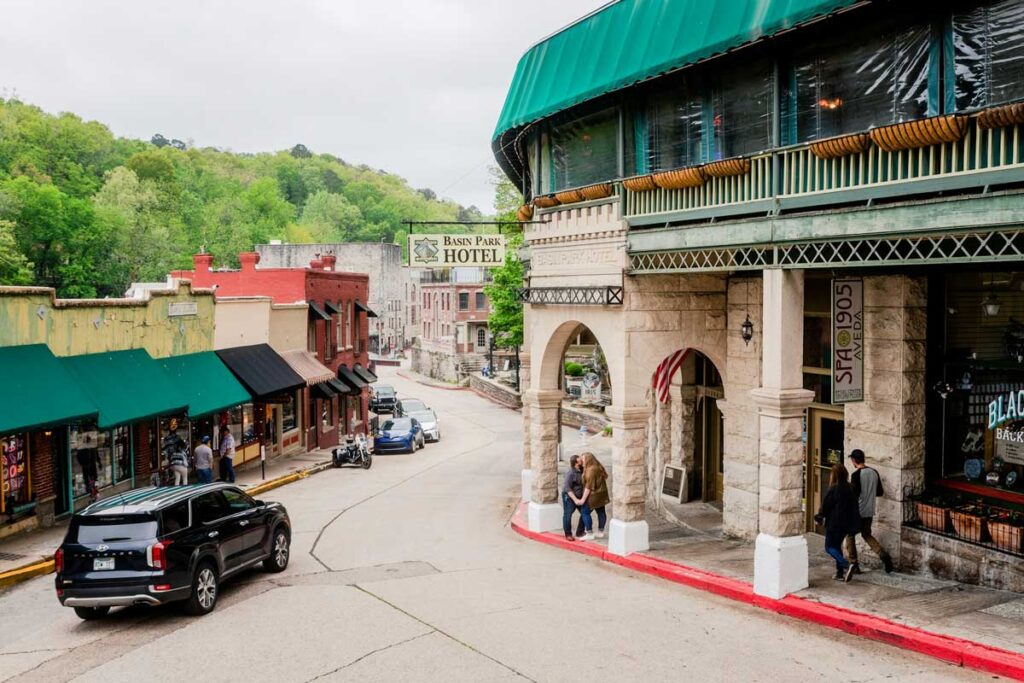
The springs didn’t cure much, as it turned out. But the Victorian town they conjured into existence — stacked improbably up and down a series of steep hillsides, its streets meeting at right angles only once — survived long after the health craze faded. The entire city is listed on the National Register of Historic Places.
The Eureka Rocket golf cart tour is one of the better ways to get under its skin. In under two hours, it covers around five miles of terrain — including neighbourhoods and springs that most visitors walking the downtown strip never find.
Check availability and book the Eureka Rocket tour →
Why Eureka Springs is hard to see on foot
The town’s nickname is “the city of stairs” — and it earns it. Streets that look close on a map are separated by steep staircases and switchbacks. Victorian homes cling to the hillsides at angles that suggest they shouldn’t still be standing. Driving yourself is complicated by one-way streets and very limited parking.
A street-legal golf cart solves most of this. It can reach backstreets and residential areas that tour buses cannot, it keeps a pace that allows you to take things in, and a group of up to five people gets the tour to themselves — it’s booked as a private experience, not shared with strangers.
The springs themselves
There are 62 documented springs in and around Eureka Springs. The tour visits 8–10 of them — far more than you’d encounter just wandering the downtown area, where one or two are signposted for visitors. The springs vary considerably: some are large enough to have historic bath houses built around them, others are little more than a trickle from a stone wall, but each has its own name and its own story.
The “healing water” narrative that drew the town’s original visitors is a fascinating piece of 19th-century American history. Native American traditions in the region had long treated the springs as sacred. European settlers arriving in the 1870s absorbed and amplified these stories, and published accounts of miraculous cures spread rapidly. Thousands arrived with every ailment imaginable. By the time medical science had largely debunked the claims — around the turn of the 20th century — the town’s Victorian infrastructure was already built, and the boom had moved on to something else.
What else the tour covers
The springs are the focus, but the route takes in a lot of the town’s broader history. Among the landmarks and stories typically included:
- The 1886 Crescent Hotel — built by the Eureka Springs Improvement Company and the Frisco Railroad at a cost of $284,000, constructed from Arkansas limestone by Irish stonemasons. It opened as a luxury resort when the healing water business was at its peak, hosting 500-person banquets and maintaining a stable of 100 horses. It later served as a women’s college, a hotel, and — most notoriously — as a fraudulent cancer clinic run by a man with no medical training in the late 1930s. Today it operates as a hotel and spa and markets itself as “America’s most haunted hotel.”
- The Basin Park Hotel — built in 1905, notable for the fact that every floor has a ground-level exit due to the hillside terrain it sits on.
- St Elizabeth of Hungary Catholic Church — an unusual building entered through its bell tower, which sits at street level while the main church is below.
- The historic residential streets — Victorian homes on Eureka Springs’ “historic loop,” many of which have been converted to bed and breakfasts, along with backstories of the characters who inhabited them.
- Local legends — the tour leans into some of Eureka Springs’ stranger folklore, including accounts of Carrie Nation (the temperance campaigner who repeatedly visited and smashed up the town’s saloons), a bank robbery gone wrong, and various ghost stories attached to the town’s older buildings. The guide is also known to address Bigfoot with some enthusiasm. Approach this element with an open mind.
Practical details
| Duration | 1 hour 50 minutes (often runs longer) |
| Price | $59.40 per adult |
| Group size | Maximum 5 people — private to your group |
| Ages | 6–99; infants on laps |
| Meeting point | New Delhi Café, 2 N Main St, Eureka Springs — hotel pick-up also available |
| Language | English and Spanish |
| Weather | Outdoor tour — runs in good weather only; full refund or reschedule if cancelled due to weather |
| Accessibility | Not wheelchair accessible |
| Cancellation | Full refund if cancelled at least 24 hours before departure |
If you are visiting in cooler months, dress in layers — the cart is open-sided and the air gets cold at speed. The tour runs in both daytime and evening slots; the evening version takes on more of a ghost tour character.
What visitors say
The tour holds a perfect 5.0 out of 5 on TripAdvisor from 187 reviews, with 100% of travellers recommending it. The private format — maximum five people — comes up repeatedly as a key part of why it works. Visitors consistently note that they saw parts of the town they would never have discovered walking independently, and that the tour covers far more ground than the downtown area alone suggests is possible.
One honest note from a recent reviewer: the evening tour places more emphasis on ghost stories and local folklore (including the Bigfoot material) than on the history covered in the daytime version. If that’s not what you’re after, book the daytime slot.
Book the tour
The Eureka Rocket tour is bookable through Viator at $59.40 per adult, with free cancellation up to 24 hours before departure. As a private tour capped at five people, it sells out quickly during peak season — particularly autumn, when Eureka Springs draws visitors for the fall foliage.
See availability and book the Eureka Rocket golf cart tour →
Frequently asked questions
What are the natural springs in Eureka Springs?
There are 62 documented springs in the Eureka Springs area. They originate in the limestone geology of the Ozark Mountains and were widely promoted in the late 19th century as having healing properties. Most are still accessible, though they are no longer promoted for medicinal use. The tour visits 8–10 of them, including several that are not on the standard tourist circuit.
Is Eureka Springs worth visiting?
It is an unusually well-preserved Victorian town — the entire city is on the National Register of Historic Places — with a distinctive character that sets it apart from most small American cities. It has a thriving arts scene, a strong tradition of independent restaurants and shops, and a history that is genuinely strange and interesting. It also has significant natural surroundings, including Beaver Lake and the nearby Thorncrown Chapel, which the American Institute of Architects ranked among the top ten architectural works of the 20th century.
How hilly is Eureka Springs?
Very. The town is built across a series of Ozark ridges and hollows, with streets that rise and fall steeply and staircases that substitute for pavements in some areas. Walking the full historic area in a day is tiring. The golf cart tour covers roughly five miles of this terrain without the elevation effort.
Is the tour suitable for children?
The minimum age is 6. Infants can travel on laps. The tour’s mix of history and local folklore tends to hold children’s attention, though the evening ghost tour version may not be suitable for younger or easily frightened children.
What is the Crescent Hotel in Eureka Springs?
The 1886 Crescent Hotel and Spa is the town’s most famous building — a limestone resort hotel built at the height of the healing water boom, later repurposed as a women’s college and then as a fraudulent cancer clinic before becoming a hotel again after World War II. It is currently a working hotel and spa and runs its own ghost tours. It features on the Eureka Rocket route.
More Arkansas travel
Other Arkansas travel stories on Planet Whitley include:
- Dig for diamonds at Crater of Diamonds State Park, Murfreesboro
- First-time visitor’s guide to Fort Smith, Arkansas.
- The best stops on the drive from Dallas to Hot Springs, Arkansas, Houston to Hot Springs drive and Memphis to Hot Springs drive.
- Where to stop on the Little Rock to Dallas drive, Little Rock to Houston drive and Little Rock to Memphis drive.