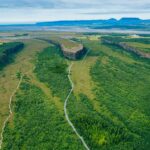
Goðafoss (pronounced goh-tha-foss) is a horseshoe-shaped waterfall on the river Skjálfandafljót in North Iceland, located directly on Route 1 (the Ring Road) approximately 50 kilometres east of Akureyri, between the towns of Akureyri and Lake Mývatn. This guide covers access, parking, public transport, what to see on both sides of the falls, accessibility, and practical planning tips for a visit to Goðafoss.
Last updated: April 2026. Goðafoss remains free to enter and free to park at — unlike many other Icelandic waterfalls, including Skógafoss and Seljalandsfoss, which introduced parking fees in 2025. Some guides published before 2025 include outdated comparisons assuming all major Icelandic waterfalls are free; this is no longer the case at several southern Iceland sites. Goðafoss currently has no parking charge.
Quick facts
| Detail | Information |
|---|---|
| Full name | Goðafoss (Waterfall of the Gods) |
| Location | Route 1 (Ring Road), Bárðardalur, North Iceland |
| GPS coordinates | 65.6828° N, 17.5502° W |
| Opening hours | Open 24 hours a day, year-round |
| Admission | Free |
| Parking | Free; two car parks (east and west banks), both open 24/7 |
| Distance from Akureyri | Approx. 50 km / 45 minutes by car east on Route 1 |
| Distance from Lake Mývatn | Approx. 35 km / 35 minutes by car west on Route 1 |
| Distance from Reykjavík | Approx. 438 km / 5.5 hours by car |
| On-site facilities | Café, restaurant, gift shop, and toilets at Fosshóll (east bank) |
| Public transport | Strætó bus Route 79 (Akureyri–Húsavík); stop at Fosshóll–Goðafoss |
| Typical visit duration | 30–60 minutes |
| Part of | The Diamond Circle scenic route |
Goðafoss opening hours
Goðafoss is a natural site and is open at all hours, every day of the year. There are no gates, no entry times, and no booking required. The car parks on both sides of the river are also open 24 hours a day. The falls can be visited at night, at dawn, and in winter — though paths can be icy in cold weather and there is no artificial lighting.
The Fosshóll café and facilities on the east bank are seasonal and keep daytime hours only, broadly 09:00–18:00, with variations depending on time of year. The café is generally open from late spring through early autumn; hours are reduced or closed in deep winter. Visiting outside these hours is perfectly possible but there will be no on-site food, drink, or staffed toilet facilities available.
Goðafoss admission and ticket prices
Entry to Goðafoss is free. There is no admission charge to see the waterfall, and no booking or ticket is required. Both viewing areas and the pedestrian bridge between them are freely accessible at all times.
Admission status was verified against current visitor information sources and last updated in April 2026.
How to get to Goðafoss
By car is the most practical option. Goðafoss sits directly on Route 1 (the Ring Road) and is clearly signposted. From Akureyri, drive east on Route 1 for approximately 45–50 minutes. From Lake Mývatn, drive west on Route 1 for approximately 35 minutes. Standard cars and campervans can access both car parks without difficulty year-round; Route 1 in this area is paved and maintained in winter.
By public bus, Strætó Route 79 runs between Akureyri (departing from Akureyri–Hof bus terminal) and Húsavík, with a scheduled stop at Fosshóll–Goðafoss on the east bank. The journey from Akureyri to the Goðafoss stop takes approximately 32–33 minutes. The service runs three times daily and operates every day of the week. Check current timetables and buy tickets at straeto.is before travelling, as schedules are subject to seasonal variation. At least one Tripadvisor reviewer notes that the bus driver on Route 79 is helpful in advising return times.
By guided tour, several operators run day trips from Akureyri that include Goðafoss alongside Lake Mývatn, Dettifoss, and other Diamond Circle stops. These tours depart from Akureyri and are an option for visitors without a car.
Parking at Goðafoss
Parking is free at Goðafoss on both banks of the river, and there is no time limit. Both car parks are open 24 hours a day.
The west bank car park is the larger of the two and sits adjacent to the main elevated viewpoint. It provides a panoramic view of the full horseshoe shape of the falls and is the more popular starting point. The east bank car park is smaller (approximately 70 spaces) and is located next to Fosshóll Café, the restaurant, toilets, and gift shop. A pedestrian footbridge over the Skjálfandafljót connects both banks, so visitors can park on either side and cross on foot to see both viewpoints without moving their vehicle.
In peak summer (June–August), both car parks can fill during busy midday periods. Overflow parking is available at the Fosshóll café site on the east bank; the café requests that overflow users make a purchase. Arriving before 09:00 or after 17:00 significantly reduces the chance of parking difficulties.
How long to spend at Goðafoss
30 to 60 minutes is enough for most visitors to walk both banks, cross the pedestrian bridge, and take in the main viewpoints. Visitors who want to spend time photographing at different angles, walk sections of the river path, or wait for optimal light conditions should allow 60–90 minutes. The total circular walking route around the falls, including crossing the bridge and returning, is approximately 1.8 miles (3 km).
Accessibility at Goðafoss
The east bank car park has paved walkways leading to viewing platforms, which are suitable for most mobility levels and for pushchairs. The terrain becomes uneven and unpaved closer to the water’s edge. Safety barriers protect the main viewing areas but are not present everywhere along the riverbank. The west bank paths are shorter and elevated but involve some uneven ground. In winter, ice on paths and steps requires extra caution; crampons are advisable between November and March.
There is no dedicated disabled parking signage at the falls, but the east bank car park is closest to the paved paths. Visitors with significant mobility requirements may find the east bank easier to navigate.
What to see at Goðafoss
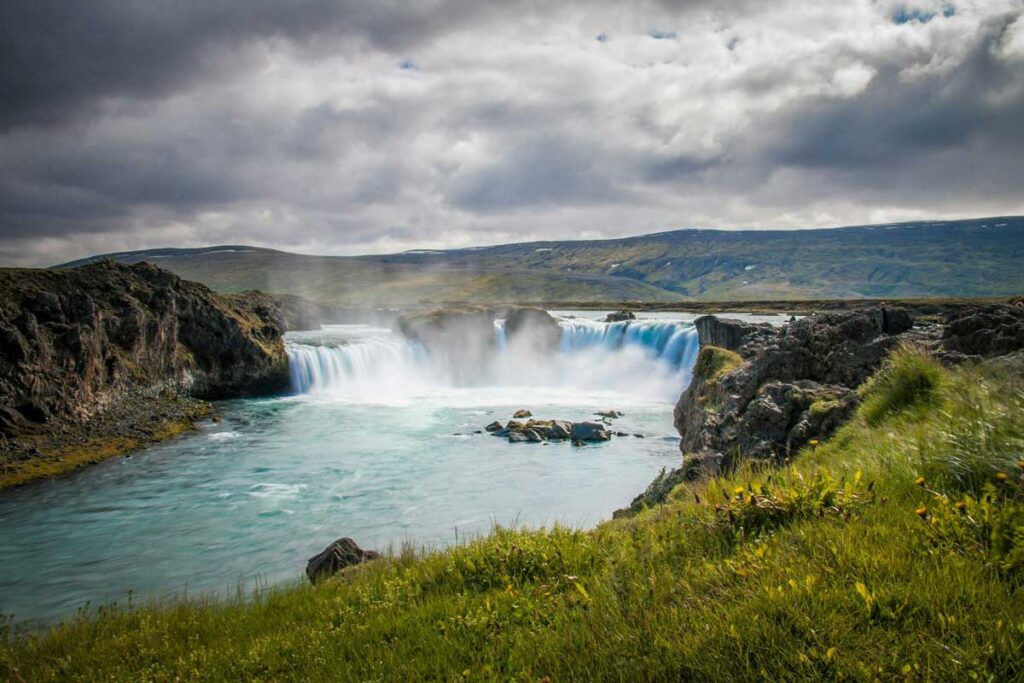
The falls themselves. Goðafoss measures 12 metres in height and 30 metres in width. The river Skjálfandafljót splits around a central rock formation, creating two separate curtains of water that merge into a horseshoe-shaped basin below. The water carries glacial sediment from the Sprengisandur highland plateau, giving it a distinctive grey-green colour. Flow rate peaks in summer when snowmelt increases the river’s volume.
The west bank viewpoint. The west bank provides an elevated, panoramic view of the full curve of the falls. Walking up the slope behind the main viewpoint gives an even wider angle on the horseshoe shape. This is the more photographed side. The west bank also has a lower riverside path leading closer to the edge of the falls; this section can be slippery.
The east bank viewpoint. The east bank is closer to the main facilities (café, toilets, gift shop) and offers a slightly different angle on the falls, looking across at the flow from the east side. Paved paths from the east car park lead to the viewing platform.
The pedestrian bridge. A footbridge crosses the river above the falls, connecting the two banks. The bridge provides a direct view down into the river channel as it approaches the drop, and is a useful crossing point for visitors exploring both sides on foot.
Fosshóll Café and facilities (east bank). Immediately adjacent to the east car park is Fosshóll, which includes a café and restaurant, a gift and souvenir shop, toilets, a small hotel and guesthouse, and a petrol station. The café serves hot food and drinks. The facilities are seasonal and operate roughly 09:00–18:00 from late spring through early autumn.
Practical visitor tips
| Tip | Detail |
|---|---|
| Arrive early or late to avoid crowds | Tour buses typically arrive from mid-morning onwards. Visiting before 09:00 or after 17:00 in summer offers far fewer people at the falls and better photographic conditions, particularly in the long evening light. |
| Walk both banks | The west bank and east bank offer meaningfully different views of the falls. The pedestrian footbridge makes it straightforward to see both sides in a single visit without moving your car. |
| Wear waterproof clothing and sturdy footwear | Mist from the falls reaches the lower viewing paths even in dry weather. Paths near the water’s edge are wet and can be slippery at any time of year; in winter, ice makes crampons advisable. |
| The falls are best seen in summer for maximum water flow | Snowmelt in June and July brings the highest river volume and the most dramatic falls. Winter visits offer frozen spray and potential northern lights, but the flow is reduced and paths are icy. |
| No booking or advance planning is needed | Goðafoss requires no ticket, no time slot, and no booking. It can be incorporated as a spontaneous stop on a Ring Road drive at any time of year. |
Frequently asked questions about Goðafoss
| Question | Answer |
|---|---|
| Is Goðafoss free to visit? | Yes. There is no admission charge and no parking fee. The only costs on site are optional food and drink at Fosshóll Café on the east bank. |
| Is Goðafoss suitable for children? | Yes. The main paved viewing paths are accessible and short. Children should be supervised near the unfenced sections of the riverbank, particularly on the lower west bank path close to the water. |
| Is Goðafoss open in winter? | Yes. The falls are accessible year-round, 24 hours a day. Route 1 past Goðafoss is maintained in winter. However, the café and toilet facilities may be closed or have reduced hours between October and April. Paths can be icy; crampons are recommended. |
| Can you visit Goðafoss without a car? | Yes. Strætó bus Route 79 between Akureyri and Húsavík stops at Fosshóll–Goðafoss on the east bank. The service runs three times daily; check straeto.is for current timetables. Guided day tours from Akureyri also include Goðafoss. |
| Are there toilets at Goðafoss? | Toilets are available at Fosshóll on the east bank when the café is open (broadly late spring to early autumn, approximately 09:00–18:00). Outside of these hours or in winter, there are no toilet facilities at the site. |
Things to do near Goðafoss
Lake Mývatn (approximately 35 minutes east by car). A large shallow lake surrounded by geothermal features, lava fields, craters, and abundant birdlife. The wider Mývatn area includes the Námafjall geothermal field, Dimmuborgir lava formations, and the Grjótagjá cave with its thermal spring.
Earth Lagoon Mývatn (formerly Mývatn Nature Baths) (approximately 40 minutes east by car). A large geothermal lagoon near Lake Mývatn drawing water from depths of 2,500 metres, with steam baths and fjord views. Open daily; summer 10:00–23:00, winter 12:00–22:00.
Húsavík (approximately 45 minutes north-east by car). A small fishing town known for whale watching on Skjálfandi Bay and home to the Húsavík Whale Museum, the Exploration Museum and the GeoSea Geothermal Baths.
Fosshóll Guesthouse and Camping (immediately adjacent, east bank). The guesthouse at Fosshóll offers rooms, a restaurant, and a campsite open from May to September, making it the closest overnight option to the falls.
Þorgeirskirkja Church at Ljósavatn (approximately 10 minutes west by car). A modern church built in 2000 to mark the thousandth anniversary of Iceland’s conversion to Christianity, connected to the historical significance of Goðafoss.
What to visit tomorrow: waterfalls within two hours of Goðafoss
Dettifoss (approximately 90 minutes by car via Route 862 or 864). Often described as the most powerful waterfall in Europe by volume, Dettifoss drops 44 metres on the river Jökulsá á Fjöllum within Vatnajökull National Park. Both the east and west banks have car parks; the west bank road (862) is paved, the east (864) is gravel.
Selfoss (approximately 90 minutes by car; same access route as Dettifoss). Located about 1 kilometre upstream from Dettifoss on the same river, Selfoss is a wide, lower waterfall typically visited on the same trip. A short walk from the Dettifoss car park leads to Selfoss.
Aldeyjarfoss (approximately 60 kilometres south, but requires a 4WD vehicle). A striking waterfall surrounded by dramatic basalt column formations, reached via Road F821 (highland road, 4WD required). Accessible in summer only when the highland road is open; not suitable for standard cars or campervans not rated for F-roads.
Kolugljúfur Canyon waterfall (approximately 90 minutes west on Route 1). A remote canyon in West Iceland where the river Víðidalsá drops through a narrow gorge. The canyon also has a small waterfall visible from a viewpoint above the rim, and is part of the Vatnsdalur area.
Geitafoss (approximately 5 minutes by car east along Route 1). A much smaller waterfall on the same river (Skjálfandafljót) as Goðafoss, easily combined in the same stop. It lacks facilities and crowds, and offers a quieter alternative view of the river.
More Iceland travel
Other Iceland travel articles on Planet Whitley include:
- What to expect at the Museum of Icelandic Sorcery and Witchcraft in Holmavik.
- Forest Lagoon, Akureyri: A practical visitor guide.
- Is it safe to visit Reynisfjara black sand beach in Iceland?
- What to expect when visiting Svartifoss waterfall in Vatnajökull National Park.
- Where to go horse riding on black sand beaches in Vik.