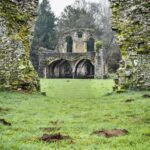
A complete guide to Rievaulx Abbey, one of Yorkshire’s most beautiful Cistercian ruins. Find hours, prices, and visitor tips for this historic site.
This guide was updated in March 2026 to include up-to-date prices. Entry fees stated on other guides may well be inaccurate.
Overview: History, what to expect, and unique features of Rievaulx Abbey
Rievaulx Abbey is one of England’s most important and spectacular monastic ruins, set within a tranquil, wooded valley on the edge of the North York Moors National Park. Founded in 1132 by Cistercian monks from Clairvaux, it became the first Cistercian abbey in the North and grew into one of the largest and wealthiest monastic settlements in Britain. Under its most famous leader, Abbot Aelred, the community swelled to over 600 people, exerting significant spiritual and economic power through sheep farming and iron mining.
Visitors can expect to walk among the soaring, skeletal remains of the abbey church, which clearly displays two distinct architectural styles: the plainer, earlier Norman work and the spectacular, high Early English Gothic extension. This Yorkshire abbey’s remote, serene location, chosen by the Cistercians for its seclusion, powerfully evokes its monastic past. The site features an elegant museum and visitor centre that displays salvaged artefacts and tells the story of the abbey’s rise and dramatic fall during King Henry VIII’s Dissolution in 1538. You can also enjoy views of the ruins from the adjacent Rievaulx Terrace (a National Trust property) built in the 18th century to frame the romantic scene.

Planning your visit to Rievaulx Abbey: opening times and access
Rievaulx Abbey is an English Heritage site and maintains seasonal operating hours.
- Summer hours (April to late October): The site is typically open daily from 10:00 a.m. to 5:00 p.m.
- Winter hours (November to late March): The abbey reduces its opening to Wednesday through Sunday. Hours are generally 10:00 a.m. to 4:00 p.m.
- Closures: The site closes on Mondays and Tuesdays during the winter season. It also observes closures around Christmas, so confirm the schedule on the English Heritage website before your visit.
- Last admission: Last entry to the site is typically 30 minutes before closing time.
Rievaulx Abbey admission fees and tickets
Tickets grant full access to the ruins, museum, and visitor centre. Online advance booking secures a 15% discount.As with other English Heritage properties such as Whitby Abbey, Corbridge Roman Town and Kirby Hall prices change seasonally – they’re more expensive during peak periods. The prices listed below are the super-saver off-season rates.
Admission prices at Rievaulx Abbey are absurdly complicated, and they vary depending on the time of year and day of the week. The prices below are for tickets booked online at least one day in advance, without a Gift Aid donation, and represent a saving of around 15% compared to tickets bought on the day at the entrance.
Super Saver — Mon–Fri, 28 Mar–22 May & 1 Sep–1 Nov; daily from 2 Nov–16 Mar
| Visitor | Price |
|---|---|
| Adult | £10.79 |
| Concession | £10.03 |
| Child | £5.35 |
Saver — Weekends & bank holidays, 28 Mar–22 May & 1 Sep–1 Nov; Mon–Fri, 23 May–31 Aug
| Visitor | Price |
|---|---|
| Adult | £12.32 |
| Concession | £11.56 |
| Child | £6.12 |
Standard — Weekends & bank holidays, 23 May–31 Aug
| Visitor | Price |
|---|---|
| Adult | £13.85 |
| Concession | £13.09 |
| Child | £6.88 |
Concession prices apply to over-65s, students with a valid student ID, and jobseekers with relevant ID. English Heritage members enter free.
Prices checked and updated March 2026.
Is it worth paying for English Heritage membership?
Entry prices for English Heritage sites, including Dover Castle, Stonehenge and Tintagel Castle, can seem extremely expensive. This is clearly a deliberate ploy to push visitors towards taking out annual English Heritage membership.
Membership gives free access to more than 400 sites across the country, and costs £82. That is, unless you get a special deal – there was a 25%-off Black Friday deal in November 2025, for example.
Whether that £82 is worth it depends on how many sites are near you (there are lots in the south of the country, not so many near me in Yorkshire). And, critically, whether you’re going to visit them with children.
Each member can take up to six children with them free of charge. Given the steep one-time entry fees, an adult member with two children is likely to recoup the cost of their membership by visiting just two or three sites within the year.
For an individual without children, I’d say English Heritage membership is worth it only if you’re planning to blitz a few sites in one year. For an individual with children, membership is a smart investment that will likely pay itself back within one school holiday. To me, it’s a no-brainer.
The real question is whether it’s worth renewing English Heritage membership after a year. That’s debatable, as you’re unlikely to go to many of these sites twice. I eventually renewed after I was offered 20% off the price. I’ll probably recoup the membership price visiting two sites in summer next year, even if I’ve ticked off most of the best ones near me.
If you buy membership through this link, I earn a small commission at no extra cost to you.
Accessibility, safety, and amenities
English Heritage provides facilities to improve the visitor experience at this remote and historic site.
- Accessibility: The visitor centre, museum, café, and shop are fully accessible. A mostly level gravel path provides access to a significant portion of the main abbey ruins, but much of the ancient floor and surrounding grass is uneven and challenging for wheelchairs.
- Facilities: The modern visitor centre houses a café with views over the ruins, offering food and refreshments. Accessible toilets are available on site.
- Audio Guide: A free audio tour comes included with admission, enhancing the experience by providing historical context to the extensive ruins.
- Parking: Paid parking is available on site for visitors, although it is free for English Heritage members.
Nearby English Heritage sites
Rievaulx Abbey sits in an area rich with historical properties, offering a great starting point for exploring other English Heritage sites in North Yorkshire:
- Helmsley Castle: Located just over two miles away (a short drive or scenic walk), this castle evolved from a formidable medieval fortress to a Tudor mansion, providing a historical contrast to the abbey.
- Byland Abbey: Another impressive Cistercian ruin in the region, Byland Abbey offers a different architectural style, notably a huge rose window that inspired York Minster.
- Mount Grace Priory: Located further north, this is the best-preserved Carthusian priory in England, offering reconstructed monk cells and a quieter, more isolated atmosphere.
- Pickering Castle: A classic 13th-century motte-and-bailey castle located in the nearby market town of Pickering.
FAQs (Frequently Asked Questions) about Rievaulx Abbey
| Question | Answer |
|---|---|
| Is Rievaulx Abbey the same as Fountains Abbey? | No, they are different Cistercian abbeys. Rievaulx was the first Cistercian foundation in the North, but Fountains Abbey (located further south) eventually became the largest in England. |
| Can I walk from Helmsley to the abbey? | Yes, a scenic public footpath connects the market town of Helmsley to Rievaulx Abbey. The walk takes approximately one hour. |
| What is the most notable feature of the ruins? | The massive, soaring arches of the church’s eastern end, built in the Early English Gothic style, create the most visually stunning feature. |
| Does the ticket include Rievaulx Terrace? | No, Rievaulx Terrace is owned and managed separately by the National Trust. Visitors require a separate ticket or National Trust membership to access the terrace views. |
| Is photography allowed inside the ruins? | Yes, photography for personal use is permitted throughout the ruins and the grounds. |
More North Yorkshire travel
Other North Yorkshire travel articles on Planet Whitley include:
- A practical guide to visiting the Captain Cook Memorial Museum in Whitby.
- How to visit Hardraw Force, England’s tallest waterfall.
- What to see at the RHS Garden Harlow Carr in Harrogate.
- Guide to the World of James Herriot in Thirsk.
- What to expect at Ripon Cathedral.