
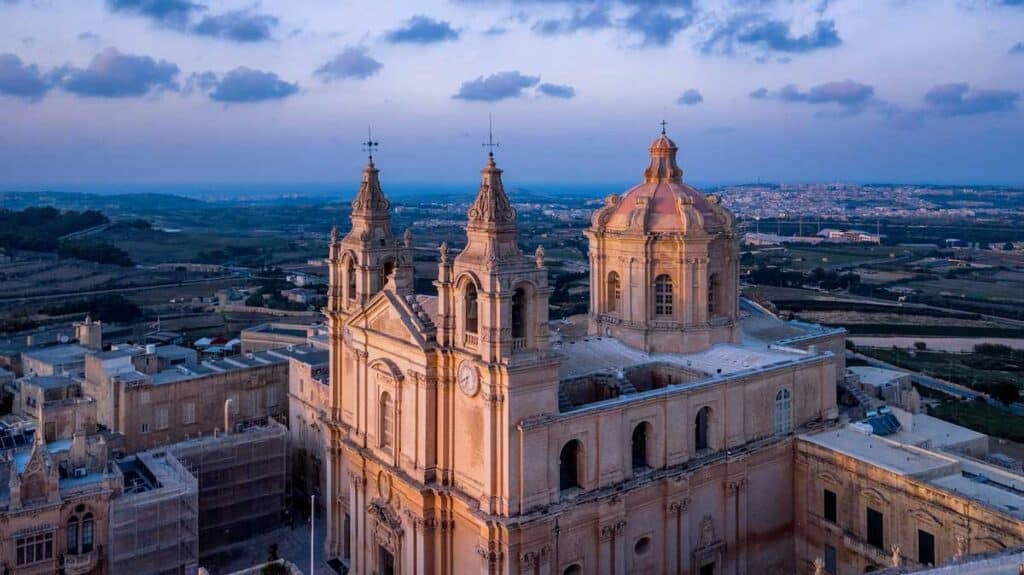
St Paul’s Cathedral is the Baroque metropolitan cathedral of Mdina, Malta, built by architect Lorenzo Gafà after an earlier cathedral was destroyed in the 1693 earthquake. This guide covers opening hours, ticket prices, transport and parking, accessibility, and practical tips for planning your visit.
This guide was updated in August 2026. The cathedral’s own website currently lists a one-off early closure for a wedding and a full-day closure for a public holiday in early September 2026, a reminder that its notice board should be checked before any visit, since exceptions like these are not reflected in general guides.
Quick facts
| Opening hours | Mon–Sat: 09:30–16:30 (last ticket 16:15). Sun (behind the rope only): 15:00–17:00 (from 16:30 in August) |
| Ticket prices | Combo ticket (Cathedral + Museum): Adult €15, senior/student €10, under-12s free |
| Address | Cathedral Square, Villegaignon Street, Mdina, Malta |
| Nearest transport | Bus to Rabat, then walk through Howard Gardens to Mdina’s Main Gate |
| Typical visit length | 45 minutes to 1.5 hours (with the museum) |
St Paul’s Cathedral opening hours
The cathedral is open for visits Monday to Saturday, 9:30 to 16:30, with the last ticket sold at 16:15.
On Sundays, general visitors may view the cathedral only from behind a rope, from 15:00 to 17:00, or from 16:30 during August.
Access can be restricted at short notice for weddings, funerals, mass, and other celebrations, so check the cathedral’s website for current notices before travelling.
St Paul’s Cathedral ticket prices
A combo ticket, covering both the Cathedral and its adjoining Museum, costs €15 for adults, and €10 for seniors (60 and over) or students with a valid student card.
Children under 12 are admitted free of charge.
Tickets are bought at the Cathedral Museum, a few metres from the cathedral itself, and are non-transferable with a fixed validation date.
Opening hours and ticket prices were checked on the official website and last updated in August 2026.
Why book the Mdina and Rabat Walking Tour?
- 🏰 Mdina’s Medieval “Silent City”: Wander through the narrow, honey-hued stone streets of Malta’s ancient fortified capital, admiring baroque palazzos, historic convents, and grand aristocratic residences.
- 🏛️ St. Paul’s Grotto & Catacombs: Step underground into the historic Wignacourt Museum complex to explore sacred early Christian catacombs and the revered cave shrine associated with St. Paul.
- 🛡️ WWII Underground Air Raid Shelters: Experience a moving look into 20th-century Maltese resilience while walking through the hand-dug subterranean shelters used during wartime bombardment.
- 🕌 Rabat’s Historic Streets: Transition outside the ancient city walls into neighboring Rabat to discover charming convents, historic churches, and quiet suburban alleyways full of local character.
- 📜 Immersive Local History & Views: Take in sweeping panoramic vistas across the island from the fortified bastion walls while a knowledgeable guide shares stories of sieges, knights, and local uprisings.
How to get to St Paul’s Cathedral
The cathedral stands on Cathedral Square, on Villegaignon Street, in the centre of Mdina.
Buses connect to Rabat, just outside Mdina’s walls; from there it is a short walk through Howard Gardens to the Main Gate, and on to Cathedral Square.
Check current bus routes at www.publictransport.com.mt before travelling, since services can change.
Parking near St Paul’s Cathedral
Parking inside Mdina is prohibited. Visitors arriving by car should park outside the Main Gate, outside Greek’s Gate, or near the Roman Domus, and walk in.
How long to spend at St Paul’s Cathedral
Most visitors need 45 minutes to an hour for the cathedral itself.
Add the adjoining museum for a fuller visit of around 1 to 1.5 hours in total.
Accessibility at St Paul’s Cathedral
Access for disabled visitors is available at the cathedral, according to the cathedral’s own website.
Visitors with specific mobility needs should contact the cathedral in advance to confirm the current arrangements.
Inside St Paul’s Cathedral: what to see
The current cathedral was built between 1697 and 1702 to a design by Maltese architect Lorenzo Gafà, replacing an earlier structure destroyed in the 1693 earthquake.
Tradition holds that the cathedral stands on the site of the Roman governor Publius’s residence, where the Apostle Paul is said to have stayed after being shipwrecked on Malta.
Inside, the marble-inlaid floor covers the tombs of former bishops, while the sacristy displays a collection of ecclesiastical silver artefacts.
A crypt beneath the cathedral holds further burials, and the interior includes paintings connected to the life of St Paul.
Practical visitor tips
| Tip |
|---|
| Dress modestly, since shawls and wraps are provided at the entrance if needed. |
| Avoid stiletto or narrow heels, since these can damage the cathedral’s inlaid marble floor. |
| Check the cathedral’s website for any notices about early closures or restricted access before travelling. |
| Visit on a weekday if possible, since Sunday access is limited to viewing from behind a rope. |
| Keep flash photography turned off, since it is not permitted inside the cathedral. |
Frequently asked questions about St Paul’s Cathedral
| Question | Answer |
|---|---|
| Is St Paul’s Cathedral suitable for children? | Yes, and children under 12 are admitted free. |
| Do you need to book tickets in advance? | Not usually, though pre-booking is available by phone or email if preferred. |
| Is the cathedral open on Sundays? | Only for limited viewing from behind a rope, between set afternoon hours. |
| Are bags allowed inside? | Small bags are fine; food and drink are not permitted inside the cathedral. |
| Is the cathedral wheelchair accessible? | Access for disabled visitors is available, according to the cathedral’s own website. |
Things to do near St Paul’s Cathedral
Palazzo Falson Historic House Museum stands a short walk away on Villegaignon Street. Mdina’s Main Gate and the bridge over the former moat make a scenic entry point to the old city.
The Roman Domus, near the Main Gate, displays mosaics and artefacts from a Roman-era townhouse. Rabat, just outside Mdina’s walls, is home to the Catacombs of St Paul and St Agatha.
Alternative attractions
St John’s Co-Cathedral, in Valletta, is Malta’s grandest Baroque church, known for its ornate marble floor and Caravaggio paintings. Our Lady of Victory Church, near the Malta Experience in Valletta, is a smaller but historically significant chapel.
Ta’ Pinu Basilica, on Gozo, is a major Marian pilgrimage site with a comparable historic and devotional significance. The Mosta Rotunda, known for its vast unsupported dome, offers a different but equally striking example of Maltese church architecture.
