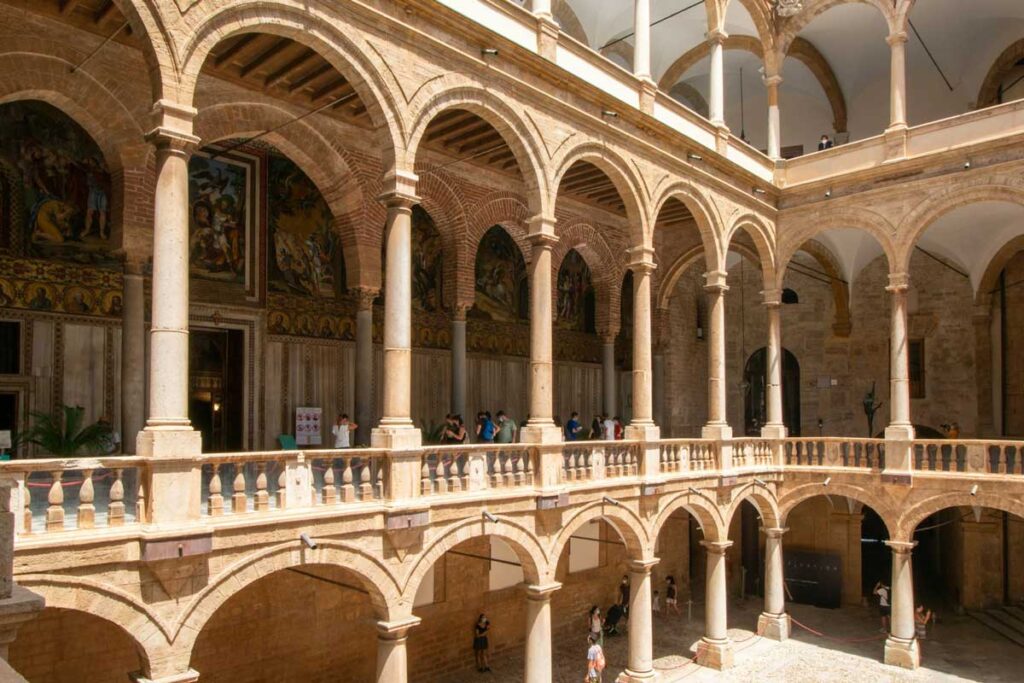
The Norman Palace (Palazzo dei Normanni) is Europe’s oldest continually inhabited royal palace, a UNESCO World Heritage Site at the heart of Palermo, and home to the breathtaking Palatine Chapel — the finest surviving example of Arab-Norman-Byzantine art in existence.
This guide was updated in June 2026. As of 18 September 2025, the Royal Apartments are now also open on Thursdays — a recent change not yet reflected in the majority of travel listings. There is also a major caveat: ongoing restoration works in the Palatine Chapel are causing temporary access restrictions and earlier closing times on certain dates throughout 2026 — always check the official site before visiting. You can book through GetYourGuide in advance.
Quick facts
| Detail | Information |
|---|---|
| Address | Piazza della Vittoria, 23, 90134 Palermo, Sicily, Italy |
| Mon–Sat hours | 08:30 — last admission 16:30 |
| Sundays and public holidays | 08:30 — last admission 12:30 |
| Closed | 25 December and 1 January |
| Full ticket (Thu–Mon + public holidays) | €19.00 |
| Full ticket (Tue–Wed) | €15.50 |
| Reduced (18–25, EU; teachers) | €17.00 (Thu–Mon) / €13.50 (Tue–Wed) |
| Reduced over-65 (EU) | €15.50 (Thu–Mon) / €13.50 (Tue–Wed) |
| Youth reduced (ages 14–17) | €11.00 (Thu–Mon) / €9.00 (Tue–Wed) |
| Under 14 (with adult) | Free |
| Audio/video guide | €5.00 |
| Parking | No dedicated parking — use public transport or nearby paid car parks |
| Nearest transit | Bus lines 109, 110, 118, 122, 124, 389 to Piazza della Vittoria |
| Typical visit | 2–2.5 hours |
Norman Palace opening hours
The palace is open every day except 25 December and 1 January. The most critical detail for planning is the Sunday and public holiday last admission at 12:30 — dramatically earlier than the Monday–Saturday 16:30 cutoff. Many visitors arrive on Sunday afternoons and cannot enter.
Monday–Saturday: open 08:30, last admission 16:30. Sunday and public holidays: open 08:30, last admission 12:30.
Royal Apartments access: previously open Thursday–Monday only, now also open on Thursdays following the September 2025 change. On Tuesdays and Wednesdays, the Royal Apartments are closed — the ticket price is lower on those days to reflect the reduced access.
Ongoing Palatine Chapel restoration works are causing partial closures and earlier last-admission times on specific dates throughout 2026. The chapel closes to visitors during Sunday Mass (09:30–11:30 on most Sundays; 09:30–11:00 in June). Several dates in 2026 have an early last ticket of 16:00. Always check the official notices on the visit page before travelling.
Norman Palace admission prices
All prices include Italian VAT and are confirmed from the official site (last modified 26 May 2026). Under-14s enter free when accompanied by an adult and not as part of a school group.
Thursday–Monday and public holidays (full access including Royal Apartments)
| Ticket | Price |
|---|---|
| Full ticket | €19.00 |
| Reduced (EU 18–25, permanent teachers) | €17.00 |
| Reduced over-65 (EU citizens) | €15.50 |
| Youth (ages 14–17) | €11.00 |
| Under 14 (with adult, not school group) | Free |
Tuesday–Wednesday (Palatine Chapel, Gardens, Exhibitions, Archaeological Area only)
| Ticket | Price |
|---|---|
| Full ticket | €15.50 |
| Reduced (EU 18–25, permanent teachers) | €13.50 |
| Reduced over-65 | €13.50 |
| Youth (ages 14–17) | €9.00 |
| Under 14 (with adult, not school group) | Free |
An audio/video guide is available for €5.00, rentable online or at the bookshop desk, in Italian, English, Spanish, French, German, and Russian. Tickets can be purchased online up to 20 minutes before last admission. Book through GetYourGuide to arrange entry in advance and avoid queue times at the ticket office.
Why visit the Norman Palace?
- 🏛️ The Palatine Chapel — the finest Arab-Norman artwork in the world: Built in 1140, the Cappella Palatina combines Byzantine mosaics, Islamic muqarnas ceiling, and Norman architectural structure in a UNESCO-listed space unlike anything else in Europe.
- 🎟️ Free for under-14s: Children up to age 13 enter free when accompanied by an adult — making this one of Palermo’s most family-accessible major monuments.
- 🌿 The Royal Apartments now open Thursdays too: Since September 2025, the lavishly decorated state rooms are accessible Thursday through Monday — a significant expansion of visiting options not yet reflected in most guides.
- 📜 Europe’s oldest continually inhabited royal palace: Built by the Arabs in the 9th century, expanded by the Normans in the 11th, and still the seat of the Sicilian Parliament today — the building spans 1,000 years of Mediterranean history under a single roof.
- 💰 Two-tier pricing saves money mid-week: Visiting on Tuesday or Wednesday — when the Royal Apartments are closed — reduces the adult ticket from €19 to €15.50, a worthwhile option for visitors whose priority is the Palatine Chapel.
How to get to the Norman Palace in Palermo
By bus: Several Palermo city bus lines serve Piazza della Vittoria directly — routes 109, 110, 118, 122, 124, and 389 all stop within a short walk of the entrance. From the city centre and the Ballarò market area, the palace is also an easy 10–15-minute walk.
On foot from central Palermo: The palace is at the western edge of the historic centre, approximately 15 minutes on foot from the Palermo Centrale railway station and 10 minutes from the Quattro Canti crossroads. Walk along Corso Vittorio Emanuele towards Porta Nuova — the palace is immediately to the right.
By car: Driving to the palace is not recommended. Palermo’s historic centre has restricted traffic zones (ZTL) and parking near the palace is very limited. Use public transport or park outside the ZTL and walk in.
5 top experiences to book in Palermo
- 🏛️ Palermo’s World Heritage sites – Discover the stories behind Palermo’s World Heritage sites on a three hour walking tour.
- 🍝 Authentic Sicilian street food – Taste authentic Sicilian street food on a small group food tour.
- ⛵ Half day luxury boat tour – Take a half day luxury boat tour with snorkelling and sea caves.
- ⚖️ Palermo’s anti-Mafia culture – Discover Palermo’s anti-Mafia culture on a No Mafia walking tour.
- 🎬 The origins of the Godfather – On a day trip to Corleone, learn about the origins of the Godfather.
Parking near the Norman Palace
There is no dedicated visitor car park at the palace. The nearest paid parking areas are outside the ZTL perimeter — particularly around the Palermo port area and along Viale della Regione Siciliana. The palace is more easily reached on foot or by bus from central Palermo.
How long to spend at the Norman Palace
A thorough self-guided visit covering the Palatine Chapel, the Royal Apartments (on access days), the Royal Gardens, and the Archaeological Area takes approximately 2 to 2.5 hours. The Palatine Chapel alone deserves at least 45 minutes — the density of the mosaic programme rewards slow, careful looking. Add the audio guide rental (€5.00) to significantly deepen the experience.
Accessibility at the Norman Palace
The Norman Palace has made barrier-free improvements wherever the historic structure permits. Accessible areas include the bookshop, the Sala Duca di Montalto, the Palatine Chapel, the Sala d’Ercole, the Sala dei Viceré, the Sala Pompeiana, the Sala Cinese, and the Royal Gardens.
Non-accessible areas include the Archaeological Area of the Punic Walls, the Sala Re Ruggero, and the Pisana Tower — all involve steps or structural constraints that cannot be removed. Guide dogs and pet-therapy dogs are permitted; no other animals are allowed, even in carriers. The site has no luggage storage.
What to see at the Norman Palace
The Palatine Chapel (Cappella Palatina) is the single most important interior in Palermo and one of the great artistic achievements of medieval Europe. Built by Roger II of Sicily between 1130 and 1140, the chapel brings together three traditions with extraordinary coherence: Byzantine mosaic craftsmen covered the walls and vaults with gold-ground narrative scenes from the Old and New Testaments; Islamic artists created the extraordinary muqarnas (honeycomb) wooden ceiling above the nave, the finest example of Fatimid-era ceiling decoration outside Egypt; and Norman architects provided the structural framework. The result is a space that functions simultaneously as a Christian chapel, an Islamic decorative masterpiece, and a Byzantine icon programme. Restoration works are ongoing — some areas may be screened off during your visit.
The Royal Apartments are accessible Thursday through Monday. The suite of lavishly decorated state rooms reflects the tastes of the various dynasties who occupied the palace after the Normans. The Sala di Re Ruggero (King Roger’s Room) on the second floor of the Pisana Tower is the most significant — its mosaic decoration of hunting scenes, animals, and trees represents the secular Norman court aesthetic, as distinct from the religious programme of the Palatine Chapel as it is possible to imagine. The Sala Pompeiana, Sala Cinese, and Sala dei Viceré document the Bourbon period of occupation in the 18th and 19th centuries.
The Pisana Tower rises above the main palace complex and houses the Roger’s Room mosaics. Access may be restricted on certain days for institutional reasons — confirmed on the official site and flagged in advance notices where possible.
The Royal Gardens (Giardini Reali) below the palace are included in all ticket tiers and provide a welcome outdoor contrast after the intensity of the interior. The gardens are laid out on terraces facing south, with palm trees and subtropical planting that reflects the Arab agricultural legacy in Sicily.
The Archaeological Area contains remains of the Punic and Roman walls that underlie the palace, giving physical evidence of the site’s occupation going back well before the Arab period. Note that this area is not wheelchair accessible.
Practical tips for visiting the Norman Palace
| Tip | Detail |
|---|---|
| Sunday last admission is 12:30, not 16:30 | This is the single most common planning mistake at this site. Sunday and public holiday visitors must be ticketed by 12:30. Arriving at 13:00 means no entry. |
| Check the Palatine Chapel restoration notices | Ongoing works are causing specific dates throughout 2026 to have earlier closing times or partial closures. Always check the official site’s notices section before travelling. |
| Thursdays now include the Royal Apartments | Since September 2025, Thursday visits include the full access ticket — a change not yet in most guides. Thursday is now as good as Friday–Monday for a full visit. |
| Tuesday and Wednesday are cheaper | At €15.50 adult, mid-week tickets save €3.50. The Palatine Chapel and gardens are fully included; only the Royal Apartments are not available those days. |
| Book online up to 20 minutes before last admission | Tickets can be purchased online right up to the last moment. Book in advance through GetYourGuide to avoid the ticket office queue. |
Norman Palace FAQ
| Question | Answer |
|---|---|
| Are the Royal Apartments open every day? | No — they are open Thursday through Monday. Tuesday and Wednesday visits include only the Palatine Chapel, Gardens, Temporary Exhibitions, and Archaeological Area, at a reduced ticket price. |
| Is the Palatine Chapel always accessible? | No — it closes during Sunday Mass (09:30–11:30), and restoration works are causing additional temporary closures and earlier closing times on specific 2026 dates. Check the official site. |
| Do I need to book in advance? | Walk-up entry is available, but booking in advance through GetYourGuide is recommended in summer and on UNESCO-site busy days. Tickets can be purchased online up to 20 minutes before last admission. |
| Are under-14s really free? | Yes — children up to age 13 enter free when accompanied by an adult and not as part of a school group. |
| Can the palace close unexpectedly? | Yes — as the seat of the Sicilian Parliament, the complex can be subject to full or partial closures without notice for institutional or religious reasons. This is stated on the official site. |
Things to do near the Norman Palace
Palermo Cathedral (Cattedrale di Palermo) is a 10-minute walk along Corso Vittorio Emanuele — another UNESCO Arab-Norman site, containing the royal tombs of the Norman and Hohenstaufen kings, including the porphyry sarcophagus of Frederick II, and free to enter the main nave.
Porta Nuova is the 16th-century triumphal gate immediately adjacent to the palace on the western side, marking the entry into Palermo’s historic street and offering good views towards the Conca d’Oro plain.
The Ballarò market is a 10-minute walk east of the palace into the Albergheria neighbourhood — Palermo’s oldest and most atmospheric street market, operating every morning with fruit, vegetables, street food, and local colour.
The Church of San Giovanni degli Eremiti is directly south of the palace, a 12th-century Norman church with five distinctive red domes and a tranquil Arab-Norman cloister garden, included on the UNESCO Arab-Norman route and very rarely crowded.
The Palazzo Chiaramonte Steri is in the La Kalsa district, a 20-minute walk from the palace — a 14th-century Gothic palace with a remarkable painted ceiling and a museum of the rooms used by the Spanish Inquisition, still bearing prisoner graffiti.
Similar palaces and UNESCO sites to visit in Sicily
The Palatine Chapel itself is the central justification for the visit — but the same UNESCO Arab-Norman of Palermo inscription covers several other monuments worth combining into a Palermo itinerary: the Church of San Giovanni degli Eremiti, the Palermo Cathedral, the Church of the Martorana (Santa Maria dell’Ammiraglio), and the Church of San Cataldo.
The Cathedral of Monreale is 8 km south-west of Palermo by bus (line 389 from Piazza della Vittoria, approximately 40 minutes) and is Palermo’s other UNESCO Arab-Norman masterpiece — a 12th-century cathedral with the largest surviving programme of Byzantine mosaics in the world, covering 6,340 square metres of interior surface.
The Cathedral of Cefalù is 70 km east of Palermo along the coast by train — a Norman cathedral begun by Roger II in 1131, contemporary with the Palatine Chapel and housing a magnificent Christ Pantocrator mosaic in the apse that is among the most powerful images of Byzantine art in the western Mediterranean.
The Villa Palagonia in Bagheria is 20 minutes by train from Palermo Centrale — Sicily’s most eccentric Baroque villa, famous for its grotesque monster statues, and a completely different register of Sicilian architectural history from the Norman Palace.
The Agrigento Valley of the Temples (Valle dei Templi) is approximately two hours south of Palermo by road or rail — Sicily’s most spectacular ancient Greek site and a UNESCO World Heritage Site in its own right, representing the island’s pre-Norman layer of history.