The Pinacoteca di Brera at Via Brera 28 in Milan is one of the most important art galleries in Italy. It was founded by Napoleon in 1809 and holds a collection of Italian painting from the 13th to the 20th century that is without equal in the north of the country.
This guide was updated in June 2026. Three things to note before you visit. Reservations are always required — including on free admission days — via the Brera Booking system; walk-up entry has very limited availability. The last entry is 18:00 despite the gallery closing at 19:15, leaving a 75-minute gap that most guides don’t clarify. And the standard ticket is €15 (or €20 for the Grande Brera combined ticket including Palazzo Citterio) — many older guides still show €10 or €12. You can book through GetYourGuide in advance.
Quick facts
| Detail | Information |
|---|---|
| Address | Via Brera 28, 20121 Milan |
| Hours | Tuesday–Sunday, 08:30–19:15 |
| Last admission | 18:00 |
| Closed | Mondays; 1 May; 25 December; 1 January |
| Pinacoteca ticket (standard) | €15 |
| Grande Brera ticket (Pinacoteca + Palazzo Citterio) | €20 |
| Reduced (EU citizens 18–25) | €2 (Pinacoteca) / €4 (Grande Brera) |
| Over-70s (Tuesdays and Wednesdays only) | €7.50 |
| Family (1–2 adults + up to 5 children) | €10 per adult |
| Persons with disability (Law 104) | Free + free companion |
| Free days | First Sunday of month (reservation required) |
| Audio guide | Included in official app (free download) |
| Nearest metro | Lanza (M2 green) or Montenapoleone (M3 yellow) |
| Nearest tram | Lines 12 and 14, Via Brera stop |
| Typical visit | 1.5–2.5 hours |
Pinacoteca di Brera opening hours
The gallery is open Tuesday to Sunday, 08:30 to 19:15. It is closed every Monday, plus 1 May, 25 December, and 1 January. The last admission is 18:00 — not 19:15. This 75-minute gap is confirmed explicitly on the official hours page and is absent from most aggregator listings. Arriving at 18:30 means no entry.
Free admission on the first Sunday of every month is available, but — unusually for a free museum day — a reservation is still required. Reservations for free Sundays open mid-week and are said to fill by Friday morning; book as soon as your travel dates are confirmed.
5 top Milan experiences to book today
- 🏛️ Combine the Duomo and Leonardo’s Last Supper in a skip-the-line small group tour.
- 🍝 Take a Milan street food tour and taste several beloved local dishes.
- 🚶 Discover Milan’s highlights and hidden gems on a private walking tour.
- 🏰 Enjoy a guided visit to Sforza Castle and learn more about Michelangelo’s Pieta Rondanini.
- 🍕 Make your own pizza and gelato at a Milan cooking class.
Pinacoteca di Brera admission prices
The standard Pinacoteca-only ticket is €15. Older guides show €10 or €12 — both out of date. A Grande Brera ticket (€20) covers the Pinacoteca on a chosen date plus Palazzo Citterio (which holds the 20th-century collections: Jesi, Mattioli, Vitali, and Jucker collections) for the same day and the following six days.
| Ticket | Price |
|---|---|
| Pinacoteca di Brera (standard) | €15 |
| Grande Brera (Pinacoteca + Palazzo Citterio access for 7 days) | €20 |
| Reduced — EU citizens 18–25 (Pinacoteca) | €2 |
| Reduced — EU citizens 18–25 (Grande Brera) | €4 |
| Over-70s (Tuesdays and Wednesdays only) | €7.50 |
| Family (1–2 adults + max 5 minors) | €10 per adult |
| Unemployed (with certificate) | €5 |
| Under 18; disability (Law 104) + companion | Free |
| First Sunday of month | Free (reservation required) |
Temporary exhibitions may add a supplement to the standard ticket price. Check before booking if visiting during an active temporary show. Book through GetYourGuide for confirmed entry.
Why visit the Pinacoteca di Brera?
- 🎨 Raphael’s Marriage of the Virgin in the room it was made for: The Sposalizio della Vergine (1504) — the painting that established Raphael’s reputation at 21 — is displayed with enough space around it to read the geometry of the composition. One of the best-presented great paintings in Italy.
- 🎟️ Mantegna’s Dead Christ is in a side room most visitors walk past: The Lamentation over the Dead Christ (c.1483) — foreshortened feet first, the wounds at eye level — is in a smaller room off the main sequence. Slow down and find it.
- 🌿 Palazzo Citterio opened in December 2024 as part of the Grande Brera: After 50 years of plans and false starts, the 20th-century wing opened with major Italian modernist collections — Boccioni, Modigliani, Picasso, Matisse. The €20 Grande Brera ticket covers both venues for 7 days.
- 📜 A live restoration laboratory in Room XVIII: Designed by Ettore Sottsass in 2001, a transparent studio in the centre of the exhibition route lets visitors observe restorers working on paintings from the collection in real time.
- 💰 Free on the first Sunday of every month with reservation: A reservation is always required — book early in the week for that Sunday, as slots fill fast.
How to get to the Pinacoteca di Brera
By metro, the closest stop is Lanza (M2 green line), a 5-minute walk south to Via Brera. From Cadorna (M1/M2) the walk is around 8 minutes. From Milan Centrale, take M2 (green) three stops to Lanza (approximately 6 minutes).
By tram, lines 12 and 14 stop near Via Brera. Several other tram lines pass along Via Pontaccio and Corso Garibaldi, both within a 3-minute walk.
On foot from the Duomo, the gallery is approximately 15 minutes north-west via Via Mercanti and Foro Bonaparte. The walk passes the Castello Sforzesco, making it a natural route for combining both attractions.
Parking at the Pinacoteca di Brera
There is no dedicated car park. The Brera neighbourhood has metered on-street parking but spaces fill quickly. The nearest covered car parks are at Parcheggio ATA Carrobbio and Parcheggio Testori near Lanza — both a short walk. Milan’s ZTL does not cover the Brera area directly, but the neighbourhood’s dense street network makes driving impractical. Public transport is strongly recommended.
How long to spend at the Pinacoteca di Brera
Allow 1.5 to 2.5 hours for a thorough visit. The Pinacoteca has 38 permanent collection rooms; a highlights pass focusing on the major works (Mantegna, Raphael, Bellini, Caravaggio, Hayez) takes 60–75 minutes. Visitors who read the room descriptions and engage with the restoration laboratory need 2.5 hours. If adding a visit to Palazzo Citterio on the same day, allow 3–4 hours total. The Grande Brera app (free on iOS and Android) provides audio guides, themed tours, and exclusive content for self-guided visits.
Accessibility at the Pinacoteca di Brera
The gallery is fully accessible to wheelchair users. A lift connects all floors of the Palazzo Brera; the entire route through the permanent collection is accessible. Accessible toilets are on the ground floor. Guide dogs are permitted. Visitors with disability (Italian Law 104 certification or equivalent) enter free, as does one accompanying companion. For foreign visitors, equivalent certification from their home country is accepted. The restoration laboratory in Room XVIII is step-free and accessible throughout.
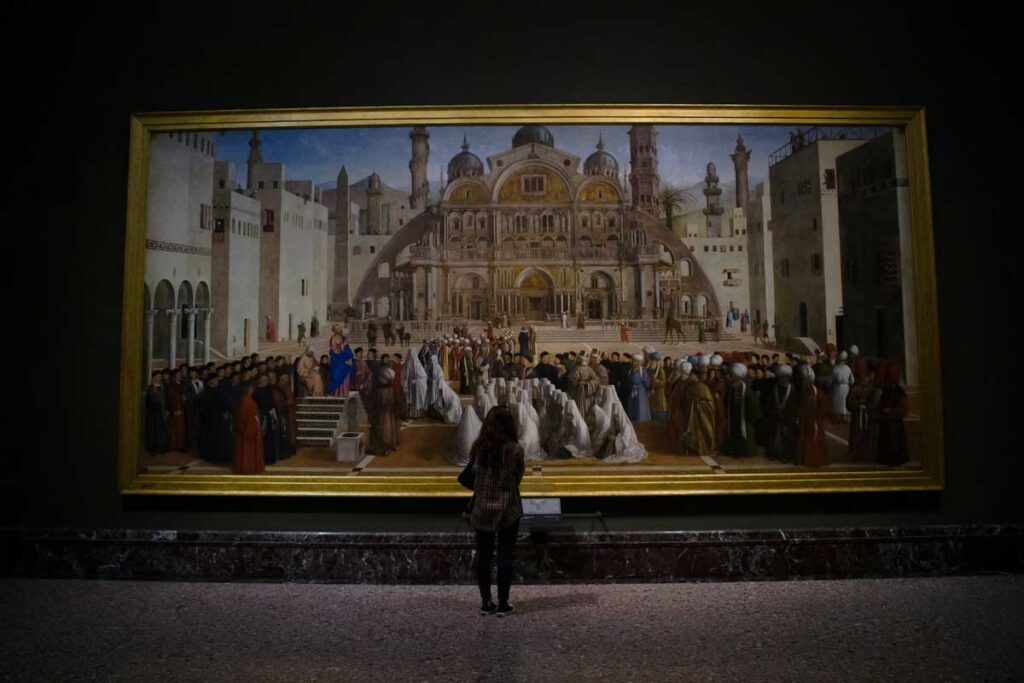
What to see at the Pinacoteca di Brera
Room XXIV is the collection’s centrepiece. Raphael’s Sposalizio della Vergine (Marriage of the Virgin, 1504) hangs alone on one wall; its geometrical perfection — the perfect circle of the background temple, the triangle formed by the figures — is best understood in person. Bramante’s Christ at the Column (c.1490) is in the same room.
Mantegna’s Dead Christ (c.1483) is in Room VI, off the main sequence. The foreshortening — feet toward the viewer at eye level, wounds open — was the most radical spatial experiment in 15th-century Italian painting. The physical scale (68 × 81 cm, smaller than expected) is part of the experience.
Giovanni Bellini’s Pietà (c.1460) hangs in the same room. Bellini was Mantegna’s brother-in-law and rival; their two works, painted at approximately the same time, represent opposing approaches to the same subject. The comparison distils a decade of North Italian painting.
Caravaggio’s Supper at Emmaus (1606) is in Room XXIX — the second, darker version, more restrained than the London painting. Recognition of Christ is conveyed through gesture rather than theatrical light.
Hayez’s The Kiss (Il Bacio, 1859) is in Room XXXVII near the exit — the most reproduced painting in the collection, a Risorgimento allegory in the form of a medieval farewell.
The Restoration Laboratory (Room XVIII) is a transparent glass-and-steel studio designed by Ettore Sottsass (2001) in the centre of the exhibition route. Visitors look directly at conservators working on collection paintings — revealing details invisible in normal display conditions.
Practical tips for visiting the Pinacoteca di Brera
| Tip | Detail |
|---|---|
| Reservations are always required | Walk-up entry is not reliably available. Book online, even for free Sunday visits. |
| Last entry is 18:00 — not 19:15 | Despite closing at 19:15, the gallery stops admitting visitors at 18:00. Arriving at 18:30 means no entry. This 75-minute gap is confirmed on the official hours page. |
| The Dead Christ is in a side room | Mantegna’s Dead Christ (Room VI) is off the main sequence and easily missed. It is one of the most important paintings in the collection. |
| Consider the Grande Brera ticket (€20) | The €20 ticket covers the Pinacoteca on your chosen date plus Palazzo Citterio for the same day and the following 6 days. If modern Italian art interests you, it is worth the extra €5. |
| Book in advance | Free Sunday slots in particular fill fast — book mid-week for the upcoming Sunday. In summer, standard timed slots also fill in advance. |
Pinacoteca di Brera FAQ
| Question | Answer |
|---|---|
| What is the ticket price? | €15 for the standard Pinacoteca ticket; €20 for Grande Brera (including Palazzo Citterio). Reduced rate for EU citizens 18–25 is €2 (Pinacoteca) or €4 (Grande Brera). Many guides still show €10 or €12 — both are out of date. |
| Is a reservation always required? | Yes. Even on free admission days (first Sunday of the month), a reservation is required. Walk-up entry has very limited availability. |
| What is the last entry time? | 18:00 — not 19:15 (the closing time). There is a 75-minute gap between last admission and closing. |
| What is Palazzo Citterio? | The new wing of the Grande Brera (opened December 2024), housed in an 18th-century palace on Via Brera. It holds major 20th-century Italian collections (Jesi, Mattioli, Vitali, Jucker). The €20 Grande Brera ticket covers both venues. |
| Is the museum closed on Mondays? | Yes, every Monday. Also closed 1 May, 25 December, and 1 January. |
Things to do near the Pinacoteca di Brera
Palazzo Citterio (Grande Brera) is directly across Via Brera and is the second venue of the Grande Brera project (opened December 2024). It holds the Jesi, Mattioli, Vitali, and Jucker collections — some of the finest holdings of Italian Futurism, Modigliani, Picasso, and Matisse in the country. Covered by the €20 Grande Brera ticket.
The Brera neighbourhood surrounds the gallery and is Milan’s art and design quarter. Via Brera, Via Fiori Chiari, and Via Madonnina are lined with independent art galleries, antique dealers, aperitivo bars, and design boutiques. The monthly Brera Arte antiques market (third Saturday of the month) occupies the courtyard and surrounding streets.
Castello Sforzesco is around 10 minutes south-west on foot. The 15th-century Sforza castle houses Milan’s civic museums and holds Michelangelo’s last work — the unfinished Pietà Rondanini. Entry to the castle courtyard is free; the museums require a separate ticket.
The Museo del Novecento is 15 minutes south on foot at Piazza del Duomo. It holds the largest and most comprehensive collection of 20th-century Italian art in Milan — a strong complement to the historic material at Brera.
The Biblioteca Nazionale Braidense occupies the same Palazzo Brera building as the Pinacoteca. Italy’s third-largest national library (after Rome and Florence), it is open to researchers and is occasionally accessible for cultural events. The reading room is one of the finest 18th-century library interiors in Lombardy.
Similar art galleries to visit near Milan
The Pinacoteca Ambrosiana is around 20 minutes’ walk south in the historic centre and holds Leonardo da Vinci’s Portrait of a Musician and the Codex Atlanticus — the world’s largest collection of Leonardo drawings. Combined Duomo + Ambrosiana ticket available. A separate and essential stop from the Brera.
The Museo Poldi Pezzoli is 10 minutes south-east on Via Manzoni and is one of the finest private collection museums in Italy — a 19th-century house with Botticelli’s Portrait of a Young Woman as its centrepiece, alongside Flemish masters, Murano glass, and armour.
The GAM – Galleria d’Arte Moderna, Milan is in Villa Reale, about 15 minutes east in the Porta Venezia area. It holds the Grassi and Vismara donations including major Impressionist works and Italian early 20th-century painting.
Palazzo Reale is next to the Duomo (5 minutes from Brera by metro) and functions as Milan’s main venue for blockbuster temporary exhibitions. Check what is showing — it regularly hosts some of the most important loan exhibitions in Italy.
The Accademia Carrara, Bergamo is around 50 minutes north-east by train and holds one of the finest provincial art collections in northern Italy — Raphael, Botticelli, Bellini, and Mantegna across 15 rooms in a purpose-built 19th-century gallery. Undervisited compared to its quality.
More Lombardy travel
Other Lombardy travel guides on Planet Whitley include:
- How fast are the direct Milan to Verona trains?
- Can you get tickets to see the Last Supper on the day?
- La Scala Theatre Museum, Milan: Practical guide for first time visitors.
- Lake Como kayak tour vs boat cruise: Which is the best way to see Lake Como?
- Plan your visit to Villa Carlotta on the shore of Lake Como.