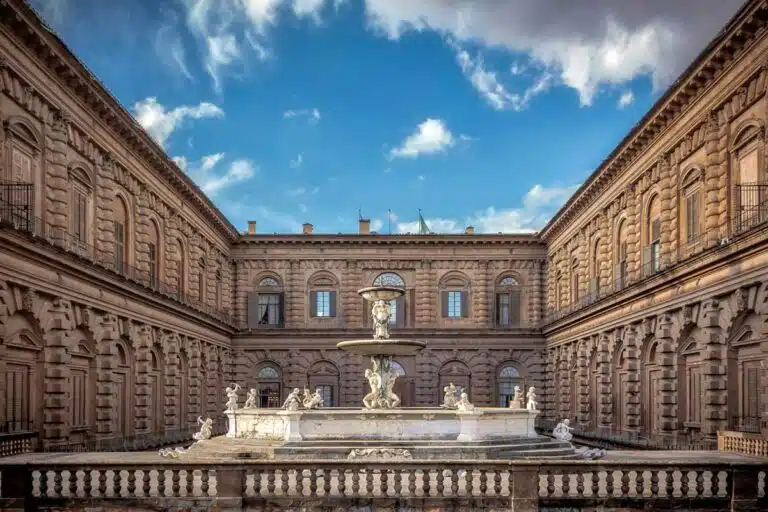
Florence is one of the world’s great art cities — a compact, walkable Renaissance capital where the Uffizi Gallery, the Galleria dell’Accademia and the Pitti Palace between them hold more masterworks per square kilometre than almost anywhere else on earth.
But the city rewards those who look beyond the headline galleries: the Medici Chapels contain Michelangelo’s most ambitious sculptural programme; the Bargello is the finest sculpture museum in Italy; the Museo Galileo traces the history of scientific discovery with instruments Galileo himself used; and the Chianti Classico vineyards begin just outside the city boundaries.
The single most important piece of advice for visiting Florence is to book everything in advance — the headline attractions sell out days or weeks ahead, and turning up without tickets for the Uffizi or Accademia in high season means very long queues or no entry at all. These guides cover Florence’s key attractions with practical information on ticket prices, opening hours, booking requirements and what to expect on arrival.
Florence’s headline galleries: Uffizi, Accademia and Michelangelo’s David
The Uffizi and the Galleria dell’Accademia are the two most visited paid attractions in Italy and among the most visited museums in the world. Both require advance booking — the Uffizi especially so during summer, when same-day tickets are essentially unavailable. These guides cover what each gallery contains, how to book, and the specific questions visitors most commonly ask before arriving.
- Uffizi Gallery, Florence: practical guide for first-time visitors — the world’s greatest collection of Italian Renaissance painting, housed in a 16th-century Medici administrative building on the Arno, with Botticelli’s Birth of Venus and Primavera, works by Leonardo, Michelangelo, Raphael, Titian and Caravaggio, and visitor logistics that require careful advance planning.
- Galleria dell’Accademia, Florence: practical guide for first-time visitors — the museum housing Michelangelo’s David, the most famous sculpture in the world, alongside his unfinished Prisoners series and a significant collection of Florentine paintings, with practical guidance on booking, timing and what to look for beyond the obvious centrepiece.
- How long are the queues to see Michelangelo’s David? — an honest, experience-based answer to the question that most visitors to the Galleria dell’Accademia ask first, covering the difference between pre-booked and walk-up queues, the best times to visit, and whether the wait is worth it without a ticket.
The Medici legacy: chapels, palaces and gardens
The Medici family shaped Florence — and, through Florence, the Italian Renaissance — more profoundly than any other single force in the city’s history. Their patronage funded Botticelli, Leonardo and Michelangelo; their palaces and chapels defined the city’s architecture; and their collections form the core of what the Uffizi and Pitti Palace hold today. These four sites form a coherent Medici itinerary that can be spread across two days.

- Medici Chapels, Florence: practical guide for first-time visitors — the funerary chapels of the Medici dynasty, containing Michelangelo’s most ambitious sculptural programme — the Dawn, Dusk, Day and Night figures in the New Sacristy — alongside the opulent Chapel of the Princes, whose pietra dura marble and semi-precious stone work is among the most extraordinary decorative achievements of the 17th century.
- Museo de Medici, Florence: practical guide for first-time visitors — the museum in the Palazzo Medici Riccardi, the family’s original 15th-century palace in the city centre, with the Chapel of the Magi containing Benozzo Gozzoli’s extraordinary fresco cycle and an exhibition on the dynasty’s 600 years of political, artistic and scientific influence.
- Pitti Palace, Florence: practical guide for first-time visitors — a Renaissance palace on the Oltrarno side of the Arno, originally built for a Medici rival and then acquired by the family, now housing five separate museums including the Palatine Gallery — with one of the finest collections of 16th and 17th-century painting in Europe — and the Royal Apartments used by the House of Savoy when Florence was briefly the capital of unified Italy.
- Boboli Gardens, Florence: practical guide for first-time visitors — the 45-hectare formal garden behind the Pitti Palace, laid out from 1549 as a Medici outdoor theatre and garden of delights, with grottos, fountains, Roman and Renaissance sculpture and elevated views across Florence’s rooftops that are among the finest in the city.
Churches, palaces and specialist museums
Beyond the headline galleries and the Medici sites, Florence has a deeper layer of attractions that reward those with time to explore: a Gothic Dominican basilica with masterworks by Masaccio and Ghirlandaio, a fortified medieval town hall with a tower climb, the finest sculpture museum in Italy, an extraordinary collection of Renaissance scientific instruments and an ornate Moorish Revival synagogue with a significant Jewish heritage museum. None of these require the same level of advance planning as the Uffizi or Accademia, but most charge admission.
- Basilica of Santa Maria Novella, Florence: practical guide for first-time visitors — the principal Dominican church of Florence, with a Renaissance marble facade by Leon Battista Alberti and an interior containing Masaccio’s Trinity — the first painting in history to use precise linear perspective — alongside Ghirlandaio’s Life of the Virgin frescoes and a Filippino Lippi chapel.
- Palazzo Vecchio, Florence: practical guide for first-time visitors — the fortified medieval town hall on the Piazza della Signoria that has been the seat of Florentine civic government since 1314, with a tower climb offering the finest elevated views over the city centre and a Salone dei Cinquecento decorated with Vasari’s enormous battle frescoes and a rumoured hidden Leonardo mural beneath the surface.
- Bargello Museum, Florence: practical guide for first-time visitors — housed in Florence’s oldest public building, a 13th-century former prison, this is the finest sculpture museum in Italy, with Donatello’s bronze David (the first freestanding nude male statue since antiquity), Michelangelo’s Bacchus, works by Cellini and Verrocchio and one of the world’s greatest collections of Renaissance decorative arts.
- Museo Galileo, Florence: practical guide for first-time visitors — a history of science museum on the Arno waterfront housing the finest collection of Renaissance scientific instruments in the world, including two of Galileo’s original telescopes, his compass, his thermometer and — in a case that stops almost every visitor — his preserved middle finger, displayed in a glass reliquary.
- Florence Synagogue and Jewish Museum: practical guide for first-time visitors — a magnificent Moorish Revival synagogue completed in 1882, one of the finest in Europe, with a Jewish Museum tracing the history of the Florentine Jewish community from the establishment of the ghetto in 1571 through to the Holocaust and the post-war period.
Food, wine and Tuscan experiences
Florence is as much a food and wine destination as a cultural one — the city that gave the world Chianti, bistecca Fiorentina and a pasta tradition of extraordinary depth. These two articles cover two of the most rewarding hands-on experiences available from the city: a wine afternoon in the Chianti Classico hills and a pasta-making class in a Florentine kitchen.
- How to visit two Chianti Classico wineries from Florence in one afternoon — a practical guide to spending an afternoon in the Chianti Classico wine zone south of Florence, covering how to reach two wineries by car without a full day trip, what to expect from the tastings and which Chianti Classico producers are worth prioritising.
- Learning to make pasta in Florence: what to expect from a pasta class — an honest account of taking a pasta-making class in Florence, covering what the experience involves, how to choose between the many operators offering this, what you actually learn and whether it’s worth the time and cost compared with simply eating very well.
Planning your Florence visit
Florence is compact — most of the major attractions are within a 20-minute walk of each other — but the logistics of visiting require more advance planning than almost any other European city. Uffizi and Accademia tickets can sell out weeks in advance in summer; the Medici Chapels, Pitti Palace and Bargello are less pressured but still benefit from pre-booking. The best time to visit is spring (April to mid-June) or October, when temperatures are comfortable and the queues are shorter than in July and August. August is the most crowded month; some smaller attractions close for part of it. The Oltrarno neighbourhood on the south bank of the Arno — where the Pitti Palace and Boboli Gardens sit — is quieter than the north bank and worth an evening for its restaurants and craft workshops.
How many days do you need in Florence?
Three days is the minimum to cover Florence’s main attractions without rushing. A first day suits the Uffizi and a walk along the Arno via the Ponte Vecchio. A second day works well for the Galleria dell’Accademia in the morning and the Medici Chapels, Palazzo Vecchio and Santa Maria Novella in the afternoon. A third day is best spent in the Oltrarno — the Pitti Palace, Boboli Gardens and the Bargello. Four or five days allows a Chianti Classico afternoon, a pasta class and unhurried time in the Museo Galileo and Florence Synagogue.
Do you need to book Florence attractions in advance?
For the Uffizi and Galleria dell’Accademia: yes, always, and as far ahead as possible — ideally two to four weeks in advance during spring and summer. For the Medici Chapels, Pitti Palace, Bargello and Palazzo Vecchio: strongly recommended in high season, possible to walk up outside July and August. For the Museo Galileo, Santa Maria Novella and Florence Synagogue: advance booking is helpful but rarely essential. Chianti Classico winery visits and pasta classes require booking regardless of season.