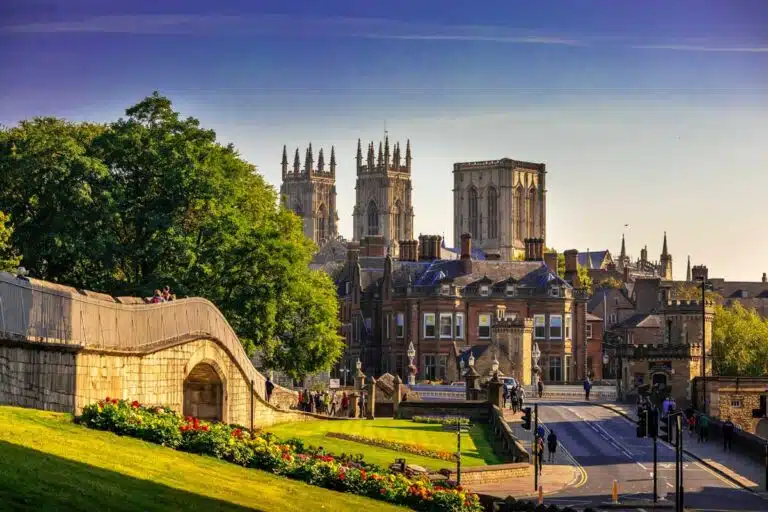
York is one of England’s most historically layered cities — a compact medieval centre still encircled by Roman walls, dominated by the soaring gothic towers of York Minster and threaded with streets like the cobbled Shambles that have changed little in centuries. Yet York is far from a museum piece: the National Railway Museum is the best of its kind in the world, the Jorvik Viking Centre brings the city’s Norse past to vivid life, and a programme of ghost tours, dungeons and family attractions gives it a broad appeal that few English cities can match. Whether you’re planning a day trip from elsewhere in Yorkshire or using York as a base for exploring the North York Moors and coast, this guide covers the city’s essential attractions with practical information on ticket prices, opening hours, booking requirements and parking.
York’s Cathedrals, Towers and Historic Buildings
York’s built heritage spans two thousand years — from Roman fortress to Viking capital to medieval powerhouse. The city centre is compact enough to walk between its major landmarks, and the city walls themselves make an excellent orientation route with views over rooftops to the Minster. These guides cover the headline historic sites and several lesser-known gems that reward the curious visitor.
- York Minster: complete visitor guide with hours, prices and accessibility tips — one of northern Europe’s great Gothic cathedrals, with a Chapter House, underground treasury and tower climb offering panoramic views across the city.
- Clifford’s Tower, York: hours, prices, parking and visitor guide — the striking 13th-century keep atop a Norman mound, offering the best elevated views over the city centre.
- Merchant Adventurers’ Hall York: ticket prices, hours and visitor tips — the finest medieval guildhall in England, built in the 1350s and still remarkably intact, with an undercroft, great hall and chapel.
- York Mansion House: opening hours, tickets and essential visitor tips — the official residence of the Lord Mayor of York, one of the earliest purpose-built mayoral mansions in England, open to visitors with guided tours.
- Fairfax House York: opening hours, tickets and how to plan your visit — a restored Georgian townhouse considered one of the finest examples of its period in England, filled with an outstanding collection of 18th-century furniture.
- Bar Convent York: hours, ticket prices and how to plan your visit — England’s oldest surviving Catholic convent, with a hidden Georgian chapel, museum exploring centuries of religious persecution, and a café worth stopping at independently.

York’s Museums and Major Visitor Attractions
York has a depth of museum provision that punches well above the city’s size — from a world-class railway collection to Viking archaeology to Georgian social history. These guides include honest assessments of who each attraction suits best, how long to allow, and whether advance booking is necessary.
- National Railway Museum York: parking guide and visitor essentials — the world’s largest railway museum, free to enter, housing the Mallard, a Japanese Shinkansen bullet train and centuries of locomotives, carriages and railway history.
- Jorvik Viking Centre York: hours, ticket prices and visitor tips — a time-car ride through a reconstructed Viking street built on the actual archaeological site, with artefacts from one of Britain’s most significant urban excavations.
- York Castle Museum: visitor guide with hours, prices and accessibility information — a social history museum built around recreated Victorian and Edwardian streets, housed in a former debtors’ prison with Dick Turpin’s cell among the highlights.
- Yorkshire Museum, York: ticket prices, opening hours and visitor guide 2026 — Roman, Viking and medieval treasures including the Middleham Jewel, set within Museum Gardens alongside the ruins of St Mary’s Abbey.
- York Dungeon tickets: do you need to book in advance? — everything you need to know about booking, pricing and what to expect from York’s most theatrical history experience.
- York Bird of Prey Centre: ticket prices, parking and visitor guide — flying displays with hawks, falcons and owls on the edge of the city, a good option for families looking to combine a York visit with something outdoors.
- York Cold War Bunker: tour prices, times and visitor information — the most recently-build English Heritage site in the country, inside the place that made contingency plans for a nuclear war.
Planning Your Visit to York
York’s compact centre means most attractions are walkable from one another, and the city walls — a continuous circuit of about three miles — make an excellent free half-day activity with views over the roofline to the Minster. Driving into the centre is not recommended; the Park & Ride network is efficient and significantly cheaper than central car parks. The National Railway Museum has its own free car park and is one of the few central attractions worth driving to directly. Several of York’s most popular paid attractions — Jorvik, the Dungeon and Clifford’s Tower — benefit from advance online booking, particularly on summer weekends and school holidays.
How many days do you need in York?
Two full days is the minimum to cover York’s headline attractions without rushing — York Minster, the National Railway Museum and either Jorvik or the Castle Museum would account for most of a first day, with the city walls, Shambles and smaller historic buildings filling a second. Three days allows you to explore more thoroughly and take an easy day trip to the North York Moors, Castle Howard or the coast at Whitby.
What is York most famous for?
York is most famous for York Minster — one of the largest Gothic cathedrals in northern Europe — its intact Roman and medieval city walls, the Shambles (a preserved medieval street), and the Jorvik Viking Centre built on the site of a major Viking-age excavation. The National Railway Museum, which is free to enter, is also one of the most visited attractions in England outside London.
Is York worth visiting for a day trip?
Yes, though a single day means making choices. The most satisfying day-trip itinerary typically combines York Minster (allow two hours including the tower climb), a walk along a section of the city walls, lunch on or near the Shambles, and either the National Railway Museum or Jorvik Viking Centre in the afternoon. Pre-booking timed entry tickets for Jorvik and Clifford’s Tower avoids queues that can eat significantly into a short visit.