The American Museum of Natural History is one of the world’s largest natural history museums, located on Manhattan’s Upper West Side, facing Central Park.
This guide was updated in July 2026. Standard adult general admission is now $37 for visitors from outside New York State. Many older guides still quote figures nearer $28, so it’s worth checking prices before you travel. The museum holds more than 40 permanent halls, from dinosaur fossils to a life-size blue whale model. You can book tickets in advance through Viator to skip the queue and secure your entry time.
Quick facts: American Museum of Natural History
| Detail | Information |
|---|---|
| Address | 200 Central Park West, New York City, NY 10024 |
| Hours | Daily, 10 am–5:30 pm (later closing on select July evenings) |
| Admission, adult (standard) | $37 |
| Admission, child 3–12 (standard) | $22 |
| Nearest subway | 81st Street (B, weekdays only, or C, daily) |
| Typical visit duration | 3 to 5 hours |
American Museum of Natural History opening hours
The museum opens daily from 10 am to 5:30 pm and closes only for Thanksgiving and Christmas Day.
Two permanent halls, the Hall of Eastern Woodlands and the Hall of the Great Plains, are currently closed. This follows updated federal regulations covering Native American cultural items, and no reopening date has been confirmed.
American Museum of Natural History ticket prices
Prices below are the standard rate, for visitors from outside New York State.
| Ticket type | Adult | Senior/student | Child (3–12) |
|---|---|---|---|
| General admission | $37 | $30 | $22 |
| General admission + one ticketed exhibition | $43 | $35 | $26 |
| General admission + all ticketed exhibitions | $48 | $39 | $30 |
Residents of New York State can pay what they wish for general admission, with valid ID. The suggested amounts are shown below.
| Ticket type | Adult (suggested) | Senior/student (suggested) | Child (suggested) |
|---|---|---|---|
| General admission | $25 | $20 | $14 |
| General admission + one exhibition | $30 | $24 | $17 |
| General admission + all exhibitions | $35 | $28 | $20 |
Children under 3 always go free, as do Museum Members. General admission includes over 40 permanent halls plus ten included exhibitions, such as the Apex Stegosaurus Fossil and Eyes on the Universe. Separately ticketed exhibitions, including the Davis Family Butterfly Vivarium and the Hayden Planetarium Space Show, cost extra and need their own timed entry slot.
Advance booking is recommended, especially in summer and during school holidays, since same-day tickets are subject to availability. You can book through Viator to save time at the door.
Why book American Museum of Natural History tickets?
- 🏛️ The blue whale: A 94-foot model dominates the Milstein Hall of Ocean Life, one of the most photographed spaces in any museum.
- 🎟️ Skip the queue: Advance booking secures a timed entry slot, so you avoid standing in line at the door.
- 🌿 Live butterflies: The Davis Family Butterfly Vivarium lets hundreds of butterflies fly freely around you.
- 📜 World-class fossils: See the Apex Stegosaurus and a Tyrannosaurus rex skeleton in the fourth-floor dinosaur halls.
- 💰 Free for under-3s: Children under three always get in free, whichever ticket type you choose.
Getting to the American Museum of Natural History
By subway, take the B train, weekdays only, or the C train, which runs daily, to 81st Street. The 1 train stops two blocks west, at Broadway and West 79th Street.
By bus, the M79 crosses Central Park along West 79th Street and stops beside the museum on West 81st Street. The M7, M10, M11, M86, and M104 buses also stop nearby.
On foot, the museum faces Central Park directly, so many visitors combine a walk through the park with their trip.
Visitors arriving from further afield can connect via Metro-North, the Long Island Rail Road, New Jersey Transit, or Amtrak, then take the subway or a taxi into the city.
Parking at the American Museum of Natural History
The museum’s parking garage opens at 6 am on weekdays and 8 am on weekends, closing at 11 pm daily. Enter on 81st Street, between Central Park West and Columbus Avenue.
Parking is not free. Rates start at $33 for up to two hours and rise to $55 for a full day, with a $10 surcharge for oversized vehicles. Free electric vehicle charging is available on the garage’s mid-level, though visitors need the ChargePoint app to use it.
How long to spend at the American Museum of Natural History
Most first-time visitors need 3 to 5 hours to cover the main halls comfortably. Families adding a planetarium show or a special exhibition should budget closer to a full day.
Accessibility at the American Museum of Natural History
The museum offers step-free access through the Rose Center for Earth and Space on 81st Street and the Gilder Center entrance on Columbus Avenue. Both have accessible restrooms and lactation stations nearby.
The Central Park West entrance on 79th Street has stairs. Visitors using strollers or wheelchairs should use the Rose Center or Gilder Center entrances instead.
The nearest subway station, 81st Street, is not wheelchair accessible. The closest accessible station is 72nd Street, served by the 1, 2, and 3 trains, with a connecting M7 bus on Amsterdam Avenue.
Visitors with disabilities can buy tickets at the discounted senior and student rate, either on-site or by calling the museum’s central reservations line.
What to see inside the American Museum of Natural History
Milstein Hall of Ocean Life: a 94-foot blue whale model hangs above dioramas of marine ecosystems from around the world. It remains one of the museum’s most photographed spaces.
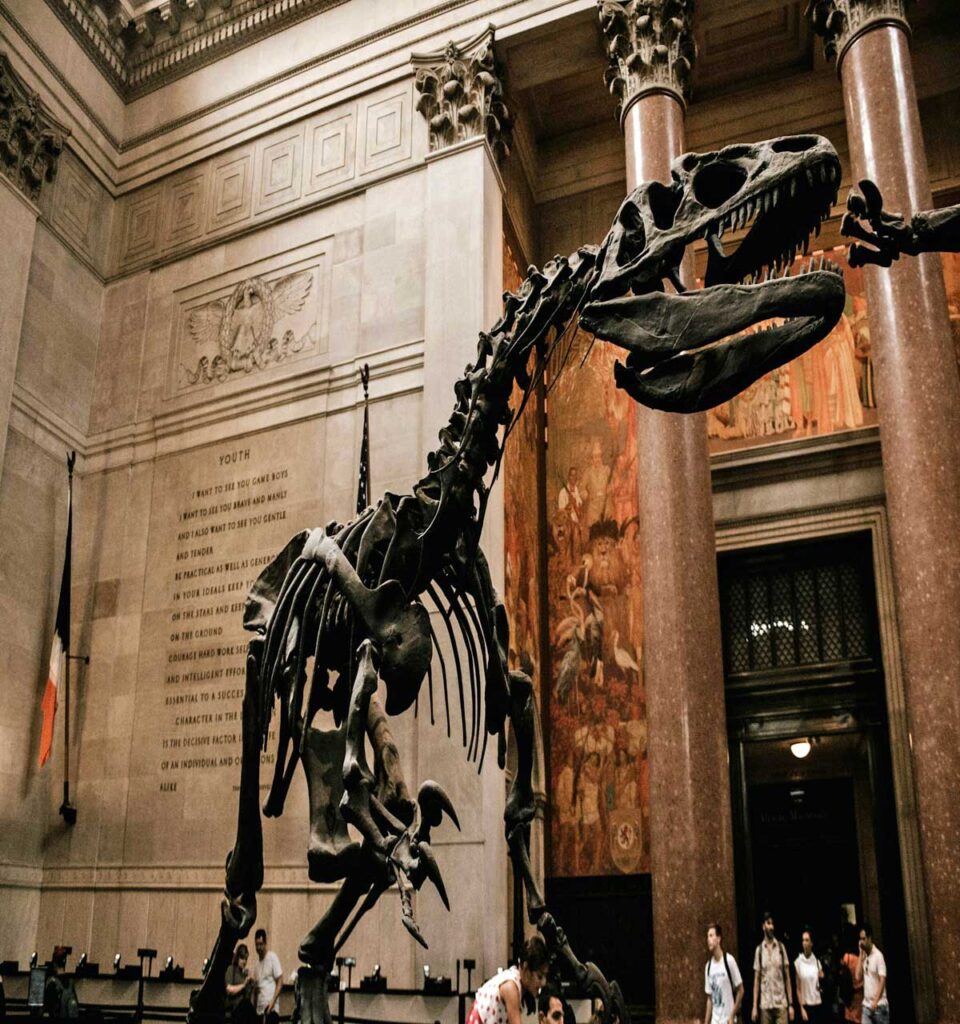
Fossil halls: the fourth floor houses the museum’s dinosaur collection, including a Tyrannosaurus rex skeleton and the Apex Stegosaurus fossil. The halls trace the evolutionary tree of vertebrate life.
Hayden Planetarium: inside the Rose Center for Earth and Space, the planetarium runs Encounters in the Milky Way, a space show exploring our solar system. Tickets cost extra and can sell out on busy days.
Richard Gilder Center: this newer wing houses the Solomon Family Insectarium and the Davis Family Butterfly Vivarium, where hundreds of live butterflies fly freely around visitors. The Invisible Worlds immersive experience is also here.
Akeley Hall of African Mammals: detailed dioramas depict elephants, lions, and gorillas in their natural habitats. The hall has changed little since it opened in 1936, giving it a distinctly old-world feel.
Mignone Halls of Gems and Minerals: thousands of specimens are on display, including a towering amethyst geode. It makes a quieter, glittering contrast to the dinosaur halls.
Native American halls: the Hall of Eastern Woodlands and the Hall of the Great Plains are currently closed, pending compliance work under updated federal regulations. Check the museum’s website for the latest status before you plan around them.
Practical tips for visiting the American Museum of Natural History
| Tip | Detail |
|---|---|
| Enter free in the last hour | Admission is waived for anyone entering during the museum’s final open hour of the day. |
| Bring ID for pay-what-you-wish | New York State residents can pay what they wish for general admission with valid ID. |
| Large bags aren’t allowed inside | Backpacks and luggage must go in a locker, priced from $7 for a small one to $12 for a large one. |
| Visit on a weekday morning | Arriving right at 10 am opening tends to be quieter than weekends and school holidays. |
| Book planetarium shows ahead | Space Show tickets sell out on busy days, so advance booking is recommended if it’s a priority. |
American Museum of Natural History FAQ
| Question | Answer |
|---|---|
| What are the opening hours? | The museum opens daily from 10 am to 5:30 pm, with later closing on selected July evenings. |
| Is the museum closed on any days? | Yes, it closes only for Thanksgiving and Christmas Day. |
| Do I need to book tickets in advance? | It’s not required, but advance booking is recommended; you can book tickets in advance through Viator. |
| Is the museum wheelchair accessible? | Most of it, yes, though the Central Park West entrance has stairs and the nearest subway station isn’t accessible. |
| How does it compare to other New York museums? | It’s larger and more object-dense than most, with over 40 permanent halls covering natural history, culture, and space science. |
Things to do near the American Museum of Natural History
Central Park is directly across the street, offering an easy way to unwind after the museum with paths, lakes, and gardens to explore.
New-York Historical stands next door on Central Park West, tracing the city’s story from Dutch settlement through to today.
The Dakota is a landmark 1884 apartment building at 72nd Street and Central Park West, a fifteen-minute walk south, famous as John Lennon’s former home.
Riverside Park runs along the Hudson River, a ten-minute walk west, and makes a quieter alternative to Central Park.
Zabar’s is a beloved food market on Broadway at 80th Street, a short walk away, known for bagels, smoked fish, and coffee.
What to visit tomorrow after the American Museum of Natural History
Yale Peabody Museum of Natural History, in New Haven, Connecticut, reopened after a major renovation and has a strong dinosaur hall. It’s about 1 hour 45 minutes away by Metro-North train.
Academy of Natural Sciences of Drexel University, in Philadelphia, is one of America’s oldest natural history museums, with dinosaur skeletons and live butterflies. It’s around 2 hours away by train.
Bruce Museum, in Greenwich, Connecticut, blends natural history and science exhibits in a smaller, easy-to-manage space. It’s about 45 minutes away by train.
New Jersey State Museum, in Trenton, pairs natural history galleries with planetarium shows and fine art. It’s roughly 1 hour 30 minutes away by train.
Staten Island Museum holds a compact natural science collection and is reachable via the free Staten Island Ferry. It’s around 45 minutes away door to door, including the ferry crossing.
More New York City travel
Other New York City travel guides on Planet Whitley include:
- Plan your visit to the Top of the Rock observation deck and the Whitney Museum of American Art.
- Visit the Fraunces Tavern Museum and the Charging Bull Sculpture in Lower Manhattan.
- What to expect at the Intrepid Museum at Pier 86, Manhattan.
- Plan your visit to the National Museum of Mathematics in Manhattan.
- Guides to NYC’s wildlife attractions: Queens Zoo, New York Aquarium and Prospect Park Zoo.