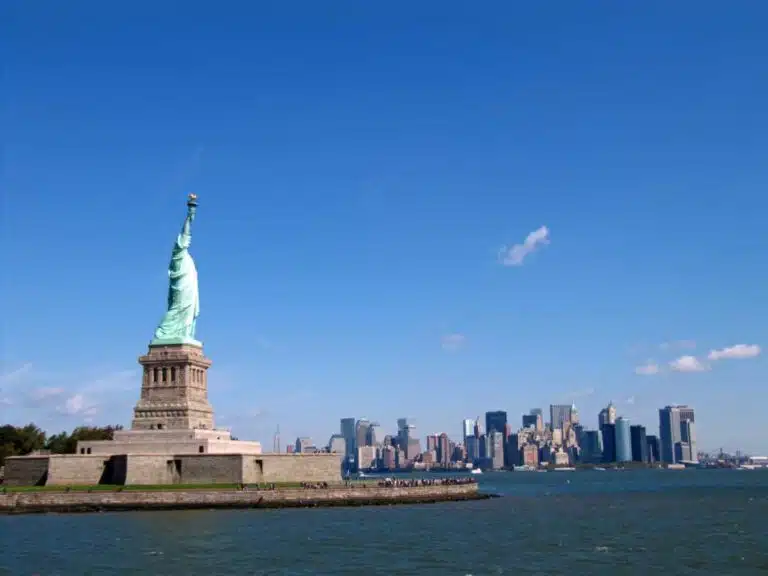
New York City needs little introduction — but it consistently delivers more than first-time visitors expect and rewards repeat visitors who dig beneath the surface. The skyline is the famous first impression, but the city’s real depth lies in what’s below and behind it: Revolutionary War history buried in the streets of Lower Manhattan, an extraordinary concentration of art along Museum Mile, Central Park hiding monuments, a carousel and a zoo within its 843 acres, and walking tours that reveal the city’s role in the abolitionist movement and the stories of Alexander Hamilton beyond the Broadway musical. These guides cover New York’s key attractions with practical information on ticket prices, opening hours, transport and honest advice on what’s worth your time and money.
Observation decks and skyline views
Viewing Manhattan from above is a quintessential New York experience and one where the ticketing options — and the differences between the decks — are more significant than most visitors realise before arriving. These guides cover all three major options with honest advice on value and what each delivers.
- Empire State Building: how to pay less for tickets — a practical guide to navigating the ticket tiers, add-ons and third-party options for the city’s most famous Art Deco observation deck, with advice on the difference between the 86th and 102nd floor experiences.
- Top of the Rock, Rockefeller Center: opening hours, ticket prices and visitor guide — the midtown observation deck that offers arguably the best direct view of the Empire State Building itself, set within the art deco 30 Rockefeller Plaza complex.
- Summit One Vanderbilt, NYC: tips for cheaper ticket prices — the city’s most immersive and technologically ambitious observation experience, with mirrored rooms and glass floors above Midtown Manhattan, and practical strategies for reducing the premium ticket cost.
- Plan your visit to Vessel at Hudson Yards.
Lower Manhattan and the harbor: Revolutionary history and the harbor
The southern tip of Manhattan is where New York began — a dense concentration of American Revolutionary history, financial heritage and the most recognisable immigration symbol in the world, all within walking distance of each other. The 9/11 Memorial adds a more recent layer of profound historical significance.

- Ellis Island and the Statue of Liberty: the mistake not to make — why the immigration museum at Ellis Island often deserves more time and attention than the statue itself, and how to balance your ferry trip between the two stops to get the most from both.
- 9/11 Memorial Museum, New York City: practical guide for first-time visitors — the museum at Ground Zero documenting the September 11 attacks and their aftermath, built within the foundations of the original World Trade Center towers, with guidance on what to expect emotionally and practically.
- Federal Hall National Memorial, NYC: visitor guide with times, prices and accessibility — the site where George Washington took the oath of office as the first President of the United States on 30 April 1789, now a free National Park Service memorial on Wall Street.
- Trinity Church, Manhattan: opening hours, visitor tips and Alexander Hamilton’s grave — the historic Gothic Revival church at the intersection of Wall Street and Broadway, with a churchyard containing the grave of Alexander Hamilton and several other Founding Fathers.
- Fraunces Tavern Museum, NYC: visitor guide with prices, times and transport — one of the oldest surviving buildings in New York, the tavern where George Washington bid farewell to his officers at the end of the Revolutionary War in 1783, now a museum and working bar.
- Charging Bull statue, Manhattan: a practical guide for first-time visitors — how to find, photograph and understand the history of the iconic bronze bull in the Financial District, including its unexpected origins as an unsanctioned overnight installation in 1989.
- Skyscraper Museum, New York City: visitor guide — a small but focused museum in Battery Park City dedicated to the engineering, architecture and history of the tall building, with scale models and exhibits on the development of the Manhattan skyline from the 1890s to the present day.
Central Park: monuments, wildlife and activities
Central Park’s 843 acres contain far more than most visitors realise — a Victorian carousel, a celebrated sled dog statue, a gilded war memorial, a small but well-regarded zoo, and a scavenger hunt that transforms a standard walk into something considerably more engaging.
- Central Park scavenger hunt: turning the green lung into a game — a review of a gamified walking tour that offers an unusually engaging way to explore the park’s most significant monuments, sculptures and landscapes.
- Balto statue, Central Park: guide to the famous sled dog — how to find the beloved bronze Siberian Husky that commemorates the 1925 serum run to Nome, when sled dogs delivered diphtheria antitoxin across 674 miles of frozen Alaska.
- Central Park Carousel: visitor guide with prices, times and access — practical information for riding one of the largest and most historic merry-go-rounds in America, in continuous operation in the park since 1871.
- USS Maine Monument, Central Park: what to expect at Columbus Circle — the towering gilded memorial at the southwest entrance to Central Park, commemorating the sailors killed when the USS Maine exploded in Havana Harbour in 1898.
- Central Park Zoo, New York City: practical guide for first-time visitors — a compact but well-designed zoo in the heart of the park, with snow leopards, red pandas and a 4D theatre, manageable in a few hours and a good option for families combining it with a broader park visit.
Art museums: Museum Mile, MoMA and the Meatpacking District
New York’s art museum offer is extraordinary in range and depth. The Upper East Side’s Museum Mile concentrates some of the greatest collections in the world within a few blocks of each other; the Whitney in the Meatpacking District has the finest collection of American art in the country; and the Frick Collection offers the intimacy of a private mansion that no larger institution can replicate.
- Upper East Side, Manhattan: a first-time visitor’s guide — how to navigate one of New York’s most affluent residential neighbourhoods and its remarkable concentration of cultural institutions, from the Metropolitan Museum of Art to the boutiques of Madison Avenue.
- Museum of Modern Art (MoMA), New York City: practical guide for first-time visitors — the most important modern art museum in the United States, with works by Picasso, Matisse, Warhol and Pollock alongside a collection that extends from Post-Impressionism to contemporary digital art.
- Frick Collection, NYC: visitor guide — one of the most exquisite and intimate art museums in the United States, housing Old Masters by Vermeer, Rembrandt and El Greco in the restored Gilded Age mansion of industrialist Henry Clay Frick.
- Whitney Museum of American Art, NYC: opening hours, ticket prices and visitor guide — the definitive collection of 20th and 21st-century American art, in a striking Renzo Piano building at the southern end of the High Line, ideally combined with a walk along the elevated railway park.
- Cooper Hewitt Smithsonian Design Museum, NYC: visitor tips and practical information — America’s only museum dedicated entirely to historic and contemporary design, housed in the former mansion of Andrew Carnegie on Fifth Avenue, with an interactive pen that lets visitors collect and recreate designs throughout the galleries.
Science, history and specialist museums
Beyond the major art institutions, New York has an exceptional range of specialist collections — a decommissioned aircraft carrier turned museum, a working 1936 subway station, a J. P. Morgan private library and one of the finest natural history museums in the world. These institutions are scattered across Manhattan and reward those willing to travel beyond Midtown for them.
- American Museum of Natural History, New York City: practical guide for first-time visitors — one of the world’s great natural history museums, with dinosaur fossil halls, a 45-metre blue whale suspended from the ceiling of the Ocean Life hall, an Hayden Planetarium and collections spanning 34 million specimens and artefacts.
- Intrepid Museum, NYC: 2026 opening hours, ticket prices and visitor tips — a WWII aircraft carrier permanently moored at Pier 86 on the Hudson River, with the Space Shuttle Enterprise and a Concorde jet among the aircraft on display alongside the carrier’s own considerable military history.
- New York Transit Museum, Brooklyn: what first-time visitors should expect — a museum inside a decommissioned 1936 subway station in Brooklyn Heights, with vintage subway cars spanning a century of New York’s underground transit history, all in their original operational environment.
- Morgan Library and Museum, NYC: guide with prices, hours and visitor tips — J. P. Morgan’s extraordinary private library, now a public museum housing illuminated manuscripts, Gutenberg Bibles, Rembrandt drawings and the original manuscript of A Christmas Carol in a building of spectacular Beaux-Arts opulence.
- Museum of the City of New York: prices, times and visitor guide — a comprehensive museum tracing the history, culture and ongoing evolution of all five boroughs, at the northern end of Museum Mile on Fifth Avenue.
- National Museum of Mathematics (MoMath), New York City: ticket prices, hours and visitor tips — the only museum in North America dedicated entirely to mathematics, with interactive exhibits that make abstract concepts tangible, well suited to families and anyone who found maths more interesting than their school made it seem.
- Five niche NYC museums worth visiting — a curated shortlist of specialist collections for visitors who want to escape the crowds at the Met and MoMA, covering some of the city’s most rewarding and least-discovered institutions.
- Plan your visit to the City Reliquary Museum in Brooklyn.
Hidden history and walking tours
New York’s streets contain layers of history that standard sightseeing itineraries rarely reach — the abolitionist networks of the Underground Railroad, the real geography of Alexander Hamilton’s Manhattan, and the 18th-century farmhouse in Inwood that survived while the city grew up around it. These guides and tour reviews cover the city’s less-obvious historical depth.
- Alexander Hamilton walking tour of Manhattan: beyond the Broadway musical — a guided walk through Hamilton’s New York, separating the historical facts from the theatrical fiction and tracing his political and personal geography across Lower Manhattan.
- Hamilton Grange National Memorial, New York: practical guide with hours and prices — the only home Alexander Hamilton ever owned, a Federal-style house he built in 1802 in the Hamilton Heights neighbourhood, now managed by the National Park Service and open for free tours.
- New York City’s slavery and Underground Railroad walking tour — a deep dive into the city’s role in both the slave trade and the abolitionist movement, revealing hidden sites and lesser-known stories about the fight for freedom in the streets of lower and midtown Manhattan.
- Catacombs by Candlelight, Nolita: exploring the vaults of Old St Patrick’s — an atmospheric candlelit tour of the historic cemetery and burial vaults beneath St Patrick’s Old Cathedral in Nolita, revealing stories of the city’s early Catholic immigrant community.
- Dyckman Farmhouse Museum, Inwood: practical guide with hours and prices — the only surviving 18th-century Dutch Colonial farmhouse in Manhattan, preserved in the Inwood neighbourhood as one of the most quietly extraordinary historic sites in the city.
- Practical guides to visiting New York City’s cathedrals: St Patrick’s Cathedral, Cathedral of St John the Divine.
Beyond Manhattan: outer borough attractions and parks
New York’s most interesting attractions are not all in Manhattan. Brooklyn, the Bronx and Queens each have significant attractions worth a dedicated visit, and several of Manhattan’s own northern parks — Fort Tryon in Washington Heights, Riverbank in Harlem — are rarely reached by visitors who don’t look beyond the standard tourist circuit.
- New York Botanical Garden, Bronx: practical guide with hours and prices — a 250-acre botanical garden in the Bronx containing 50 distinct gardens including a Victorian glasshouse, a rose garden and one of the largest remaining tracts of old-growth New York forest.
- Van Cortlandt House Museum, Bronx: practical guide with hours and prices — New York City’s oldest surviving Georgian manor house, built in 1748, set within Van Cortlandt Park and used as a headquarters by both George Washington and British General Howe during the Revolutionary War.
- General Grant National Memorial, New York City: practical guide with hours and prices — the largest mausoleum in North America, housing the tombs of Ulysses S. Grant and his wife, a free National Park Service site in Riverside Park that most visitors to the city never find.
- Fort Tryon Park, Manhattan: practical guide with hours and tips — a hilltop park in Washington Heights with some of the best views over the Hudson River and the Palisades available from Manhattan, and home to the Heather Garden — the largest public garden in the NYC parks system north of the botanical gardens.
- Riverbank State Park, Harlem: practical guide with hours and prices — a 28-acre park built on top of a wastewater treatment facility on the Hudson River in West Harlem, with an Olympic-sized swimming pool, an ice skating rink, athletics facilities and Hudson River views.
- Roberto Clemente State Park, Bronx: practical guide with hours and prices — a Bronx waterfront park on the Harlem River with an outdoor pool, fishing pier and views across to upper Manhattan, named after the Puerto Rican baseball legend and humanitarian.
- Queens Zoo, New York City: practical guide for first-time visitors — a small but well-designed zoo in Flushing Meadows-Corona Park focused entirely on North American wildlife, including bison, American black bears and a petting zoo with farm animals.
- New York Aquarium, Brooklyn: practical guide for first-time visitors — the oldest continuously operating aquarium in the United States, on the Coney Island waterfront, with sand tiger sharks, sea otters, walruses and an outdoor sea lion theatre.
- Prospect Park Zoo, Brooklyn: practical guide for first-time visitors — a compact zoo within Prospect Park focused on interactive animal demonstrations and red pandas, hamadryas baboons and wallabies, a good family option when combining with a visit to the park.
- Brooklyn Children’s Museum: practical guide with hours and prices — the world’s oldest children’s museum, founded in 1899, with hands-on exhibits covering science, culture and the natural world, in the Crown Heights neighbourhood.
- Guide to Pelham Bay Park in the Bronx – including Orchard Beach and the Bartow-Pell Mansion.
- Westchester Country attraction guides: Playland Park.
- NYC garden guides: Wave Hill, Brooklyn Botanic Garden.
Road trips from New York City
New York is a natural starting point for drives south along the Eastern Seaboard — both Philadelphia and Baltimore are within comfortable reach, and the routes between them pass through some of the most historically significant landscapes in the United States.
- NYC to Philadelphia drive: best stops, distance and drive time — the drive southwest through New Jersey to one of America’s most historically significant cities, with options to detour through Princeton and the Delaware Valley.
- NYC to Baltimore road trip: best stops, distance and drive time — the drive south through New Jersey, Delaware and Maryland, with stops that can include Philadelphia, Wilmington and the Chesapeake and Delaware Canal before arriving in Baltimore’s Inner Harbor.
- The best stops on the New York City to Cincinnati drive.
- New York to Connecticut drives: What to see on the NYC to Stamford CT drive.
Planning your New York City visit
New York is a year-round destination, though spring (April to June) and autumn (September to November) offer the most comfortable weather and manageable crowd levels. The Metropolitan Card (MetroCard) or the newer OMNY contactless payment system covers the subway and buses — a car is not only unnecessary but actively counterproductive for most itineraries. Several of the city’s best attractions — Federal Hall, General Grant National Memorial, Hamilton Grange and the Dyckman Farmhouse — are free. The New York City Pass and Explorer Pass can offer good value for visitors planning multiple paid attractions across several days. Advance booking is essential for the observation decks during summer and school holidays, and for the 9/11 Memorial Museum at any time of year.
How many days do you need in New York City?
Five days covers New York’s main attractions without excessive rushing. A first day suits Lower Manhattan — the 9/11 Memorial, Federal Hall, Trinity Church and the harbor. A second day works well for Central Park and the Upper East Side museums. A third day suits Midtown — an observation deck, the Morgan Library, the Whitney or MoMA. A fourth day works for specialist museums — the Intrepid, the Transit Museum in Brooklyn or the American Museum of Natural History. A fifth day suits a walking tour and time in one of the outer borough attractions or parks. Those with a week can add the Bronx botanical gardens, the New York Aquarium at Coney Island and a road trip to Philadelphia.
What is New York City best known for?
New York is best known for its skyline, the Statue of Liberty, Central Park, Times Square and its status as a global capital of finance, culture and media. Among more culturally focused visitors it is known for the Metropolitan Museum of Art, the Whitney, MoMA and Broadway. The city’s Revolutionary War history — concentrated in Lower Manhattan — is significantly underappreciated given how much of it is free to access and within easy walking distance.