The Ancient Theatre of Taormina (Teatro Antico di Taormina) is a Hellenistic theatre begun in the 3rd century BC, rebuilt substantially by the Romans, and set on a hillside above the Ionian Sea with Mount Etna visible on the southern horizon.
This guide was updated in June 2026. The full admission price is now €16, with a reduced rate of €9 — several major guides and aggregators still show the pre-2025 prices of €10 or €14. Three active alerts apply to the 2026 season: the Antiquarium is closed for restoration; the Goethe Trail is not accessible to the public; and from 8 to 18 June 2026, the front section of the stage will be only partially visible due to screen installation for the Taormina Film Festival. You can book through GetYourGuide in advance.
Quick facts
| Detail | Information |
|---|---|
| Address | Via del Teatro Greco 1, 98039 Taormina, Sicily, Italy. |
| Hours (general) | 09:00 to one hour before sunset; verify seasonally on the Aditus site |
| Last admission | 45 minutes before closing |
| Full ticket | €16 |
| Reduced ticket | €9 (18–25 year olds, FAI members) |
| Under 18 | Free |
| Free admission days | First Sunday of the month; 25 April; 2 June; 4 November |
| Closed when | During concerts and performance events; occasionally for maintenance |
| Antiquarium | Closed for restoration (date of reopening unconfirmed) |
| Goethe Trail | Not accessible to the public |
| Nearest cable car | Mazzarò–Taormina (runs daily from 08:00) |
| Nearest bus | Taormina bus station (Interbus/ASM from Catania, Messina) |
| Typical visit | 1–2 hours |
Ancient Theatre of Taormina opening hours
The theatre is open daily from 09:00 until one hour before sunset, which means closing times vary significantly by season. In peak summer (June–August), this can be as late as 20:00; in winter it may be as early as 16:00. Last admission is 45 minutes before closing. Always verify the current closing time on the Aditus official ticketing page before visiting, as hours also change around maintenance periods and events.
The theatre closes to daytime sightseeing during concerts and performances — a busy summer schedule runs from late June through September. If you are planning an afternoon visit, check the event calendar first.
Ancient Theatre of Taormina admission prices
The 2026 full ticket price is €16 and the reduced price is €9. Multiple guides and aggregators still show €10 (the pre-2025 price) or €14 — both are now out of date. Prices are confirmed via the official Aditus ticketing platform and the taormina.it 2026 events guide.
| Category | Price |
|---|---|
| Full ticket | €16 |
| Reduced (18–25 year olds; FAI members) | €9 |
| Under 18 | Free |
| Disabled visitors + one companion | Free |
| First Sunday of the month | Free (ticket collected on site only) |
| 25 April, 2 June, 4 November | Free (national holidays) |
Free tickets cannot be purchased in advance — they are issued only at the on-site ticket office on the relevant day. Proof of eligibility for reduced or free tickets must be presented at the entrance. Book your ticket through GetYourGuide to skip the queue.
Why visit the Ancient Theatre of Taormina?
- 🏛️ The view alone justifies the visit: The stage backdrop frames Mount Etna to the south and the Bay of Naxos to the east — a panorama present in no other theatre in the ancient world.
- 🎟️ Free entry on three national holidays and the first Sunday of the month: April 25, June 2, and November 4 are all free-admission days — rarely highlighted in travel guides.
- 🌿 Second-largest ancient theatre in Sicily: After Syracuse, this is the largest surviving classical theatre in Italy in terms of seating capacity — around 4,500 spectators — and one of the best-preserved Roman-era structures anywhere.
- 📜 Still a working venue: Every summer the theatre hosts the Taormina Film Festival and a full programme of concerts and opera. Tickets for performances are separate from the archaeological admission.
- 💰 Arrive at opening to beat the crowds: Tour coaches arrive from about 09:30. The 10 to 15 minutes between gate-open and their arrival are the quietest of the entire day — and the light on Etna is at its best in the early morning.
How to get to the Ancient Theatre of Taormina
On foot from Taormina town centre, the theatre is an 8–10 minute walk uphill from the main street Corso Umberto I. Turn off Corso Umberto at Via Teatro Greco and follow it directly to the entrance. This is the simplest approach for visitors already in Taormina.
By cable car from Mazzarò, the funivia runs between the seafront at Mazzarò and the town centre daily from 08:00 (summer; from 09:00 in winter). From the cable car upper station, the theatre is a 10–15 minute walk. The cable car does not stop close to the theatre entrance.
By bus from Catania, Interbus runs multiple daily services from Catania Fontanarossa airport and the city centre to Taormina’s bus station on Via Luigi Pirandello (journey approximately 1.5 hours). From the bus station, a downhill walk or ASM local shuttle reaches the town centre and the approach to the theatre.
By car, exit the A18 motorway (Catania–Messina) at Taormina and follow signs to the historic centre. Cars cannot enter the pedestrianised centre. Use the Porta Catania or Lumbi car parks and walk or take the ASM shuttle bus to the centre.
Parking at the Ancient Theatre of Taormina
There is no parking at the theatre itself. Parking Lumbi (on Via Circonvallazione, north of the town) and Parking Porta Catania (south) are the main options, both with shuttle connections to Corso Umberto I. Parking in Taormina can be difficult at peak periods — arriving by bus or cable car from below is considerably easier in July and August.
How long to spend at the Ancient Theatre of Taormina
Allow 1 to 1.5 hours for a thorough visit at a relaxed pace. The archaeological site is not large, but the view and the seating terraces reward time. A guided tour typically runs 60–75 minutes. An audio guide in Italian, English, French, German, and Spanish is available for purchase at the entrance, adding depth to a self-guided visit. Note: the Antiquarium (small museum within the site) is currently closed for restoration — this removes one element that would previously have added 15–20 minutes.
Accessibility at the Ancient Theatre of Taormina
The theatre is partially wheelchair accessible. A designated entrance leads to the main terrace from which the signature postcard view — theatre ruins, sea, and Etna — is visible and photographable from a flat surface. The upper tiers and seating rows involve steep ancient steps and are not wheelchair accessible. The Antiquarium is currently closed for restoration regardless of mobility. Disabled visitors and one companion enter free with valid proof of disability.
The approach along Via Teatro Greco from Corso Umberto I is paved but uphill; the final approach to the entrance involves some uneven stone surfaces. Baby carriers are preferable to pushchairs for families. Service animals are permitted.
What to see at the Ancient Theatre of Taormina
The theatre structure was founded by the Greeks in the 3rd century BC and substantially reconstructed by the Romans in the 2nd century AD for gladiatorial games. The Romans enclosed the open stage with a towering scaenae frons (stage wall) and modified the orchestra. The result is a hybrid — Greek semicircle in plan, Roman in almost all visible material detail.
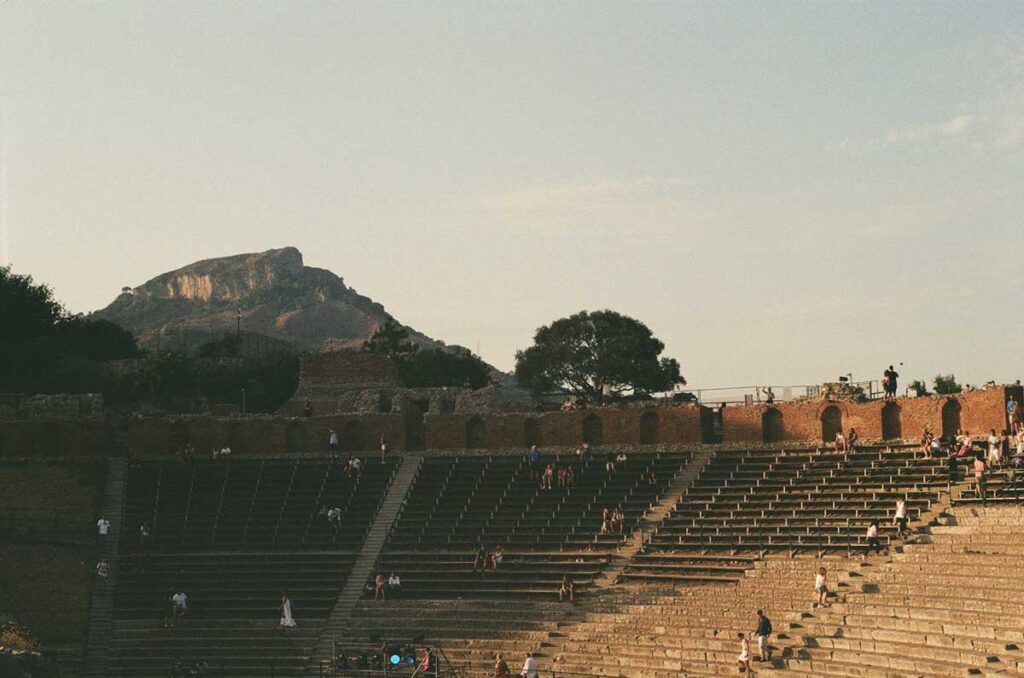
The view from the cavea is the defining experience. Looking south from the upper seating tiers, Mount Etna dominates the skyline behind the ruined stage wall; on clear days its summit is snowcapped even in summer. Looking east, the Bay of Naxos and Giardini Naxos stretch below. The combination of ancient architecture, active volcano, and sea is genuinely unique.
The stage and orchestra show the Roman adaptation clearly. The original Greek circular orchestra was modified into a semi-circle; a drainage channel indicates gladiatorial combat in the arena. The remains of the scaenae frons — two tiers of columns in brick and granite — still stand behind the performance space.
The site as a concert venue gives the theatre an additional dimension. From June to September, the space converts into one of Italy’s most spectacular live music venues. Concerts take place at night, with the illuminated ruins visible from the stage and Etna as backdrop. Daytime visitors may find parts of the site under preparation for performances during this period.
Practical tips for visiting the Ancient Theatre of Taormina
| Tip | Detail |
|---|---|
| Check for 2026 active alerts | The Antiquarium is closed for restoration; the Goethe Trail is not accessible; and from 8 to 18 June the front of the stage is partially obscured by Film Festival screen installation. |
| Arrive at 09:00 | Tour coaches arrive from about 09:30. The theatre at opening is significantly quieter. The morning light also catches Etna at its most dramatic. |
| The correct price is €16 | Many guides still show €10 or €14. The 2026 full price is €16; reduced is €9. |
| Free entry days require on-site tickets | Free admission on the first Sunday of the month and on 25 April, 2 June, and 4 November is confirmed, but free tickets can only be collected at the ticket office on the day — no advance booking available. |
| Book in advance | Booking online is the only way to guarantee skip-the-line entry during peak summer. The official Aditus platform and GetYourGuide both offer this. |
Ancient Theatre of Taormina FAQ
| Question | Answer |
|---|---|
| What is the adult ticket price? | €16 for the full ticket in 2026. Many guides still show €10 or €14 — those prices are out of date. Reduced rate is €9 for 18–25 year olds and FAI members. |
| Is the Antiquarium open? | No. It is currently closed for restoration. No confirmed reopening date is listed on the official site. |
| Are there free admission days? | Yes — the first Sunday of each month, plus 25 April, 2 June, and 4 November. Free tickets are issued on site only; advance booking is not available for these dates. |
| Can I visit during the Film Festival? | From 8 to 18 June 2026, the front section of the stage is only partially visible due to screen installation. The theatre remains open to visitors during this period. |
| Is it wheelchair accessible? | Partially. The main terrace — with the full view of the ruins, sea, and Etna — is reachable. The seating tiers involve steep ancient steps and are not accessible. Disabled visitors and one companion enter free. |
Things to do near the Ancient Theatre of Taormina
Corso Umberto I is Taormina’s main pedestrian street and runs from Porta Messina to Porta Catania, lined with cafés, shops, baroque churches, and viewpoint terraces. It takes about 20 minutes to walk end to end and passes through most of the town’s historic landmarks.
Piazza IX Aprile is the main square of Taormina, two minutes’ walk from the theatre entrance. The terrace viewpoint looks directly down to the bay and across to Etna. The Church of Sant’Agostino and the 12th-century Torre dell’Orologio both face onto it.
Parco Duca di Cesarò (Public Gardens) are formal Edwardian gardens on the south side of Taormina, five minutes’ walk from the theatre. They were laid out by Lady Florence Trevelyan in the 1890s and contain tropical planting, follies, and terrace views. Entry is free.
Isola Bella and Mazzarò Beach are accessed by the cable car from Taormina to the shore below. The nature reserve at Isola Bella is a 15-minute walk from the lower cable car station. Day sunbeds and beach access are commercial; the nature walk around the island is free.
Giardini Naxos is the resort town visible from the theatre’s cavea in the bay below. The modern town surrounds the site of ancient Naxos — the first Greek colony in Sicily (734 BC) — and the Naxos Archaeological Museum and park cover the original settlement.
Similar ancient theatres to visit in Sicily
The Greek Theatre of Syracuse (Teatro Greco) is the largest ancient theatre in Sicily and one of the largest in the ancient world — seating up to 15,000 spectators. It sits within the Neapolis Archaeological Park alongside the Roman amphitheatre and the Ear of Dionysius cave. Around 1.5–2 hours south of Taormina by car. Admission via the Parco Archeologico della Neapolis.
The Theatre of Segesta is a perfectly preserved 5th-century BC Greek theatre set on an isolated hillside in western Sicily, with views across a valley to the mountains. Unlike Taormina it was never reused or modified — the seating is original Greek masonry. Segesta Archaeological Park is around 3 hours west of Taormina.
The Odeon of Taormina is a small Roman theatre directly on Corso Umberto I in Taormina, partially excavated beneath later buildings. Entry is free and the viewing is from the street level — a short detour from the Ancient Theatre.
The Theatre of Tindari is a Greek theatre at the archaeological site of Tindari on a cape northwest of Taormina, around 1 hour’s drive. Smaller than Taormina’s theatre but overlooking the Tyrrhenian Sea. The sanctuary of the Black Madonna and the lagoon below the cape make this a compelling combination stop.
Valle dei Templi, Agrigento is not a theatre but the most important collection of Greek temples in the world outside Greece, and the scale provides context for understanding the civilization that built Taormina’s theatre. Around 3 hours south-west by car or train via Catania.
More Sicily travel
Other Sicily travel guides on Planet Whitley include:
- Key information for visiting Palermo Cathedral in Sicily.
- Plan your visit to the Palermo Botanic Gardens.
- Practical guide to visiting the Norman Palace in Palermo, with times, prices & visitor tips.
- See the monster statues at Villa Palagonia in Bagheri near Palermo.
- Guide to using the Funivia dell’Etna cable car on Mt Etna’s southern flank.