The Museo Archeologico Nazionale di Napoli (MANN) at Piazza Museo 18/19 holds the most important collection of Graeco-Roman antiquities in the world, including treasures excavated from Pompeii, Herculaneum, and the Farnese collection.
This guide was updated in June 2026. Four significant alerts apply for 2026. The Mosaic of Alexander is currently under restoration and not on display — the single most sought-after object in the museum. The main entrance has moved to the western door since 5 February 2025 (restructuring works). The Egyptian Collection can only be reached by stairs (lift unavailable). And on free admission days, the Egyptian Collection, Secret Cabinet, and Magna Graecia section remain closed. The full price is €20. You can book through GetYourGuide in advance.
Quick facts
| Detail | Information |
|---|---|
| Address | Piazza Museo 18/19, 80135 Naples, Italy. |
| Current entrance | Western door (main door closed due to restructuring works from 5 Feb 2025) |
| Hours | Wednesday–Monday, 09:00–19:30 |
| Last admission | 18:30 |
| Gallery clearance begins | 19:00 |
| Closed | Tuesdays; 1 January; 25 December |
| Full price | €20 |
| Reduced (EU citizens 18–25) | €2 |
| Artecard holders (post free entries) | €10 |
| Free admission | Under 18; Italian teachers; all visitors with disabilities |
| Free days | First Sunday of the month; 25 April; 2 June; 4 November; 8 March (women) |
| Mosaic of Alexander | Under restoration — not on display |
| Egyptian Collection | Staircase access only (lift unavailable) |
| Advance booking fee | €0 |
| Nearest metro | Museo (Line 1) |
| Typical visit | 2–4 hours |
MANN opening hours
The museum is open Wednesday to Monday, 09:00 to 19:30. It is closed every Tuesday — except when Tuesday falls on a public holiday, in which case the museum opens that Tuesday and closes the following Wednesday instead. 2026 exceptions: open Tuesday 2 June (closed Wednesday 3 June); open Tuesday 8 December (closed Wednesday 9 December). The museum is closed on 1 January and 25 December.
Last admission is 18:30; staff begin clearing galleries at 19:00. Note that on free admission days, the Egyptian Collection, Secret Cabinet, and Magna Graecia section are closed to the public for safety and security reasons.
MANN admission prices
The full admission price is €20, confirmed on the official tickets page (last modified 9 June 2026). Several guides and aggregators still list €15 or €12 — both figures are significantly out of date. The reduced price for EU citizens aged 18–25 is €2 — an unusually low figure that surprises most visitors. Advance booking carries no additional fee (€0).
| Category | Price |
|---|---|
| Full price | €20 |
| Reduced (EU citizens 18–25) | €2 |
| Artecard holders (after free entries used) | €10 |
| Under 18 | Free |
| Italian teachers (with institutional certification) | Free |
| Disabled visitors | Free |
| First Sunday of month; 25 April; 2 June; 4 November | Free (all visitors) |
| 8 March | Free (all women) |
| OPEN MANN annual card (adult) | €25 |
| OPEN MANN annual card (youth) | €5 |
Free entry tickets on free admission days cannot be booked in advance and must be collected at the ticket office on the day. Book your MANN ticket in advance through GetYourGuide to guarantee timed entry.
Why visit the MANN?
- 🏛️ The greatest Graeco-Roman collection in the world: The Farnese Hercules, the Farnese Bull, the Pompeii frescoes, and the Secret Cabinet are all here — a depth of material that no other museum matches for this period and region.
- 🎟️ EU citizens aged 18–25 pay just €2: The reduced rate for young EU visitors is among the lowest at any major Italian national museum. Present your passport or EU ID card at the ticket desk.
- 🌿 The world’s most complete Pompeii collection: The excavations at Pompeii, Herculaneum, and the Vesuvian villas produced objects now held almost entirely at the MANN — visiting here before or after Pompeii itself adds enormous context.
- 📜 The Secret Cabinet (Gabinetto Segreto): The collection of erotic artefacts from Pompeii and Herculaneum, deemed too explicit for public display until 1971, contains around 250 objects including the famous satyr and goat group. Included in the standard ticket on normal days.
- 💰 No advance booking fee: Unlike most major Italian museums, the MANN charges €0 for advance reservation — there is no financial penalty for booking ahead.
How to get to the MANN
By metro, take Line 1 (yellow) to the Museo stop — the museum is directly above the station, a 2-minute walk from the exit. This is the simplest approach from anywhere in Naples and from the central station (Garibaldi/Piazza Garibaldi, one stop on Line 1).
From Naples Centrale (main train station), take metro Line 1 (direction Piscinola or Garibaldi) to Museo — approximately 5 minutes and 3 stops. Alternatively, walk 25 minutes north via Via Pessina.
From the port (Stazione Marittima), take the R2 bus from Via Cristoforo Colombo or Piazza Municipio towards Piazza Cavour, alight near Piazza Museo — approximately 15 minutes.
From Piazza del Plebiscito, bus 24 or taxi to Piazza Museo — approximately 10 minutes.
Parking at the MANN
No dedicated museum parking exists. The nearest public car parks are at Via Shelley and Piazza Cavour. Driving in the Naples historic centre is heavily congested and the ZTL applies to large sections of the centre. The metro (Line 1, Museo stop) is overwhelmingly the preferred option.
How long to spend at the MANN
Allow 2 to 4 hours for a meaningful visit. The museum is very large (over 100 rooms across multiple floors) and cannot be fully covered in a single session without significant pace. Most visitors focus on the Farnese Collection, the Pompeii galleries (mosaics, frescoes, daily life objects), and the Secret Cabinet. Visitors specifically coming to see the Mosaic of Alexander should note it is currently off display due to restoration — two observation windows in the Mosaics Collection allow views of the active conservation work.
Accessibility at the MANN
The museum has lifts, ramps, and accessible toilets. However, two active access limitations apply. The Egyptian Collection in the basement is currently only reachable by stairs — the lift is unavailable until further notice. The restructuring works across the building mean some galleries and rooms are temporarily closed; the official schedule of open rooms is published and regularly updated on the MANN website. Disabled visitors and one companion enter free. The OPEN MANN annual card scheme also offers priority access. Wheelchairs are available on request.
What to see at the MANN
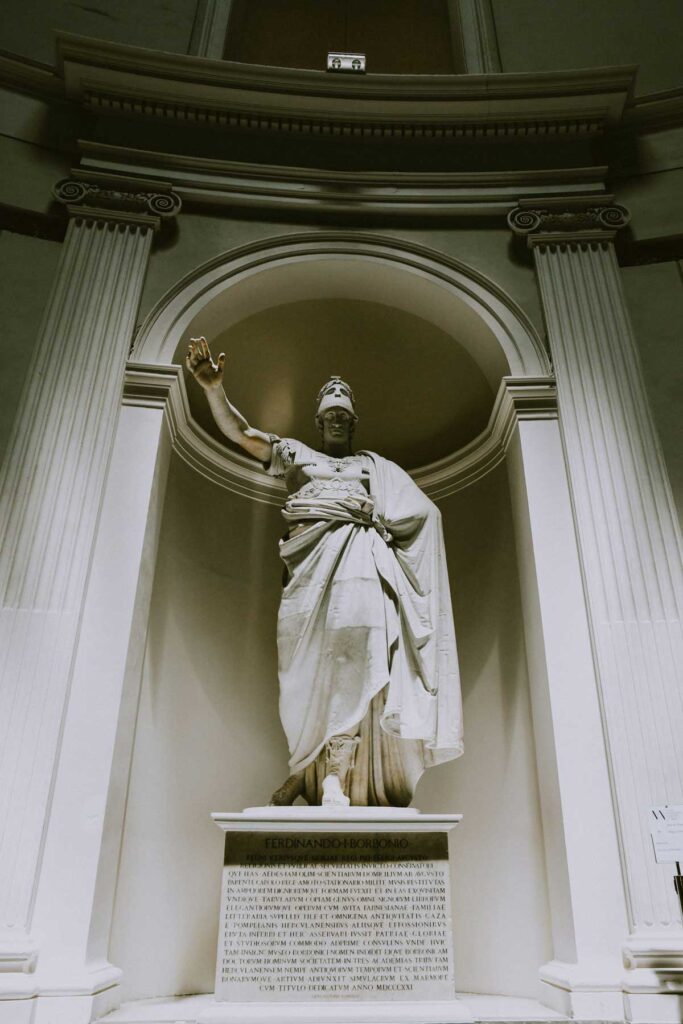
The Farnese Collection (ground floor) is the monumental foundation of the museum. The Farnese Hercules — a colossal marble copy of a 4th-century BC bronze by Lysippos, excavated from the Baths of Caracalla in 1546 — stands nearly 3.5 metres tall. Its copying shaped European art for two centuries. The Farnese Bull is the largest surviving ancient sculptural group, depicting the punishment of Dirce. Portrait busts, gems, and bronzes occupy the surrounding rooms.
The Mosaics Collection (mezzanine) holds the most important Roman mosaic collection in the world, from Pompeii and Herculaneum. The Mosaic of Alexander (c.100 BC, from the House of the Faun) is currently under extraordinary restoration and not on display — two observation windows show restorers at work. The Plato’s Academy mosaic and the Nilotic landscape remain on display.
The Pompeii Frescoes Galleries hold the finest collection of Roman wall painting in existence. Second Style illusionist frescoes from the Villa of the Mysteries and Fourth Style cycles from multiple Pompeian houses provide the most complete picture of Roman painting available anywhere.
The Secret Cabinet (Gabinetto Segreto) holds approximately 250 erotic objects from Pompeii and Herculaneum — lamps, vessels, frescoes, and sculptures depicting mythological and everyday erotic subjects. Closed to the public until 1971, it is accessible on the standard ticket on normal days but closes on free admission days.
The Daily Life Collection contains material objects of Roman domestic life at extraordinary preservation — furniture, surgical tools, food remains, jewellery, and toys from houses sealed by Vesuvius in 79 AD.
Practical tips for visiting the MANN
| Tip | Detail |
|---|---|
| Enter from the western door | The main door on Piazza Museo is closed due to restructuring works from 5 February 2025. Use the western door. Many guides still direct visitors to the main entrance. |
| The Mosaic of Alexander is not on display | This is the most visited single object at the MANN, currently under extraordinary restoration. Two observation windows allow views of active conservation in the Mosaics Collection. |
| Free days close key galleries | On free admission days (first Sunday, national holidays), the Egyptian Collection, Secret Cabinet, and Magna Graecia section are closed. Factor this in before choosing a free day to visit. |
| Check the open rooms schedule | Renovations mean some galleries close temporarily and reopen. The MANN publishes an up-to-date schedule of open rooms on its website — check before visiting. |
| Book in advance | There is no booking fee at the MANN — advance reservation is free. Pre-booking guarantees a time slot and avoids queuing, especially during busy summer weekends. |
MANN FAQ
| Question | Answer |
|---|---|
| What is the ticket price? | €20 full price. Reduced to €2 for EU citizens aged 18–25; free for under-18s, disabled visitors, and Italian teachers. Many guides still show €15 or €12 — both are out of date. |
| Is the Mosaic of Alexander on display? | No. It is under extraordinary restoration and not on display. Two observation windows allow views of restorers at work in the Mosaics Collection. |
| Where is the entrance? | The main entrance on Piazza Museo is closed due to restructuring works. Since 5 February 2025, visitors enter through the western door. |
| Is it closed on Tuesdays? | Yes, every Tuesday — with exceptions when Tuesday falls on a public holiday (museum opens that day and closes the following Wednesday instead). |
| Are the Egyptian Collection and Secret Cabinet always open? | No to both. The Egyptian Collection can currently only be reached by stairs (lift unavailable). The Secret Cabinet is closed on free admission days. |
Things to do near the MANN
Piazza Bellini and the Decumanus Maximus are 5 minutes’ walk south — the principal east-west artery of the ancient Greek city of Neapolis lies beneath the modern Via dei Tribunali. In Piazza Bellini, Greek city walls from the 5th century BC are visible in an excavated area below street level.
The Cappella Sansevero is around 15 minutes’ walk south-east and holds the Veiled Christ by Giuseppe Sanmartino (1753) — a marble figure of such extraordinary technical mastery that it has been disputed since creation whether the veil is marble or real fabric. Admission charged; advance booking strongly recommended.
The Catacombe di San Gennaro is a 10-minute walk north-west and is Naples’ most significant early Christian catacomb (2nd–4th century AD), with some of the oldest Christian frescoes in existence. Guided tours only; admission charged. ExtraMANN discount applies with a MANN ticket.
The Complesso Monumentale di Santa Chiara is 15 minutes south — a vast Gothic church rebuilt after World War II bombing, containing the celebrated majolica cloister decorated with 18th-century tiles depicting pastoral scenes. Admission charged for the museum; church entry free.
Spaccanapoli is the informal name for the long straight street (Via Benedetto Croce–Via San Biagio dei Librai) that bisects the historic centre from Piazza del Gesù Nuovo to the east. Walking its length from the MANN takes around 20 minutes and passes the principal historic churches, food markets, and craft streets of central Naples.
Similar archaeological museums to visit near Naples
Pompeii Archaeological Park is around 30 minutes south-east by Circumvesuviana train from Naples Piazza Garibaldi. The MANN and Pompeii are the essential pair — the objects excavated from the site are mostly at the MANN, while the buildings, streets, and gardens remain at Pompeii itself.
Herculaneum Archaeological Park is around 20 minutes south-east by Circumvesuviana and offers a smaller but better-preserved Roman town than Pompeii. The wooden furniture, food, and organic materials survived carbonisation by the pyroclastic surge.
Paestum Archaeological Museum and Greek Temples is around 90 minutes south by train or car. The museum holds the Tomb of the Diver (c.475 BC) — the only surviving complete ancient Greek figurative painted tomb — alongside finds from the three well-preserved Greek temples still standing on site.
Reggia di Caserta is around 30 minutes north by train and is the largest royal palace in the world by volume, built for the Bourbon kings of Naples in the 18th century. The gardens and state apartments require a full half-day.
The Capua Amphitheatre and Campania Roman Museum, Capua is around 40 minutes north by train or car. The second-largest amphitheatre in the Roman world (after the Colosseum) is significantly less visited than the equivalent sites and holds important gladiatorial material.
More Italy travel
Other Italy travel guides on Planet Whitley include:
- Guides to ancient sites in Rome: The Temple of Vesta in the Roman Forum, the Pantheon, the Baths of Caracalla, Castel Sant’Angelo and Circus Maximus.
- Guides to Rome’s most spectacular churches: The Basilica of Saint Mary of Minerva and the Church of St Ignatius of Loyola.
- Practical guide to visiting Castel del Monte near Bari.
- Top tips for visiting Castello Svevo in Bari.
- Plan your visit to the Rocca dei Papi in Montefiascone, Lazio.