The Temple of Apollo is an ancient, monumental Hellenistic sanctuary located in the Yenihisar neighbourhood of Didim, within the Aydın province of Turkey. This guide covers opening hours, ticket prices, transport and parking, accessibility, and practical visitor tips.
This guide was updated in May 2026 to reflect the current entry fee of €6 for foreign visitors and the extended summer 20:00 closing time.
Quick facts about the Temple of Apollo
| Feature | Details |
| Opening hours | 08:30 to 20:00. |
| Ticket prices | €6 for foreign adult visitors |
| Address | Yenihisar Mah., Özgürlük Cad., 09270 Didim/Aydın |
| Nearest public transport | Local dolmuş (minibuses) from Didim centre |
| Typical time needed | 45 to 60 minutes |
Temple of Apollo opening hours
The Temple of Apollo opening hours are from 08:30 to 20:00. The final visitor entry and ticket sales are permitted at 19:30.
The archaeological site remains open seven days a week year-round, meaning visitors can access the ruins on weekends and all Turkish public holidays.
Temple of Apollo ticket prices
The standard Temple of Apollo ticket price for foreign adult visitors is €6, which must be paid at the main entrance ticket booth. Opening hours and ticket prices were checked on the official website and last updated in May 2026. Payment is accepted in Turkish Lira based on the official daily exchange rate, or via an international credit or debit card.
Entry to this archaeological site is fully included in the Museum Pass The Aegean, a prepaid access card designed for tourists exploring the western coast. This regional city pass provides entry to multiple state-run historical sites for a fixed price over a multi-day period. Other major attractions included in this pass are the Ancient City of Ephesus, the Ancient City of Miletus, and the Ancient City of Priene.
How to get to the Temple of Apollo
To get to the Temple of Apollo using public transport, visitors can take a local dolmuş (minibus) that travels regularly between Altınkum beach and Didim town centre. These minibuses run frequently throughout the day and drop passengers directly outside the archaeological site on Özgürlük Caddesi.
Visitors driving rental vehicles or arriving via organised coach tours from major tourist hubs like Kuşadası or Bodrum will follow the main D330 highway towards Didim. The historical site is prominently signposted with standard brown archaeological tourism boards leading straight into the central Yenihisar district.
Parking at the Temple of Apollo
There is free, unrestricted street parking at the Temple of Apollo available along the main roads and side streets immediately surrounding the archaeological zone. Most visitors park directly along Özgürlük Caddesi, which borders the eastern edge of the historical sanctuary.
During peak summer afternoons, the immediate street parking often fills up quickly due to an influx of large tourist coaches. If the primary street parking is occupied, visitors can use several small, privately managed, paid car parks situated just a two-minute walk from the main ticket gate.
How long to spend at the Temple of Apollo
Most visitors will spend 45 to 60 minutes at the Temple of Apollo to walk around the perimeter and explore the central courtyard. This timeframe allows enough time to view the towering columns, photograph the Medusa head carvings, and read the informational placards.
Because the site consists of a single, highly concentrated monumental structure rather than a sprawling ancient city, it does not require a lengthy visit. Visitors who wish to hire an independent local guide or thoroughly read every architectural information board should allocate up to 90 minutes.
Accessibility at the Temple of Apollo
Accessibility at the Temple of Apollo is partially restricted due to the uneven, natural terrain and the large ancient stone blocks scattered throughout the site. The primary perimeter walkway surrounding the upper edge of the temple is relatively flat and can be navigated by sturdy wheelchairs and mobility scooters.
Accessing the inner sanctum, known as the adyton, requires walking down steep, uneven, and poorly lit ancient stone tunnels. Wheelchairs and walking frames cannot enter these lower sections, and there are no ramps or elevators connecting the upper viewing paths to the central courtyard floor.
Inside / what to see at the Temple of Apollo
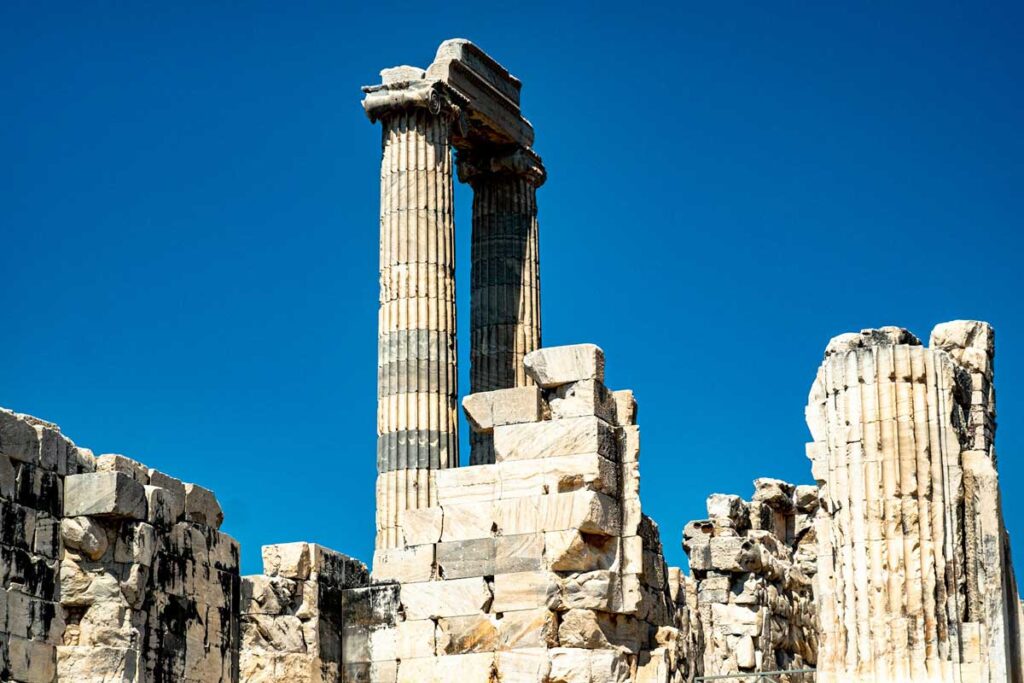
Visitors begin their tour by entering the site through the main gates and approaching the colossal marble columns that define the temple’s outer perimeter. Only three of the original 120 massive Ionic columns remain standing at their full height, providing a clear indication of the building’s immense scale. The remaining column bases form a dense “forest of stone” across the raised outer platform.
The most famous artefact visible on-site is a large, carved marble block featuring the detailed face of Medusa, which sits on the ground near the entrance. This heavy stone carving originally served as an architectural frieze located high on the temple’s exterior before falling during an earthquake.
To access the central, open-air courtyard, visitors must walk down one of two narrow, vaulted stone tunnels that slope downward from the main entrance area. These dark passageways were historically used by ancient priests and oracle seekers to reach the sacred inner sanctuary.
The central courtyard floor sits significantly lower than the outer columns and features the foundations of a smaller inner shrine, known as a naiskos. This specific area was the historical site of the sacred spring where the oracle of Apollo delivered prophecies to ancient pilgrims.
Scattered throughout the surrounding grassy perimeter are dozens of intricately carved marble fragments, including column capitals decorated with griffins, bulls, and floral patterns. The modern perimeter walkway allows visitors to view the entire structure from an elevated vantage point before exiting near the souvenir stalls.
Practical visitor tips
| Tip Category | Visitor Advice |
| Timing | Visit early in the morning at 08:30 or late in the afternoon to avoid the intense, unshaded midday sun during summer. |
| Crowds | The site rarely experiences severe overcrowding, but mid-morning arrivals often overlap with large tour bus groups travelling from Kuşadası. |
| Layout | The site is entirely exposed to the elements, with no shaded areas available anywhere inside the main archaeological zone. |
| Entry process | You must purchase your entrance ticket at the roadside booth before proceeding to the turnstiles located at the main gate. |
| On-site logistics | There are numerous cafes, restaurants, and souvenir shops situated directly across the street from the temple for post-visit refreshments. |
Frequently asked questions about the Temple of Apollo
| Question | Answer |
| Is the Temple of Apollo suitable for children? | Yes, the open spaces make it easy to navigate, though parents must ensure children do not climb on the fragile ancient ruins. |
| Do you need to book tickets in advance for the Temple of Apollo? | No, standard admission tickets can be purchased easily upon arrival at the official entrance ticket booth. |
| Is the Temple of Apollo open on Sundays? | Yes, the archaeological site operates seven days a week, including all Sundays and Turkish national holidays. |
| Are bags allowed at the Temple of Apollo? | Standard backpacks and daypacks are permitted, as there are no strict security restrictions or bag checks at the entrance. |
| Is there an audio guide available for the Temple of Apollo? | Yes, official digital audio guides can be downloaded via the Turkish Museums mobile application for a detailed historical explanation. |
Things to do near the Temple of Apollo
- Altınkum Beach: A popular, bustling sandy beach located in Didim, featuring shallow waters and a lengthy pedestrian promenade lined with restaurants.
- Ancient City of Miletus: A sprawling archaeological site featuring a massive, well-preserved Hellenistic theatre and extensive Roman bath complexes.
- Miletus Museum: A modern regional museum displaying significant artefacts, statues, and coins excavated from Miletus, Priene, and Didyma.
- Ancient City of Priene: An ancient Ionian city situated on steep hillside terraces, famous for its grid-plan street layout and the Temple of Athena.
- Lake Bafa Nature Park: A large, scenic saltwater lake surrounded by rugged mountains, offering hiking trails and the ruins of Byzantine monasteries.
What to visit tomorrow
- Ancient City of Ephesus: A massive, world-renowned Roman city featuring the Library of Celsus, terrace houses, and a grand 25,000-seat amphitheatre. Go in through the south gate.
- Aphrodisias: A well-preserved ancient city dedicated to the goddess of love, featuring a monumental stadium and a large collection of marble sculptures.
- Hierapolis: An ancient Greco-Roman spa city built directly above the cascading white mineral terraces of Pamukkale.
- Temple of Artemis: The scattered column fragments and swampy foundations marking the site of one of the Seven Wonders of the Ancient World.
- Basilica of St. John: The impressive stone ruins of a large 6th-century Byzantine church built over the believed burial site of John the Apostle.
More Turkey travel
Other Turkey travel articles on Planet Whitley include:
- The best time to visit the House of the Virgin Mary near Ephesus.
- Türkiye vs Turkey: When to start using a country’s new name?
- Practical guide to visiting the Museum of Anatolian Civilisations in Ankara.
- Practical guide to visiting Galata Tower in Istanbul.
- Why bother seeing the Nike relief at Ephesus.