Why see the Nike relief at Ephesus? My guide examines its historical context and where to find it within the ancient city ruins.
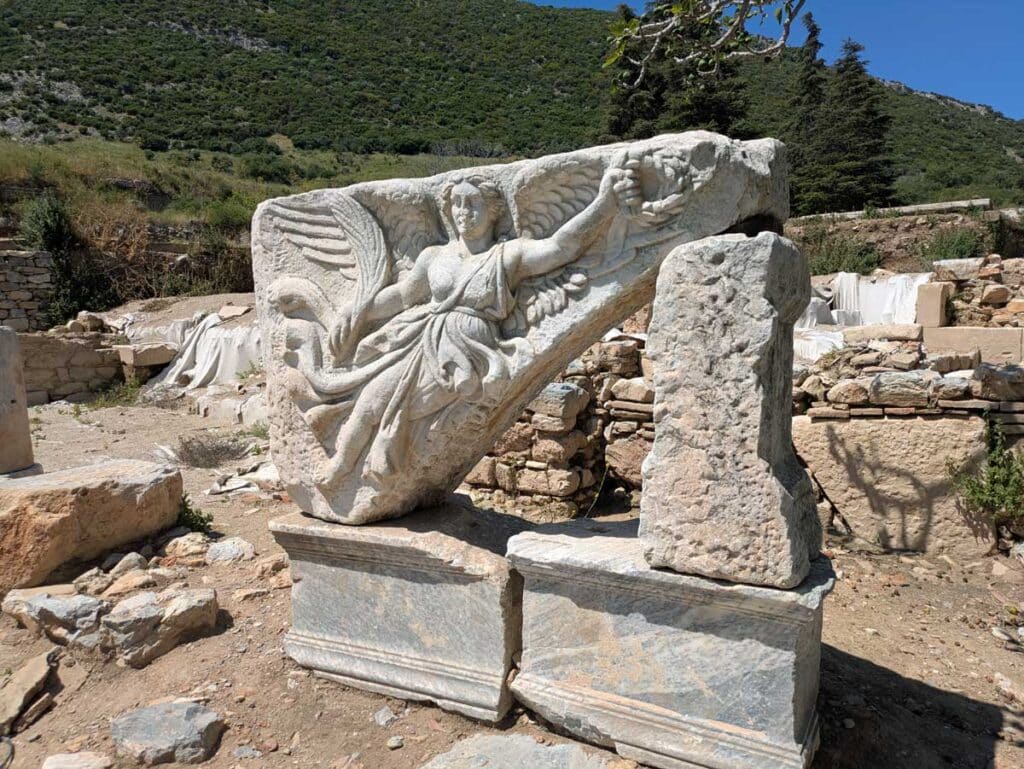
On Curetes Street in the ruins of Ephesus, Turkey, a carved marble panel of the goddess Nike is one of the site’s most recognisable features. Propped between two stone supports, this ancient piece of public art shows the winged goddess holding a laurel wreath and a palm branch, both traditional symbols of victory in the ancient world.
Why book the Best of Ephesus tour from Kusadasi Port?
- ⏱ Relax with port pickup and drop-off in a comfortable, air-conditioned vehicle
- 🏛 Visit UNESCO-listed Ephesus, including the Celsus Library, Ancient Theatre, and Terrace Houses
- 🙏 Explore the sacred House of the Virgin Mary and the Temple of Artemis
- 🍴 Option to enjoy a delicious local lunch at your own pace
- 🏅 Skip-the-line access means more discovery time and less waiting
What the Nike relief represents
Nike was the Greek goddess of victory, and her presence in Ephesus reflected the city’s importance as a commercial and cultural centre. The carving is thought to have formed part of the Gate of Hercules, which once marked a key point on Curetes Street. Although the gate itself has long since collapsed, fragments like this help visitors understand the scale and decoration of Ephesus during its Roman heyday.
The sculptor’s attention to detail is still clear: the folds of Nike’s drapery and the spread of her wings suggest motion, even though the fragment is incomplete.
Ephesus in context
Ephesus was one of the largest cities in the Roman Empire, known for its monumental buildings such as the Library of Celsus and the Great Theatre. Reliefs and statues like the Nike panel were not simply decorative but served to reinforce ideas of power, success and divine favour.
For modern visitors, the Nike relief is one of many smaller details that bring the archaeological site to life. It provides a direct link between mythology and the practical use of art in a Roman city.
Visiting the Nike relief in Ephesus
- The relief is located on Curetes Street, roughly halfway between the Library of Celsus and the Hercules Gate. Start at the South Gate and walk downhill.
- Ephesus is best reached from the town of Selçuk, which has regular connections to İzmir and Kusadasi.
- The site can be visited independently, but guided tours give useful background to details such as the Nike relief.
- Arriving early in the day avoids both the heat and the largest tour groups.
Why the Nike relief is worth noting
The fragment may be small compared to Ephesus’s grander monuments, but it captures a key part of the city’s story. For travellers, it is a reminder that the ruins are not only about vast theatres and libraries but also about the craftsmanship and symbolism woven into everyday urban spaces.
Things to do near the ruins of Ephesus
- Ephesus Experience Museum – Opposite the Great Theatre, this immersive museum uses audiovisual displays to explain the ancient city’s history and architecture.
- Terrace Houses – These excavated Roman residences within the archaeological site contain mosaics, frescoes and evidence of how wealthy Ephesians lived.
- House of the Virgin Mary – This religious site in the hills above Ephesus is associated with the tradition that Mary spent her final years in the area.
- Temple of Artemis – Near Selçuk, the remains of this ancient temple include scattered foundations and a reconstructed column marking the location of one of the Seven Wonders of the Ancient World.
- Basilica of St John – These substantial Byzantine ruins on Ayasuluk Hill in Selçuk are traditionally associated with the burial place of the apostle John.
Alternative attractions
- Ephesus Archaeological Museum – In Selçuk town centre, this museum displays sculptures, statues and other artefacts recovered from Ephesus and surrounding sites.
- Ayasuluk Castle – This hilltop fortress overlooks Selçuk and offers views across the town and surrounding archaeological landscape.
- Şirince Village – This hillside village near Selçuk has traditional architecture, narrow streets, small shops and local food and wine producers.
- Temple of Apollo at Didim – This large ancient sanctuary has monumental columns and remains of a temple dedicated to Apollo, around 90km south of Ephesus.
- Museum of Anatolian Civilisations – In Ankara, this major archaeological museum presents artefacts from civilisations across Anatolia, from prehistoric settlements to the classical period.
More Turkey travel
Other Turkey travel articles on Planet Whitley include:
- The best time to visit the House of the Virgin Mary near Ephesus.
- Türkiye vs Turkey: When to start using a country’s new name?
- Getting the fear while quad biking in Cappadocia.
- Going deep underground at Derinkuyu Underground City in Cappadocia.