The Basilica of St. John is a monumental 6th-century Byzantine church ruin and historical pilgrimage site located on Ayasuluk Hill in the Selçuk district of Izmir, Turkey. This guide covers opening hours, ticket prices, transport and parking, accessibility, and practical visitor tips.
This guide was updated in May 2026 to reflect the current entry fee of €6 for foreign visitors and the confirmed 19:00 closing time.
Quick facts about the Basilica of St. John
| Feature | Details |
| Opening hours | 08:00 to 19:00. |
| Ticket prices | €6 for foreign adult visitors |
| Address | İsa Bey Mahallesi, St. Jean Sok., No:4, 35920 Selçuk/İzmir |
| Nearest public transport | Selçuk İZBAN Station or Selçuk Bus Terminal |
| Typical time needed | 45 to 60 minutes |
Basilica of St. John opening hours
The Basilica of St. John opening hours are 08:00 to 19:00 every day of the week. The final visitor entry and the closure of the main ticket office occur at 18:30 during these peak summer months, so arriving after this time will result in denied entry.
Basilica of St. John ticket prices
The standard Basilica of St. John ticket price for foreign adult visitors is €6, which is payable directly at the main entrance ticket booth before proceeding to the turnstiles. Opening hours and ticket prices were checked on the official website and last updated in May 2026. Payment for individual admission is processed in Turkish Lira based on the official daily exchange rate, and major international credit cards are widely accepted by the staff.
Entry to this archaeological site is fully included in the Museum Pass The Aegean, a prepaid digital or physical card designed for international tourists exploring the western Turkish coast. This official regional pass provides general admission to multiple state-run historical sites for a fixed, upfront price over a multi-day validity period. Other major historical attractions included in this pass are the Ancient City of Ephesus, the Ancient City of Miletus, and the Ancient City of Priene.
Why book the Best of Ephesus Tour from Kusadasi Port?
- 🏛️ The Library of Celsus & Grand Theatre: Walk through one of the best-preserved Greco-Roman cities in the world, marveling at the two-story facade of the iconic library and the massive 25,000-seat theatre where St. Paul once preached.
- 🙏 House of the Virgin Mary: Visit this peaceful pilgrimage site nestled on Nightingale Mountain, believed by many to be the final residence of Mary, and explore the sacred spring and wishing wall.
- 🏺 Temple of Artemis: Stand on the site of one of the Seven Wonders of the Ancient World; though only ruins remain, the historical significance of this once-colossal temple to the goddess Diana is a must-see for history buffs.
- ⚓ Hassle-Free Shore Excursion: Specifically designed for cruise passengers, this tour offers flexible pick-up directly from the Kusadasi Port with a “back-to-ship” guarantee, ensuring you make the most of your limited time ashore.
- 🎓 Private Professional Guidance: Enjoy a personalized experience with a certified local guide who brings the ruins to life with stories of ancient Roman daily life, gladiatorial combat, and the city’s role in early Christianity.
How to get to the Basilica of St. John
To get to the Basilica of St. John using public transport, visitors arriving from the regional centre of Izmir or the Adnan Menderes Airport should take the İZBAN commuter train line south to Selçuk Station. From this central railway station, it is a straightforward ten-minute walk uphill along clearly marked pedestrian pavements to reach the main archaeological site entrance on Ayasuluk Hill.
Visitors arriving via the Selçuk central bus terminal (otogar), which services regular minibuses from Kuşadası and long-distance coaches from Istanbul, face a similarly short, five-minute pedestrian route. Those arriving by private rental car or taxi from the Aegean coast will follow the D515 highway directly into the Selçuk district, where standardised brown tourist signs point towards the basilica and the adjacent fortress.
Parking at the Basilica of St. John
There is regulated, paid street parking at the Basilica of St. John located directly outside the primary entrance gate on St. Jean Sokak, specifically designated for visitor vehicles. This immediate parking strip is actively managed by local municipal attendants who will collect a minor flat parking fee in cash upon your arrival.
During the busy summer months and on weekends, this immediate roadside parking area frequently reaches total capacity by mid-morning due to the heavy influx of arriving tourist coaches and private guides. If this dedicated space is full, visitors can easily use several larger municipal car parks located in the central Selçuk town square, which simply requires a steep five-minute walk back up the hill to the entrance.
How long to spend at the Basilica of St. John
Most visitors will spend 45 to 60 minutes at the Basilica of St. John to walk the main perimeter, read the historical plaques, and view the central tomb area without feeling rushed. This timeframe allows enough time to observe the reconstructed brick pillars, walk up the northern incline to the Ayasuluk Fortress walls, and photograph the panoramic views.
Because the site consists primarily of ground-level foundational ruins rather than intact, multi-level roofed structures, it is relatively quick to navigate the entire footprint. Visitors who wish to hire an independent local guide, sit on the viewing terraces, or read every piece of available archaeological information should allocate up to 90 minutes.
Accessibility at the Basilica of St. John
Accessibility at the Basilica of St. John is highly restricted due to the uneven ancient stone pathways, deep gravel terrain, and scattered architectural fragments that characterise the historical footprint. The initial entrance pathway involves navigating a moderate incline from the street level, and there are no continuous paved, flat routes connecting the various ruined sections of the former church.
Wheelchairs, mobility scooters, walking frames, and pushchairs will struggle significantly on the rugged, uneven ground that covers the majority of the open-air archaeological compound. Many of the internal pathways between the ruined walls and column bases are covered in loose dirt that actively impedes wheeled mobility devices. There are no elevators, modern ramps, or step-free alternatives available to assist visitors in reaching the higher viewing terraces or the adjacent fortress.
Inside / what to see at the Basilica of St. John
Visitors enter the site through the monumental Persecution Gate and proceed along an ancient stone pathway toward the main footprint of the ruined church structure. The building was originally constructed in the 6th century by the Byzantine Emperor Justinian I and was historically considered one of the largest and most significant churches in the early Christian world.
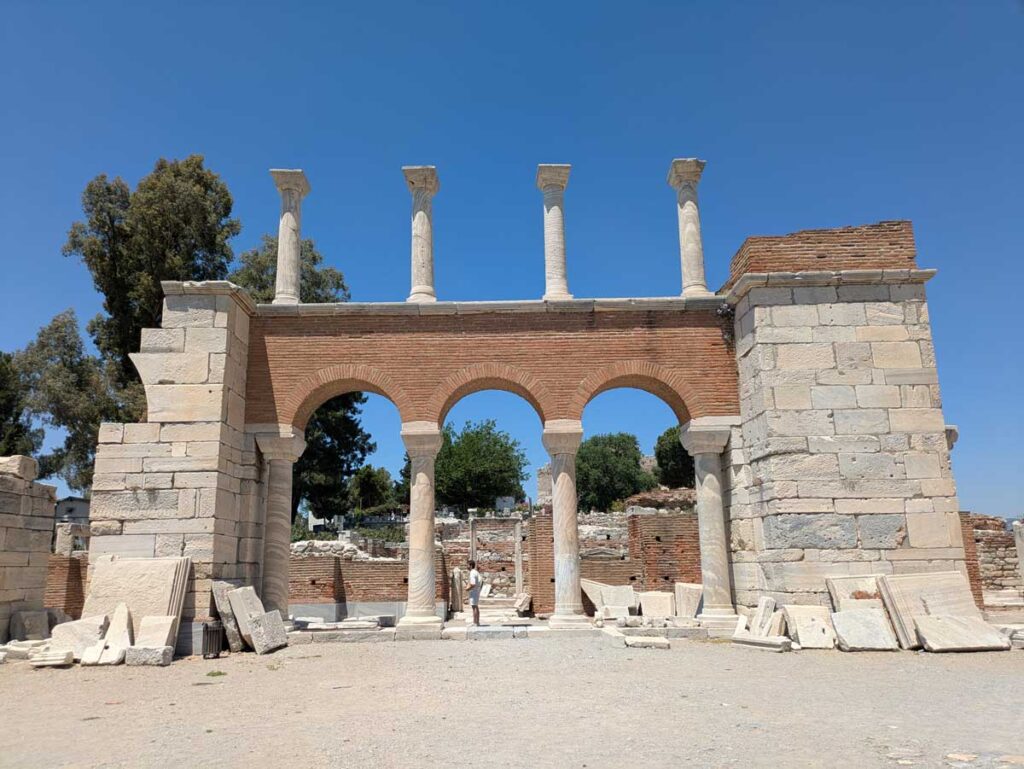
The central highlight of the site is the designated tomb area, which is historically believed to be the final resting place of John the Apostle, who purportedly wrote his gospel in Ephesus. This specific focal point is marked by a raised marble platform bordered by four prominently reconstructed, freestanding columns that provide visitors with a clear sense of the original building’s massive scale.
Scattered extensively throughout the grassy central nave are numerous ruined brick pillars, intricately carved marble capitals, and surviving fragments of ancient floor mosaics. Visitors are able to walk freely among these foundational remains to clearly trace the distinct cross-shaped floor plan of the original six-domed basilica structure.
Located directly behind the main church ruins is a small, semi-circular stone amphitheatre and the structural remnants of the ancient octagonal baptismal pools. These ancillary structures provide further historical context regarding how the complex functioned as a major religious pilgrimage destination and community centre during the Byzantine era.
From the northern edge of the basilica grounds, visitors can walk up a slight dirt incline to reach the heavily restored stone walls and towers of Ayasuluk Fortress. The elevated terraces surrounding the church ruins also offer unobstructed, panoramic views stretching over the modern town of Selçuk, the Isa Bey Mosque, and the distant ruins of the Temple of Artemis.
Practical visitor tips
| Tip Category | Visitor Advice |
| Timing | Arrive early in the morning at 08:00 or late in the afternoon to avoid the intense midday heat, as the hilltop location offers almost no natural shade. |
| Crowds | The site is generally much quieter and less congested than the nearby Ancient City of Ephesus, meaning overcrowding is rarely a major issue. |
| Layout | The site is entirely exposed to the elements and spans a large, uneven footprint, requiring visitors to wear sturdy footwear and walk carefully over loose stones. |
| Entry process | You must purchase your entrance ticket at the designated roadside booth before proceeding to scan it at the physical turnstiles located at the main gate. |
| On-site logistics | There are no extensive food or drink facilities inside the archaeological zone itself, so visitors must ensure they bring their own bottled water. |
Frequently asked questions about the Basilica of St. John
| Question | Answer |
| Is the Basilica of St. John suitable for children? | Yes, the open spaces allow for easy walking, but parents must strictly ensure children do not climb on the fragile historical ruins. |
| Do you need to book tickets in advance for the Basilica of St. John? | No, standard general admission tickets can be purchased quickly and easily upon arrival at the official entrance ticket booth. |
| Is the Basilica of St. John open on Sundays? | Yes, the archaeological site operates seven days a week, including all Sundays and Turkish national public holidays throughout the year. |
| Are bags allowed at the Basilica of St. John? | Standard backpacks and daypacks are fully permitted, as there are no strict security restrictions or extensive bag checks at the main entrance. |
| Is there an audio guide available for the Basilica of St. John? | Yes, official digital audio guides can be securely downloaded via the Turkish Museums mobile application for detailed historical commentary. |
Things to do near the Basilica of St. John
- Ayasuluk Fortress: A restored medieval castle located on the same hill as the basilica, featuring stone walls, defensive towers, and a small historic mosque.
- Ephesus Museum: A modern regional museum in central Selçuk displaying significant statues, ancient coins, and artefacts excavated directly from the nearby ancient city.
- Isa Bey Mosque: An impressive 14th-century Seljuk architectural masterpiece featuring a large courtyard, intricate stone carvings, and asymmetrical minarets.
- Ancient City of Ephesus: A sprawling, world-renowned Roman city featuring the Library of Celsus, wealthy terraced houses, and a grand 25,000-seat amphitheatre.
- Temple of Artemis: A single reconstructed column and scattered stone foundations marking the swampy site of one of the Seven Wonders of the Ancient World.
What to visit tomorrow
- Ancient City of Miletus: A sprawling archaeological site featuring a massive, well-preserved Hellenistic theatre and extensive Roman bath complexes located south of Ephesus.
- Ancient City of Priene: An ancient Ionian city situated on steep hillside terraces, famous for its grid-plan street layout and the monumental Temple of Athena.
- Temple of Apollo (Didim): A monumental Hellenistic sanctuary dedicated to the oracle of Apollo, featuring colossal standing columns and detailed marble carvings.
- Aphrodisias: A well-preserved ancient city dedicated to the goddess of love, featuring a monumental Roman stadium and a large collection of marble sculptures.
- Hierapolis: An ancient Greco-Roman spa city built directly above the cascading white mineral terraces of Pamukkale, featuring an expansive ancient necropolis.
More Turkey travel
Other Turkey travel articles on Planet Whitley include:
- The best entrance gate for Ephesus.
- Why bother seeing the Nike relief at Ephesus.
- The best time to visit the House of the Virgin Mary near Ephesus.
- Practical guide to visiting the Museum of Anatolian Civilisations in Ankara.
- Practical guide to visiting Galata Tower in Istanbul.