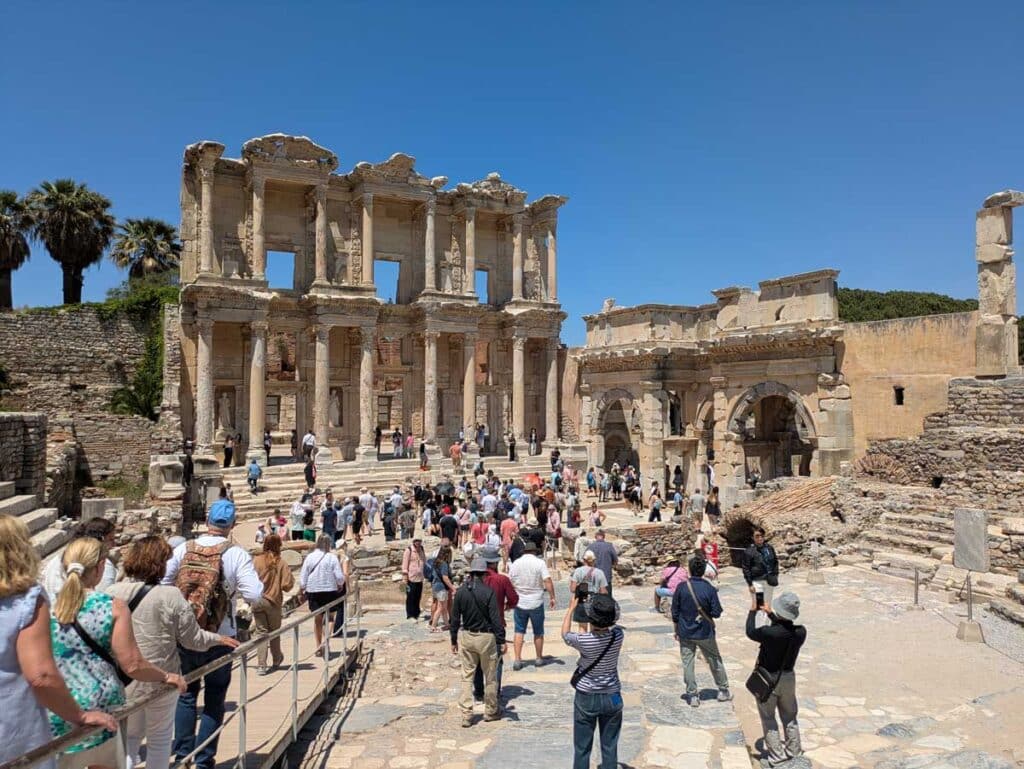
The Library of Celsus is widely considered the most remarkable monument in Ephesus, Turkey. Built between A.D. 100 and 110 by Gaius Iulius Aquila to honour his father, the Roman senator Tiberius Iulius Celsus Polemaeanus, the building served both as a library and as a memorial. It can also be interpreted as a heroon, or shrine, constructed over the burial chamber of Celsus himself.
Why book the Best of Ephesus tour from Kusadasi Port?
- ⏱ Relax with port pickup and drop-off in a comfortable, air-conditioned vehicle
- 🏛 Visit UNESCO-listed Ephesus, including the Celsus Library, Ancient Theatre, and Terrace Houses
- 🙏 Explore the sacred House of the Virgin Mary and the Temple of Artemis
- 🍴 Option to enjoy a delicious local lunch at your own pace
- 🏅 Skip-the-line access means more discovery time and less waiting
A masterpiece of Roman architecture
The library originally featured a striking façade approached by nine steps, flanked by statue bases. Beyond this, visitors would have entered a vestibule leading into the main library chamber. The façade’s aediculated design, with its columns and decorative niches, contrasted beautifully with the brick construction of the walls. Inside, the floors and walls were revetted with marble, showcasing the grandeur of Roman craftsmanship.
- Want to visit Ephesus on a guided tour? Check out the options here.
Destruction and rediscovery
Unfortunately, the Library of Celsus did not survive intact. It was destroyed by an earthquake around A.D. 270 and never rebuilt in antiquity. Later, in the late Roman period, its remains were incorporated into the rear wall of a street fountain, leaving only traces of its former splendour.
The restored façade
What visitors see today at Ephesus is the re-erected façade, painstakingly restored between 1970 and 1978 with financial support from Anton Kallinger-Prskawetz. The restoration brought the monumental frontage back to life, giving travellers a powerful sense of how impressive the building once was.
Why book the Best of Ephesus Tour from Kusadasi Port?
- 🏛️ The Library of Celsus & Grand Theatre: Walk through one of the best-preserved Greco-Roman cities in the world, marveling at the two-story facade of the iconic library and the massive 25,000-seat theatre where St. Paul once preached.
- 🙏 House of the Virgin Mary: Visit this peaceful pilgrimage site nestled on Nightingale Mountain, believed by many to be the final residence of Mary, and explore the sacred spring and wishing wall.
- 🏺 Temple of Artemis: Stand on the site of one of the Seven Wonders of the Ancient World; though only ruins remain, the historical significance of this once-colossal temple to the goddess Diana is a must-see for history buffs.
- ⚓ Hassle-Free Shore Excursion: Specifically designed for cruise passengers, this tour offers flexible pick-up directly from the Kusadasi Port with a “back-to-ship” guarantee, ensuring you make the most of your limited time ashore.
- 🎓 Private Professional Guidance: Enjoy a personalized experience with a certified local guide who brings the ruins to life with stories of ancient Roman daily life, gladiatorial combat, and the city’s role in early Christianity.
Why you should visit
The Library of Celsus is more than just a ruin; it is the soul of Ephesus. Its striking façade makes it one of the most photographed ancient sites in Turkey, and its story combines Roman politics, architectural innovation, and cultural pride.
In an ancient city that is the sum of its parts, the Library of Celsus is the standalone attraction that makes you stand back and admire in awe. Given it’s in the lower end of the site, you’re best off entering through the South Gate, then walking downhill past the Nike relief. That way, the Library of Celsus is a memorable highlight towards the end of the visit.
Things to do near the Library of Celsus
- Ephesus Museum – Located in Selçuk, this archaeological museum displays statues, sculptures and other artefacts excavated from Ephesus and the surrounding area.
- Basilica of St John – The remains of a large Byzantine basilica on Ayasuluk Hill, traditionally associated with the burial place of the Apostle John.
- Temple of Artemis – The scattered remains of one of the Seven Wonders of the Ancient World, including a reconstructed column and surviving foundations.
- House of the Virgin Mary – A pilgrimage site on Mount Koressos, around 7km from Selçuk, traditionally believed by many Christians to be where Mary spent her final years.
- Isa Bey Mosque – A 14th-century Seljuk mosque at the foot of Ayasuluk Hill, known for its large courtyard, stone decoration and distinctive minarets.
Alternative attractions
- Priene Ancient City – The remains of an ancient Greek city on the slopes of Mount Mykale, with a well-preserved theatre, Temple of Athena and grid-planned streets.
- Miletus Ancient City – A substantial archaeological site with a large theatre, ancient streets and the remains of one of the most important cities of ancient Ionia.
- Didyma – An ancient sanctuary centred on the enormous Temple of Apollo, whose surviving columns and monumental ruins illustrate the scale of the original complex.
- Magnesia on the Maeander – The ruins of an ancient Greek and Roman city with a large stadium, theatre and remains of a major temple complex.
- Claros Archaeological Site – An ancient sanctuary dedicated to Apollo near Ahmetbeyli, with surviving columns, inscriptions and other remains from the religious complex.
More Turkey travel
Other Turkey travel articles on Planet Whitley include:
- Türkiye vs Turkey: When to start using a country’s new name?
- Getting the fear while quad biking in Cappadocia.
- Going deep underground at Derinkuyu Underground City in Cappadocia.
- Practical guide to visiting the Patara Archaeological Site – the ancient capital of Lycia.
- How to make the most of the Perge Archaeological Site in Antalya.
Disclosure: This article contains affiliate links. Book through them, and I earn a small commission.