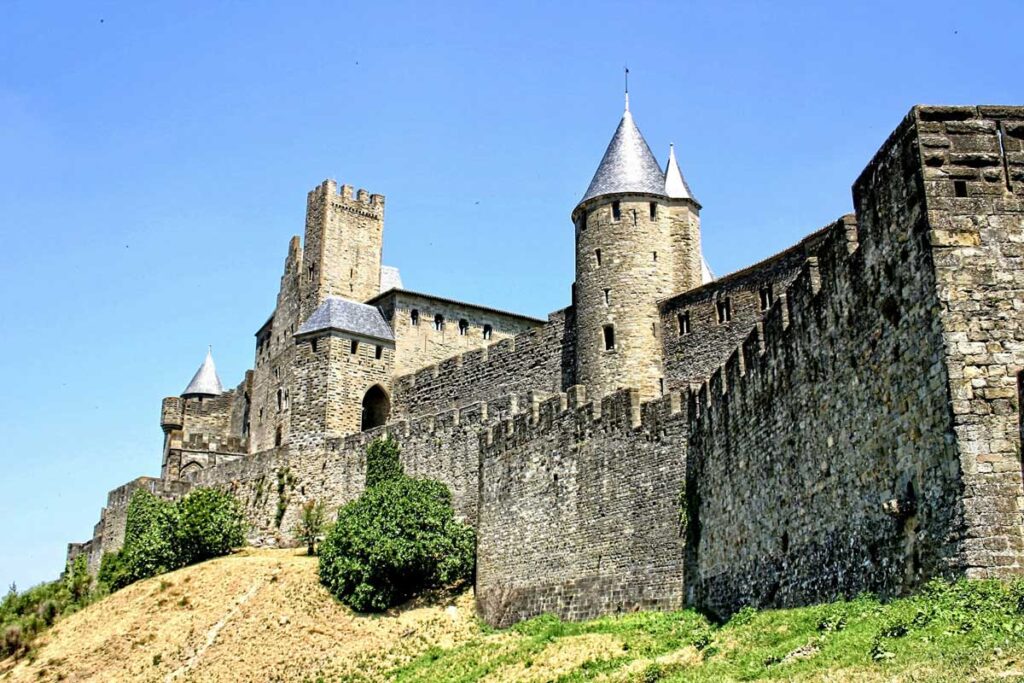
Carcassonne Castle — officially the Château Comtal and its double ring of ramparts — is a UNESCO World Heritage-listed medieval fortress. It’s managed by the Centre des Monuments Nationaux within the walled city of Carcassonne in southern France.
This guide was updated in May 2026. One fact that almost every current guide gets badly wrong about this French castle: the summer adult admission price is €19, not the €11 cited by several articles published as recently as April 2026. A second point worth clarifying upfront: entry into the walled Cité itself is free. The ticket covers the Château Comtal and the covered rampart walkways only — the parts most visitors specifically come for, but not the only reason to visit. You can book through GetYourGuide to reserve a timed entry slot and skip the queue at the Porte Narbonnaise.
Quick facts
| Detail | Information |
|---|---|
| Address | 1 rue Viollet-le-Duc, 11000 Carcassonne, France |
| Summer hours (1 Apr–30 Sep) | 10:00–18:30 (last admission 17:30) |
| Winter hours (1 Oct–31 Mar) | 09:30–17:00 (last admission 16:00) |
| Closed | 1 January, 1 May, 25 December |
| Summer adult ticket | €19 |
| Winter adult ticket | €13 |
| Under-18s | Free |
| 18–25 EU nationals / French residents | Free |
| Nearest station | Carcassonne (SNCF), approx. 2.5 km from the Cité |
| Typical visit | 1.5–2.5 hours |
Opening hours
The castle is open daily except on three public holidays. From 1 April to 30 September it opens at 10:00 and closes at 18:30; last admission is at 17:30. From 1 October to 31 March it opens at 09:30 and closes at 17:00; last admission is at 16:00. In both seasons the monument stops admitting visitors one hour before closing.
The castle is closed on 1 January, 1 May (Labour Day), and 25 December. Check the official CMN site for any additional closures during your visit window.
Note that the free-access areas of the Cité — the streets, squares, and outer public spaces — keep their own informal hours and are accessible at most times of day.
Ticket prices
All prices include French VAT. Booking in advance is strongly recommended as places are limited.
Individual tickets — at the ticket office or online
| Period | Adult price |
|---|---|
| 1 April to 30 September | €19 |
| 1 October to 31 March | €13 |
Partnership discounts (summer / winter)
| Discount card | Summer | Winter |
|---|---|---|
| Carca’City Pass, CEZAM card | €16.50 | €11.50 |
| SNCF TGV Inoui or Intercités ticket (valid <5 days) | €16.50 | €11.50 |
| SNCF Grand Voyageur loyalty card | €15 | €10 |
Free admission
Under-18s; EU nationals and legal French residents aged 18–25; disabled visitors and one accompanying adult; jobseekers (with a certificate dated within the last six months); Education Pass and Culture Pass holders. Valid proof must be shown at the ticket office.
Audioguide: €4 per person, available in French (including a children’s version), English, Spanish, Italian, and German.
Discovery tour (guided): €21 per adult in summer; €14 in winter. Under-7s free; ages 7–17 and special public: €8.
Book through GetYourGuide to secure a timed slot in advance, particularly for summer visits.
Why visit Carcassonne Castle?
- 🏰 Europe’s largest intact medieval fortification: The double ring of ramparts, 52 towers, and Château Comtal make Carcassonne the most complete surviving example of medieval defensive architecture in Europe.
- 🌍 UNESCO World Heritage Site: Designated in 1997, recognising both the fortress and the 13th-century lower town as an outstanding ensemble of medieval urban planning.
- 📜 A history spanning four civilisations: Gallo-Roman walls, Visigoth towers, Carolingian rebuilding, and the Cathar chapter of the 13th century are all legible in the stonework.
- 🎧 Audioguide in six languages: The €4 audioguide includes a dedicated children’s version in French, making this an unusually well-equipped family visit.
- 🆓 Free under-18s, and free entry to the Cité: Children pay nothing to visit the castle, and the walled medieval town surrounding it is free to enter and explore at any time.
How to get there
By train: Carcassonne SNCF station is in the lower town, approximately 2.5 km from the Cité. From the station, the most direct route is by navette (shuttle bus) in season, or on foot along the canal towpath and then up through the Bastide Saint-Louis — allow around 30–40 minutes on foot. Taxis are available at the station.
By car from Toulouse: Take the A61 motorway east; exit at junction 23 (Carcassonne Ouest) and follow signs for the Cité.
By car from Perpignan or Narbonne: Take the A9 west to the A61; exit at junction 24 (Carcassonne Est) and follow the N113 towards the centre.
The main entrance to the ticketed areas is the Porte Narbonnaise on the east side of the Cité. The ticket office is immediately inside this gate, on the left.
Parking
Signposted paid car parks sit directly below the Cité, a short walk from the Porte Narbonnaise. The main visitor car parks (P1 and P2) are on the south-east side of the fortifications. During July and August these fill by mid-morning; arriving before 09:30 is advisable. Parking is not free at any time of year. No vehicles are permitted inside the walled city. Visitors with mobility limitations can enquire about accessible parking closer to the gates by contacting the monument directly.
How long to spend
The Château Comtal and covered rampart walk together take most visitors between 90 minutes and two and a half hours. Add time for the free streets of the Cité — the Basilica of Saint-Nazaire, the squares, and the shops — and a full morning or afternoon is the realistic minimum. The lower town (Bastide Saint-Louis) and the Canal du Midi are further reasons to base yourself in Carcassonne for at least a day.
Accessibility
A dedicated accessibility page is available on the official CMN website. The terrain inside the Cité and the castle is uneven in places, with cobbled surfaces, steps, and narrow medieval passageways. Disabled visitors and one accompanying adult receive free admission; valid proof must be shown. The monument advises contacting the team in advance to discuss specific requirements. Guide and assistance dogs are permitted; no other pets are allowed inside the castle.
What to see inside the castle and ramparts
The Porte Narbonnaise is the grand eastern gateway into the paid area and sets the tone immediately. Two enormous round towers flank the entrance; the machiolated stonework overhead was designed for dropping materials onto attackers below. It is one of the most photographed elements of the whole fortification.
The outer and inner ramparts form a double ring enclosing a strip of land known as the lices. Walking between the two walls gives a clear sense of the defensive logic — any attacker who breached the outer ring found themselves trapped in the corridor between, exposed to fire from both sides. The outer rampart is largely a 19th-century restoration by Eugène Viollet-le-Duc; the inner ring preserves more original medieval fabric.
The Château Comtal is the fortified palace at the heart of the Cité, built in the 12th century by the Trencavel viscounts and subsequently strengthened by the French Crown after its capture in 1226. Entry to the courtyard and the covered walkways runs from here. The château contains an archaeological museum displaying carved stonework, capitals, and medieval artefacts recovered during excavations of the site.
The lapidary repository houses architectural fragments collected from across the site during restoration works. It is a quieter space that rewards the detail-minded visitor: inscriptions, carvings, and sections of original stonework that would otherwise be lost to weathering.
The covered walkways and hoardings are among the most distinctive features of the visit. Projecting wooden galleries — reconstructed based on historical and architectural evidence — run along sections of the inner rampart, showing how defenders were able to fire downward at attackers at the base of the walls.
The west rampart terrace gives the best panoramic views: the lower town (Bastide Saint-Louis), the Canal du Midi, and on clear days the snow-capped Pyrenees to the south. It is the most rewarding viewpoint in the entire site and worth seeking out specifically.
The Basilica of Saint-Nazaire is inside the walled Cité but does not require a castle ticket. Its Romanesque nave and Gothic choir make it one of the finest early-Gothic interiors in the Languedoc. The 14th-century stained glass in the transept is exceptional. Entry is free.
Practical visitor tips
| Tip | Detail |
|---|---|
| The summer price is €19, not €11 | Multiple guides published in 2026 still list €11 as the adult price. This figure is years out of date. Budget accordingly. Book through GetYourGuide to confirm your current price. |
| The Cité itself costs nothing | Walking the medieval streets, visiting the Basilica, eating and shopping in the Cité are all free. Only the Château Comtal and covered rampart walk require a paid ticket. |
| Book a timed slot in summer | The castle has a limited daily capacity and the CMN website states that booking is strongly recommended. July and August see the longest queues and fastest sell-outs. |
| Arrive at opening in peak season | Parking fills quickly from mid-morning in summer. The castle is also appreciably quieter in the first hour after opening before tour groups arrive. |
| Suitcases are not permitted | Large luggage and suitcases cannot be taken into the monument. There is no left-luggage facility on site; store bags at Carcassonne station before visiting. |
FAQ
| Question | Answer |
|---|---|
| Do I pay to enter the medieval walled town? | No. The Cité — the medieval walled city — is free to enter at any time. The ticket covers the Château Comtal and the covered rampart walkways only. |
| Is €19 really the current adult price? | Yes, for visits between 1 April and 30 September. The winter price is €13. Many third-party guides still show €9.50 or €11; these are outdated figures. |
| Are children under 18 free? | Yes — all visitors under 18 pay nothing. EU nationals and regular French residents aged 18–25 also enter free with valid ID. |
| Does the SNCF train ticket give a discount? | TGV Inoui and Intercités tickets valid for less than five days reduce the price to €16.50 (summer) or €11.50 (winter). Eurail and Interrail passes do not reduce the price. |
| Can I visit without booking in advance? | Yes, tickets are sold at the gate, but in summer queues can reach 20–40 minutes. Booking in advance guarantees entry at a specific time and avoids the queue. |
Things to do nearby
The Cité de Carcassonne streets and squares warrant at least an hour beyond the castle ticket. The Place du Château, the lanes around the Basilica, and the quiet sections near the Porte d’Aude are best explored in the morning before the peak crowds arrive.
The Basilica of Saint-Nazaire stands inside the Cité and is free to enter. Its Romanesque nave was built in the 11th and 12th centuries; the Gothic choir and transept came later and contain exceptional 14th-century stained glass depicting biblical and hagiographic scenes.
The Canal du Midi runs along the southern edge of the lower town and is a UNESCO World Heritage Site in its own right. The towpath makes for a pleasant flat walk or cycle between Carcassonne’s two historic areas; boat trips depart from the Carcassonne port.
The Bastide Saint-Louis is the 13th-century planned lower town laid out by Louis IX after the expulsion of Carcassonne’s original inhabitants. Its geometric street grid, the Place Carnot market square, and the Notre-Dame de la Santé church are all worth half an hour.
The vineyards of the Languedoc begin within a few kilometres of Carcassonne in every direction. The Minervois, Corbières, and Malepère appellations surround the city; most domaines welcome visitors for tasting without appointment outside the summer harvest period.
What to visit tomorrow
Château de Peyrepertuse (~1 hour by car): The most dramatic of the Cathar castles, built along a limestone ridge at over 700 metres. The double castle sprawls across the clifftop with dizzying drops on all sides. Its isolation and scale make it a very different experience from the polished presentation of Carcassonne.
Château de Quéribus (~1 hour by car): The last Cathar stronghold to fall, in 1255. A single keep perches on an isolated peak with views extending to the sea on clear days. Compact but vertigo-inducing, and best combined with Peyrepertuse as a day trip.
Château de Lastours (~30 minutes by car north): Four ruined Cathar castles ranged along a single rocky spur above the Orbiel valley. Unlike the large managed sites, Lastours feels genuinely wild; a panoramic viewpoint across the valley offers the best overview of all four structures together.
Château de Foix (~55 minutes by car west): The compact three-towered castle of the Counts of Foix rises directly above the confluence of two rivers in the town of Foix. The Ariège valley setting is striking, and the castle museum covers the Cathar period with good archaeological context.
Montségur (~1.5 hours by car): The spiritual and military capital of Catharism before its fall in 1244, after a siege that ended with the burning of over 200 Cathars who refused to recant. The climb to the ruins is steep but short; the plateau views and the weight of the site’s history make it one of the most affecting visits in southern France.
More France travel
Other France travel guides on Planet Whitley include:
- Practical guide to visiting the Palais des Papes in Avignon.
- French castle guides: Foix Castle near Toulouse and Chateau de Castelnaud in the Dordogne.
- Loire Valley castle guides: Chenonceau Castle, the Chateau de Bouges, the Chateau Royal d’Amboise, the Chateau de Saumur and Chambord Castle.
- Important visitor information for Chateau de Compiegne and Chateau de Pierrefonds in Hauts-de-France.
- Visitor guides for National Monuments around Paris: The Chateau de Vincennes, the Chateau de Maisons and Villa Savoye.