
Forte di Bard sits on a sheer rocky spur above the village of Bard in the lower Aosta Valley — a 19th-century military fortress now housing four museums, major photography and nature exhibitions, a hotel, and restaurants, with Napoleonic history embedded in every stone.
This guide was updated in June 2026. The full admission has been €15 since 29 November 2025 — several guides still show older prices. A practical note for train travellers: a replacement bus service is operating until 31 December 2026 while the Ivrea–Aosta railway undergoes electrification. You can book through GetYourGuide in advance.
Quick facts
| Detail | Information |
|---|---|
| Address | Forte di Bard, 11020 Bard, Valle d’Aosta, Italy |
| Hours (Tue–Fri) | 10:00–18:00 (ticket office closes 17:00) |
| Hours (Sat–Sun) | 10:00–19:00 (ticket office closes 18:00) |
| Closed | Mondays; extraordinary closure Thursday 4 June 2026 |
| Special openings | Open every day in August; 26 Dec–6 Jan: 14:00–19:30; 1 Jan: 14:00–19:30; 31 Dec: 10:00–18:00 |
| Full price | €15 (from 29 November 2025) |
| Reduced (over 65) | €12 |
| Special reduced (ages 19–25) | €6 |
| ALL FORTE ticket (all museums + exhibitions) | €24 |
| Annual Membership Card | €35 (unlimited entry for one year) |
| Free | Ages 0–18; disabled visitors + companion; licensed tourist guides; accredited journalists |
| Guided tours (Sat/Sun) | 11:00 and 15:00; €10 + admission |
| Nearest train station | Hone-Bard (500m) — replacement bus service active until Dec 2026 |
| Parking P0 (multi-level, paid) | €5 daytime / €3 evening / €2 night |
| Parking P1, P2, P3 | Free (300–600m from fort) |
| Free shuttle (Sun/holidays) | From P0–P3 to the fort |
| Dogs | Medium/large in non-exhibition areas on lead; small in carriers in museums; no dogs at events |
| Typical visit | 2–4 hours |
Fort Bard opening hours
The fort is open Tuesday to Friday, 10:00–18:00, and Saturday and Sunday, 10:00–19:00. The ticket office closes one hour before closing time in each case. The fort is closed every Monday. On Thursday 4 June 2026, the fort is closed all day for an institutional event — confirmed as an extraordinary closure on the official information page.
Special openings: open every day in August; open 26 December–6 January 14:00–19:30 (except 31 December: 10:00–18:00, and 1 January: 14:00–19:30).
Opening hours and prices were checked on the official website in June 2026.
Fort Bard admission prices
Prices apply from 29 November 2025. Several guides still reference older pricing.
| Ticket | Price |
|---|---|
| Full price | €15 |
| Reduced (over 65) | €12 |
| Special reduced (ages 19–25) | €6 |
| ALL FORTE (all museums + exhibitions) | €24 |
| Annual Membership Card | €35 |
| Ages 0–18 | Free |
| Disabled visitors + companion | Free |
| Licensed tourist guides | Free |
| Groups (12+ people) | Reduced rate; 1 free per 20 paying |
The standard ticket covers up to three exhibition spaces. The ALL FORTE ticket (€24) covers all museums and all current exhibitions — if more than two exhibitions interest you, it represents better value. Book through GetYourGuide to confirm your visit date and ticket type.
Why visit Fort Bard?
- 🏰 Napoleon came here twice: In 1800, Forte di Bard blocked Napoleon’s entire army for two weeks during the Second Italian Campaign — a single fortress holding up 40,000 troops. The fort was demolished on Napoleon’s orders and rebuilt by the Savoy kings between 1830 and 1838. The story is told in full inside the Prisons museum.
- 🎟️ Three current exhibitions through summer 2026: Sebastião Salgado’s Glaciers (24 April–27 September 2026), Wildlife Photographer of the Year 61st Edition (21 March–12 July 2026), and Feeding the World (14 March–19 July 2026) — one ticket, three major international shows.
- 🌿 Fully barrier-free, with panoramic lifts: All levels of the fort are accessible via lifts and ramps. The panoramic lifts cutting through the rock face connect the village below to the highest terrace — the views from the upper battlements across the Aosta Valley are exceptional.
- 📜 The Museum of the Alps: A multimedia and interactive exploration of the Alps as a natural, human, and cultural landscape — one of the most comprehensive Alpine interpretation centres in Italy.
- 💰 Free for all under-18s: Children and teenagers enter free at all times. With free parking at P1, P2, and P3, this makes Fort Bard one of the most accessible family cultural days out in the Aosta Valley.
How to get to Fort Bard
By car, take the A5 motorway (Turin–Aosta) and exit at Pont-Saint-Martin (6 km south of Bard) or Verrès (9 km north). The fort is on the SS.26 state road through the valley. Drive time from Turin: approximately 60 minutes; from Aosta: approximately 40 minutes; from Milan: approximately 2 hours.
By train, the nearest station is Hone-Bard, 500 metres from the fort. However, from 3 January 2024 to 31 December 2026 a replacement bus service operates for the Ivrea–Aosta railway line while electrification works are underway. Plan your journey at trenitalia.com and allow extra time.
By bus, local transport serves the lower Aosta Valley via Vita Group and Arriva lines. Private transfers and shuttles are available from transfervallee.eu.
On foot along the Via Francigena: the fort is located on the ancient Canterbury–Rome pilgrim route as it crosses the Aosta Valley. The route enters the valley from the Gran San Bernardo Pass.
Parking at Fort Bard
Four parking options exist near the fort:
Parking P0 (multi-level, at the fort base, paid): €5 daytime / €3 evening / €2 night. Free for disabled visitors with valid badge at the Infopoint. Parking P1 Liéron (free, ~300m away along SS.26). Parking P2 San Giovanni (free, ~200m away; a path through chestnut woods leads to the fort). Parking P3 Viadotto (free, ~600m away). A free shuttle runs on Sundays and holidays from P0, P1, P2, and P3 to the fort entrance.
How long to spend at Fort Bard
Allow 2 to 4 hours for a thorough visit covering the Museum of the Alps, the Prisons, and one major exhibition. The ALL FORTE ticket and a full day allow all four museums, all exhibitions, and time on the battlements and terraces — a comfortable full-day programme. Guided tours of the monument run on Saturdays and Sundays at 11:00 and 15:00 (€10 + admission, 75 minutes).
Accessibility at Fort Bard
The fort is fully barrier-free. Every level is reachable by lift or ramp, including the highest battlements. A wheelchair is available on request (book in advance: +39 0125 833818). Three Braille description totems and relief maps are on the second floor of the multi-storey car park for blind visitors. Changing tables are in the toilets adjacent to the Gola Cafeteria and Cannoniere. Free WiFi is available throughout. Disabled visitors and their companion enter this Italian castle free.
What to see at Fort Bard
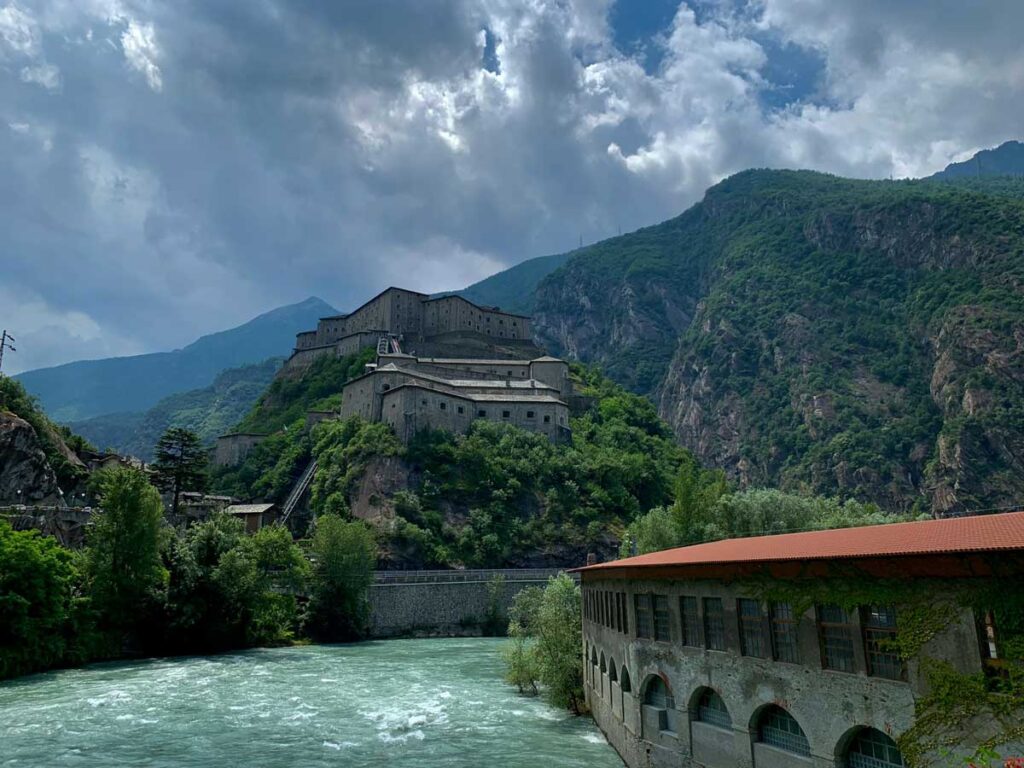
The monumental complex itself is the first experience. The fort rises in three sections (Opera Mortella, Opera Carlo Alberto, and Opera Ferdinand) up the rocky spur above Bard village, connected by panoramic lifts that cut through the cliff. Walking the exterior ramparts and terraces — with the Dora Baltea river valley spreading below and the Alpine peaks above — is as much a part of the visit as any museum.
The Museum of the Alps is a multimedia and interactive journey across the natural, human, and cultural history of the Alps. Themes include geology, glaciers, high-altitude ecosystems, Alpine agriculture, mountain communities, and the relationship between the Alps and European civilisation. The approach is immersive and well suited to both adults and children.
The Prisons tell the specific history of Forte di Bard — how the original medieval tower became a military stronghold, how Napoleon’s army was held up for two weeks in 1800, how the fort was demolished and completely rebuilt by the Savoy kingdom between 1830 and 1838, and how it fell into disuse before its comprehensive restoration opening in 2006.
The Ferdinand Museum (Fortifications and Frontiers) covers three themes: Alpine fortification architecture from the 15th to 20th century; the Fortified Alps 1871–1946; and the Alps as a political and military frontier.
The Children’s Alps is a dedicated interactive space for families exploring the mountains through games, sensory activities, and child-oriented displays.
Current exhibitions: Sebastião Salgado’s Glaciers (24 Apr–27 Sep 2026) — 54 photographs of the world’s glacial landscapes; Wildlife Photographer of the Year, 61st Edition (21 Mar–12 Jul 2026); Feeding the World (14 Mar–19 Jul 2026).
Practical tips for visiting Fort Bard
| Tip | Detail |
|---|---|
| Full price is €15 (from 29 Nov 2025) | Several guides still show earlier prices. The ALL FORTE ticket (€24) covers all museums and all exhibitions — better value if you plan to see more than two spaces. |
| Train passengers: check the replacement bus | The Ivrea–Aosta railway has a replacement bus service (no trains) until 31 December 2026 due to electrification works. Plan via trenitalia.com. |
| Dogs: specific rules apply | Medium/large dogs on lead only in non-exhibition areas. Small dogs in carriers in museums. No dogs at exhibitions or events. |
| Book in advance | Tickets can be purchased at the fort, but pre-booking is recommended for guided tours and on busy summer weekends when the fort can be well-attended. |
Fort Bard FAQ
| Question | Answer |
|---|---|
| What is the full ticket price? | €15 from 29 November 2025. Over-65s pay €12; ages 19–25 pay a special rate of €6. Under-18s enter free. The ALL FORTE ticket (all museums + exhibitions) is €24. |
| Is the fort open on Mondays? | No — closed every Monday. Also closed Thursday 4 June 2026 for an institutional event. Open every day in August. |
| Can I travel by train? | The nearest station is Hone-Bard (500m). However, the Ivrea–Aosta line is running replacement buses instead of trains until 31 December 2026. Check trenitalia.com before travelling. |
| What exhibitions are currently on? | Sebastião Salgado’s Glaciers (24 Apr–27 Sep 2026), Wildlife Photographer of the Year 61st Edition (21 Mar–12 Jul 2026), and Feeding the World (14 Mar–19 Jul 2026). |
| Is the fort wheelchair accessible? | Fully accessible — all levels reachable by lift or ramp. A wheelchair is available on request. Disabled visitors and one companion enter free. |
Things to do near Fort Bard
The Village of Bard below the fort has a historic centre with medieval streets, a small church, and the Maison Bleue art gallery — a short walk from the fort base.
Perloz and the lower Aosta Valley surround Bard with traditional mountain villages, chestnut woods, and the Dora Baltea river valley. The Via Francigena pilgrim route passes through here; walking sections of it provides context for the fort’s historical significance as a valley-controlling garrison.
Pont-Saint-Martin is 6 km south and is the gateway to the Aosta Valley. The well-preserved Roman bridge (Ponte di San Martino) over the Lys torrent is one of the finest surviving Roman bridges in north-western Italy. Freely accessible.
Bard Alpinismo Lento (slow alpinism) trails connect the fort to the surrounding ridge walks and viewpoints. The fort provides maps for several marked routes in the lower valley.
Aosta city is 48 km north and is a UNESCO-listed Roman and medieval city: intact Roman walls, a triumphal arch, the Roman theatre, and the cathedral. A practical full-day pairing with a Fort Bard visit.
Similar fortress and mountain museums to visit near Fort Bard
Castello di Fénis, Aosta Valley is around 30 km north of Bard and is the best-preserved medieval castle in the Valle d’Aosta — frescoed courtyards, drawbridges, and towers intact. Managed by the Aosta Valley Region; admission charged.
Castello di Issogne is around 5 km north of Bard and is a Renaissance residence rather than a military fortress, with a famous pomegranate fountain. Also managed by the Aosta Valley Region.
Forte di Exilles, Susa Valley (Piedmont) is around 40 km south-west of Bard across the regional border and is a comparable Savoy-era fortress controlling the Susa Valley approach to France. Admission charged; open seasonally.
The Museo delle Alpi, Turin is part of the Mastio della Cittadella and covers Alpine culture from a specifically Piedmontese and broader Alpine perspective — a useful complement to the Museum of the Alps inside Fort Bard. Around 80 km south.
Castel Savoia, Gressoney-Saint-Jean is around 50 km north of Bard in the upper Aosta Valley — a late 19th-century royal hunting castle built for Queen Margherita of Savoy, surrounded by alpine garden terraces. Managed by the Aosta Valley Region.
More Italian castles
Other Italian castle guides on Planet Whitley include:
- What to expect when visiting Lerici Castle in Liguria.
- What to do before visiting Castel Sant’Angelo in Rome.
- Plan your visit to the Rocca dei Papi in Montefiascone, Lazio.
- What to expect at Castello di Vezio on Lake Como.
- Key information for visiting Miramare Castle in Trieste.
