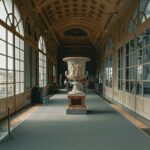
The Boboli Gardens behind Palazzo Pitti in Florence, Italy, are one of the great Italian Renaissance gardens — 45 hectares of terraced garden, grottos, fountains, and statuary stretching from the Oltrarno to Porta Romana.
This guide was updated in June 2026. Two things to note before you go: the on-day ticket is €10, but advance booking costs €13 — more expensive rather than less, which is the opposite of visitor expectations. And the gardens are closed on the first and last Monday of each month, a closure pattern that catches many visitors by surprise since most guides simply list daily opening. You can book through GetYourGuide in advance.
Quick facts
| Detail | Information |
|---|---|
| Address | Piazza de’ Pitti 1, 50125 Florence (main entrance via Palazzo Pitti courtyard) |
| Closed | First and last Monday of each month; 25 December |
| Extraordinary opening | 1 January 2026 (exceptionally open) |
| Hours: Jan, Feb, Nov, Dec | 08:15–16:30 (last admission 15:30) |
| Hours: March, October (standard time) | 08:15–17:30 (last admission 16:30) |
| Hours: March (summer time), Apr, May, Sep, Oct (summer time) | 08:15–18:30 (last admission 17:30) |
| Hours: June, July, August | 08:15–19:10 (last admission 18:10) |
| On-day ticket | €10 |
| Advance booking ticket | €13 |
| Combined Pitti + Boboli (on day) | €22 |
| Combined Pitti + Boboli (advance) | €25 |
| Reduced | €3 (EU citizens 18–25) |
| Combined Boboli + Bardini (on day only) | €15 (available from 3 March 2026) |
| PassePartout 5 days (Uffizi + Pitti + Boboli) | €40 |
| Porcelain Museum | Closed for refurbishment — no reopening date confirmed |
| Nearest bus | Multiple ATAF lines to Piazza de’ Pitti |
| Typical visit | 1.5–2.5 hours |
Boboli Gardens opening hours
The gardens are open every day except the first and last Monday of each month and 25 December. Closing times vary by season — from 16:30 in winter to 19:10 in high summer. The last admission is always one hour before closing. In July and August this means last entry at 18:10; in December and January it is 15:30. Always verify the closing time for your specific visit date before arriving late.
The Porcelain Museum inside the gardens is currently closed for refurbishment with no confirmed reopening date.
Boboli Gardens admission prices
The on-day ticket is €10 — cheaper than the €13 advance-booking price. This is the opposite of how most museums work, and many visitors inadvertently pay the higher price by purchasing ahead. The on-day ticket is purchased at the Palazzo Pitti ticket office on the day of the visit.
| Ticket | On day | Advance |
|---|---|---|
| Single Boboli only | €10 | €13 |
| Combined Pitti + Boboli | €22 | €25 |
| Combined Boboli + Bardini (on day only, from 3 March 2026) | €15 | — |
| Reduced (EU citizens 18–25) | €3 | €3 |
| Under 18 | Free | Free |
| PassePartout 5 days (Uffizi + Pitti + Boboli) | €40 | — |
The Boboli + Bardini combined ticket (€15, on-day only) launched from 3 March 2026 — it is not available online and must be purchased at the ticket office on the day. No existing travel guide mentions it. Book through GetYourGuide if you prefer the advance option.
Why visit the Boboli Gardens?
- 🌿 45 hectares of Renaissance garden design: The Boboli is the garden that made Italian formal garden design the model for European courts — the axis, the amphitheatre, the grotto, and the bosco are all present at a scale rarely matched.
- 🎟️ Buy on the day to pay €3 less: The on-day ticket (€10) is cheaper than the advance ticket (€13). If your schedule is flexible, buying at the Pitti ticket office on the day saves money rather than costing it.
- 🌿 The Grotta del Buontalenti: The most important Mannerist grotto in Italy, designed by Bernardo Buontalenti from 1583. The artificial stalagmites, encrusted shells, and deliberately disorientating spaces were a form of Renaissance theatre — and the original casts of Michelangelo’s Prisoners stood here for 200 years.
- 📜 The new Boboli + Bardini combined ticket: From 3 March 2026, the on-day ticket desk sells a combined ticket (€15) covering both the Boboli and the adjacent Bardini Garden — a lesser-known terraced garden with outstanding views over Florence. Not available online.
- 💰 The gardens extend to Porta Romana and Forte di Belvedere: The upper gardens — less visited than the parterre — are reached through five separate entrances including Forte di Belvedere and Porta Romana, all valid on the same ticket.
How to get to the Boboli Gardens
On foot from central Florence, the main entrance is through the Palazzo Pitti courtyard on the south bank of the Arno — a 5-minute walk from the Ponte Vecchio and 8 minutes from the Uffizi via the bridge. The Annalena entrance on Via Romana (east side) and the Porta Romana entrance (south) are alternative access points valid on the same ticket.
By bus, ATAF bus routes serving the Oltrarno include bus D, 11, and 36, all of which pass near Piazza de’ Pitti. From the historic centre, buses cross the Arno at Ponte Vecchio and Ponte Santa Trinita.
On foot from the Pitti Palace ticket office, the main garden access is immediately after the Ammannati courtyard. The garden map (downloadable as a PDF from the Uffizi website) is essential — the 45-hectare site is complex and easy to get disoriented in.
5 great Florence experiences to book
- 🏛️ Cover Florence in a day – including the Duomo, Uffizi and skip-the-line tickets for Michelangelo’s David.
- 🍝 Learn how to make pasta the Tuscan way at a cooking class with unlimited wine.
- 🎨 On a guided tour of the Uffizi Gallery, discover the detail in the Renaissance masterpieces.
- 🗿 Discover much more than David on a guided tour of the Galleria dell’Accademia.
- 🍷 Take a 4WD Tuscan wine safari – with several winery tastings and a three-course lunch.
Parking at the Boboli Gardens
There is no dedicated parking at the Boboli Gardens. The Oltrarno neighbourhood has limited street parking. The Oltrarno is a ZTL area at certain times; check the ZTL boundaries before driving. Most visitors arrive on foot or by bus from the historic centre — both options are significantly easier than driving.
How long to spend at the Boboli Gardens
Allow 1.5 to 2.5 hours for the gardens alone. The lower garden (amphitheatre, Neptune Fountain, Buontalenti Grotto, Island Pond) takes around 60–90 minutes; the upper garden (Knight’s Garden, Kaffeehaus, upper terraces) adds another 30–45 minutes. Visitors who explore the full perimeter including the Porta Romana and Forte di Belvedere exits should allow 3 hours. Combining with Palazzo Pitti (separate ticket) requires a full half-day at minimum.
Accessibility at the Boboli Gardens
Two entrances have accessible access: one from Piazza de’ Pitti (left side of the courtyard), one from Piazza di Porta Romana. The garden is accessible only with an accompanying person — confirmed on the official Uffizi accessibility page. The terrain is predominantly clay and gravel, almost entirely sloping, with significant ascents and descents. The Porcelain Museum is not accessible. An accessible toilet is available near the Amphitheatre, reached via a stairlift. Drinking fountains are available at several points but given the size of the garden, visitors are advised to bring their own water.
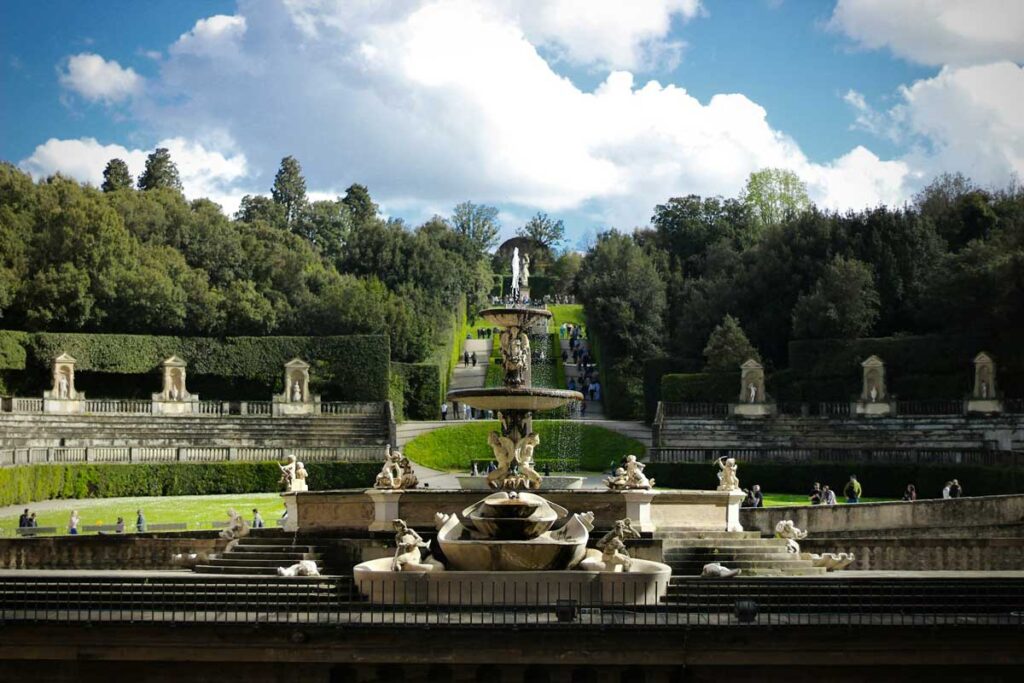
What to see at the Boboli Gardens
The Grotta del Buontalenti is the essential stop. Designed by Bernardo Buontalenti and completed in 1593, the three chambers progress from the artificial-looking outer grotto (with painted and stuccoed figures dissolving into the stone) to an inner room that once held Giambologna’s Venus Bathing. The outer room held casts of Michelangelo’s four unfinished Prisoners from 1585 until 1908; these were moved to the Accademia and replaced with copies. The layered meanings — art emerging from raw matter, nature subdued by artifice — made this grotto the most influential in Europe.
The Amphitheatre sits directly above the Palazzo Pitti and follows the curve of the ancient quarry that supplied stone for the palace. The elliptical form was used for court entertainments, including what is considered the first opera ever staged: Jacopo Peri’s Dafne in 1598. The central obelisk came from Luxor via Rome.
The Fountain of Neptune stands at the highest point of the main axis — a 1565 bronze figure of the sea god by Stoldo Lorenzi. From this terrace the full length of the garden axis is visible back down towards the palace, and views extend across the Arno valley.
The Island Pond (Vasca dell’Isola) is one of the most peaceful spots in the garden: a circular pool with a small island containing orange trees, set within the garden’s wider landscape. The statuary around the perimeter includes works by Giambologna’s workshop.
The Kaffeehaus is an 18th-century Rococo pavilion on the upper terrace — one of the few surviving examples of Rococo architecture in Tuscany. It was built for the Habsburg-Lorraine court and now offers a café with garden views.
Practical tips for visiting the Boboli Gardens
| Tip | Detail |
|---|---|
| Buy on the day to save €3 | The on-day ticket (€10) is cheaper than advance booking (€13). Unless you need the guaranteed time slot, buying at the Pitti ticket office on arrival saves money. |
| Check the closed Mondays | The gardens close on the first and last Monday of each month — not just any Monday. Check which Mondays fall in your travel dates. |
| Download the map before going | The 45-hectare garden is complex. The official Uffizi website has a downloadable PDF map — load it on your phone before arriving. Signal inside the garden is unreliable. |
| The Porcelain Museum is closed | Confirmed on the official site with no reopening date. Don’t factor it into your visit planning. |
| Book in advance if you need a guaranteed slot | Walk-in tickets are always cheaper, but in peak summer the gardens can reach capacity. Advance booking (€13) guarantees entry at your chosen time. |
Boboli Gardens FAQ
| Question | Answer |
|---|---|
| Is it cheaper to book in advance? | No — the opposite. The on-day ticket is €10; the advance ticket is €13. If your plans are flexible, buy at the door. |
| Which Mondays is it closed? | The first and last Monday of every month. The gardens are open on all other Mondays (except 25 December). |
| Is the Porcelain Museum open? | No — it is closed for refurbishment with no confirmed reopening date. |
| What is the new Boboli + Bardini ticket? | A combined on-day ticket (€15) for both the Boboli and the adjacent Bardini Garden, available at the ticket office from 3 March 2026. It cannot be booked online. |
| Can I enter from somewhere other than Palazzo Pitti? | Yes — the Annalena entrance on Via Romana, Forte di Belvedere, and Porta Romana are all valid entry and exit points on the same ticket. |
Things to do near the Boboli Gardens
Palazzo Pitti is the natural companion visit — the ticket offices are shared and the combined ticket covers both. The Palatine Gallery, Gallery of Modern Art, and Royal Apartments are all inside the palace.
Giardino Bardini is accessible from the Boboli (and from Via de’ Bardi for non-Boboli visitors). The terraced garden has excellent views of Florence from its upper belvedere, a late-antique wisteria arbour that flowers spectacularly in spring, and the Villa Bardini exhibition spaces. Now combinable with the Boboli on a single ticket.
Ponte Vecchio is a 5-minute walk north from the Pitti entrance. The medieval bridge lined with jewellers since 1593 connects the Oltrarno to the Uffizi district and is the natural route into or out of the Boboli visit.
The Forte di Belvedere is a 16th-century Medici hilltop fortress and the highest point of the Boboli complex. It is accessible from the upper gardens or via Costa San Giorgio. The bastions give the finest elevated panorama of Florence available without a tower climb.
The Oltrarno neighbourhood surrounds the Pitti complex and is one of the most rewarding areas of Florence for independent exploration — artisan workshops, independent restaurants, and the churches of Santo Spirito and Santa Maria del Carmine (with the Brancacci Chapel) are all within easy walking distance.
Similar historic gardens to visit near Florence
The Giardino dei Semplici, Florence is the university botanical garden of Florence, established by Cosimo I in 1545 as one of the oldest botanical gardens in the world. Located in San Marco, 15 minutes’ walk north of the Duomo; modest admission charge.
Villa La Petraia, Sesto Fiorentino is a Medici villa 5 km north of Florence with a formal garden terrace and excellent panoramic views of the city. The garden is free to enter; the villa is managed as a national museum with free admission.
Giardino di Villa Gamberaia, Settignano is a privately owned hillside garden outside Settignano (20 minutes from Florence by bus) considered one of the finest small gardens in Italy. Open by appointment or on specific visitor days; check the schedule in advance.
Villa Medicea di Castello, Sesto Fiorentino has a formal Renaissance garden containing the original Fountain of Hercules and Antaeus by Ammannati, and the Grotto of Animals. It is adjacent to Villa La Petraia and the two gardens are visitable together.
Parco di Pratolino (Villa Demidoff), Praglia Sieve is a 17th-century English landscape park 12 km north of Florence, containing Giambologna’s colossal Appennino — a 14-metre seated figure emerging from a hill.
More Tuscany travel
Other Tuscany travel guides on Planet Whitley include: